![Fabian von Kleinsorgen [VP Growth & Sales Operations]](https://simplesystem.com/hs-fs/hubfs/Autoren_Blog/Fabian_vin_kleinsorgen_autor.png?width=200&name=Fabian_vin_kleinsorgen_autor.png)

13.10.2026

![Fabian von Kleinsorgen [VP Growth & Sales Operations]](https://simplesystem.com/hs-fs/hubfs/Autoren_Blog/Fabian_vin_kleinsorgen_autor.png?width=100&name=Fabian_vin_kleinsorgen_autor.png)

Choosing the right procurement strategies affects not only costs but also the resilience of your supply chain and your ability to innovate. One of these strategies, single sourcing, is increasingly coming into focus. This involves deliberately concentrating on a single supplier for a specific product or service. But is this focus a strategic advantage or an incalculable risk? This article provides a comprehensive look at the concept.
Single sourcing refers to a deliberate strategic decision to source a specific product or service exclusively from a single, carefully selected supplier, even though several qualified providers are available on the market. It is therefore not a necessity, but rather a deliberate focus on a single supplier.
It is important to distinguish this from sole sourcing. In sole sourcing, there is effectively only one supplier capable of providing the required good or service—for example, due to patents or a monopoly position. Single sourcing, on the other hand, is a choice. The goal is often to build a deep, long-term partnership that goes beyond mere transactions and enablescloser collaboration in areas such as development and process optimization.
Opting for a single-sourcing strategy can provide your company with significant competitive advantages. Consolidating your entire purchasing volume with a single partner is more than just an administrative simplification; it is a strategic lever. It unlocks potential that often remains untapped when procurement is spread across multiple suppliers. The key advantage lies in establishing a deep, trusting partnership that goes far beyond the mere exchange of goods for money.
This close supplier relationship is the foundation for further benefits, such as direct cost savings through volume discounts and optimized procurement processes, and increased innovation. When you choose a supplier, you’re investing in a relationship that, if implemented successfully, can lead to higher quality and greater efficiency. Below , we’ll examine the benefits of single sourcing in detail before addressing the associated risks.
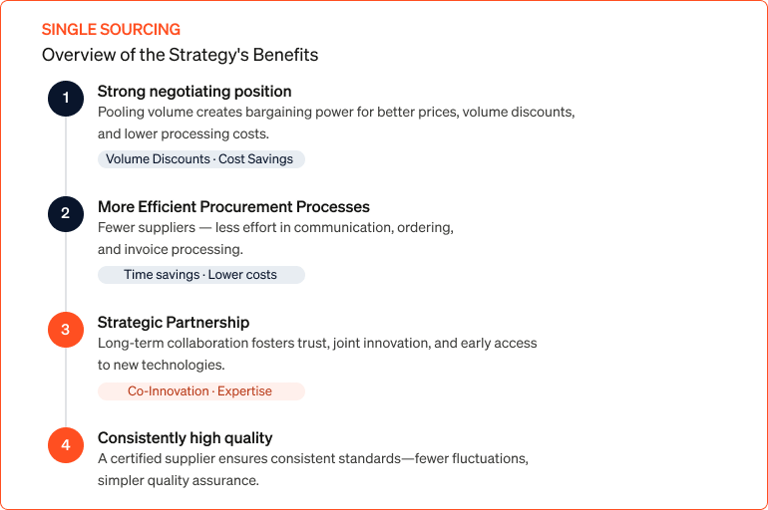
By directing your entire purchasing volume for a specific product or service to a supplier , you create significant bargaining power. This strategic advantage enables you to negotiate significantly better prices and terms.
The direct cost savings from volume discounts are often the most obvious benefit. In addition, however, your process costs also decrease significantly. Reducing the number of suppliers lowers administrative overhead, minimizes transportation costs through consolidated shipments, and simplifies the entire invoicing process as well as contract management.
Managing a single supplier relationship is significantly less complex than coordinating with multiple suppliers. Your procurement processes become leaner and more efficient: communication is more direct, orders are standardized, and the entire operational process—from inquiry to payment—is streamlined.
This reduction in administrative workload frees up valuable resources in your procurement team, which can now be used for more strategic tasks. Instead of dealing with the coordinating various suppliers, your team can focus on market analysis, risk management, or identifying new cost-saving opportunities.
A long-term single-sourcing strategy transforms a purely transactional relationship into a strategic partnership. This closer collaboration fosters trust, transparency, and openness. Your supplier gains deep insights into your specific needs and can proactively develop solutions. This can lead to joint product development and the exchange of valuable know-how. You often gain early access to the supplier’s new technologies or materials. In this way, the supplier becomes a driver of your own innovation and helps you gain a competitive edge.
If you source your goods from a single, carefully selected supplier, you ensure consistent product quality. There are no fluctuations that could arise from differing production standards, materials, or processes among various suppliers.
Quality assurance is also significantly simplified. Instead of having to audit and monitor multiple supply chains, you can focus your resources on close collaboration and continuous improvement with this single partner. Jointly defining standards and testing procedures helps minimize quality issues from the outset.
Although the advantages are compelling, relying on a single supplier also carries significant risks. The main disadvantage is the high level of dependence, which can put your company in a vulnerable position. Every advantage has a potential downside that you must carefully weigh. An inadequate risk assessment can quickly negate the initial cost savings and, in the worst case, jeopardize your company’s very existence.
The biggest disadvantage of single sourcing is the dependence on a single supplier. If this partner fails due to production problems, financial instability, strikes, or natural disasters, your entire supply chain comes to a standstill. There is no immediate replacement, which can lead to production downtime, delivery delays, and significant revenue losses. This risk is not merely theoretical; current challenges in global supply chains are highlighted in the BME Report on Supply Chain Risks. You lose the flexibility to respond to bottlenecks at short notice.
A close tie to a single supplier can limit your ability to respondflexibly to changes in the market. If another provider finds a more innovative, cost-effective, or higher-quality solution, you are bound by your long-term commitment. In addition, competitive pressure on your sole supplier may decrease. Without the need to continually compete against rivals, that supplier’s own innovation and optimization efforts could wane.
While you initially have a strong negotiating position due to the combined volume, this balance of power can shift over time. The more your company is integrated into the supplier’s processes and the higher the switching costs become, the more your dependence grows. The supplier is aware of its exclusive position and could usethis to demand less favorable prices and terms when renewing contracts. Your bargaining power erodes as it becomes more difficult to switch suppliers.
Focusing on a single supplier is just one of several procurement strategies. To make the right decision for your company, it is essential to be familiar with the alternatives as well. The most important ones are dual sourcing and multiple sourcing, which differ primarily in the number of suppliers.
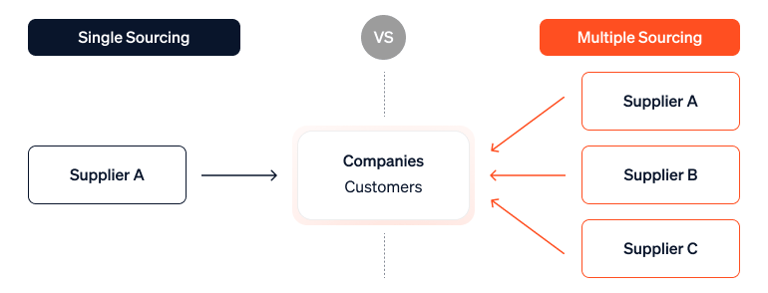
With dual sourcing, demand for a product is deliberately splitbetween two suppliers. This strategy is often considered the golden mean: it significantly reduces the extreme dependence associated with single sourcing and protects against supply disruptions. At the same time, the number of suppliers remains manageable, allowing for deeper relationships than with multiple sourcing. Healthy competition between the two partners can also lead to better prices and continuous innovation.
Multiple sourcing means procuring a product or service from several suppliers at the same time. The main advantage lies in maximum flexibility and risk minimization. If one supplier fails to deliver, the others can fill the gap. Constant competition also ensures market-driven prices. The disadvantages, however, include high transaction and procurement process costs, potentially fluctuating quality, and the lack of strategic partnerships.
The decision for or against single sourcing is not a one-size-fits-all one, but a highly strategic one. It depends on the type of product, the structure of the market, your business objectives, and your risk tolerance. In the following scenarios, however, single sourcing may be the superior strategy: