![Jörg Schmidt [Head of Vendormanagement]](https://simplesystem.com/hs-fs/hubfs/Autoren_Blog/Joerg_schmidt_autor.png?width=200&name=Joerg_schmidt_autor.png)
13.10.2026

![Jörg Schmidt [Head of Vendormanagement]](https://simplesystem.com/hs-fs/hubfs/Autoren_Blog/Joerg_schmidt_autor.png?width=100&name=Joerg_schmidt_autor.png)

Since January 1, 2023, the Supply Chain Due Diligence Act (LkSG) has been in effect in Germany. Since then, many companies have faced the challenge of thoroughly scrutinizing their global supply chains and ensuring compliance with human rights. With the adoption of the European Supply Chain Directive (CSDDD) in 2024, you will face additional requirements. But what does this mean specifically for your company? What obligations must you fulfill, and how can these be implemented in a practical way?
This guide provides you with a comprehensive and easy-to-understand overview of German and European supply chain legislation. We’ll show you what’s importantwhen implementing corporate due diligence obligations so you can operate in compliance with the law and fulfill your responsibilities.
The Supply Chain Act, officially known as the Act on Corporate Due Diligence Obligations in Supply Chains (LkSG), requires companies in Germany to ensure respect for human rights in their supply chains. The goal is to prevent human rights violations such as child labor or forced labor and to protect fundamental environmental standards. To this end, the law defines specific due diligence obligations, compliance with which is monitored by the Federal Office for Economic Affairs and Export Control (BAFA).
The Supply Chain Act reflects a paradigm shift: away from voluntary commitments and toward legally binding corporate responsibility. The federal government enacted the law to improve the living conditions of people in global value chains and to create a level playing field for companies that arealready committedto sustainability. The goal is to ensure that products sold in Germany are not made possible by exploitation or environmental destruction.
The legal provisions are based on internationally recognized standards, such as the UN Guiding Principles on Business and Human Rights. They require companies to establish a risk management system to identify and minimize human rights and environmental risks within their own business operations as well as among their direct and indirect suppliers. Effective management of these risks is therefore not only a legal obligation but also a key component of a robust supplier risk.
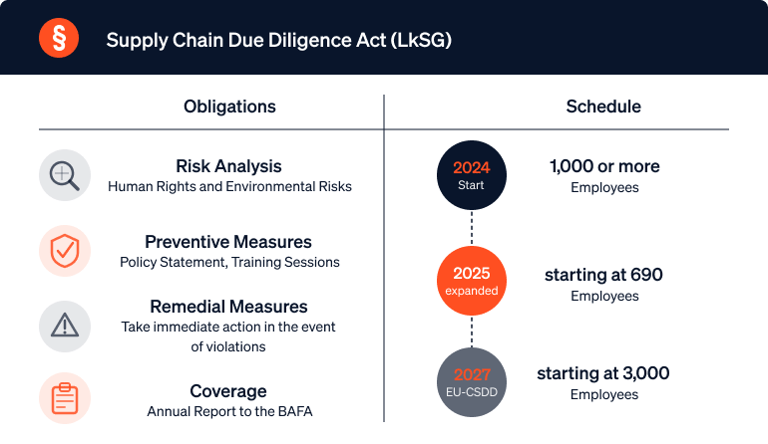
One of the most pressing questions for many CEOs and procurement managers is: “Are we even affected?” The applicability of the law is clearly defined based on the number of employees at companies based in Germany. The legislature has adopted a phased approach here, primarily to give larger companies time to implement the requirements before expanding the scope of entities subject to the law. Stricter rules have been in effectsince 2024.
When calculating the number of employees, it is not only full-time permanent employees who are relevant. Part-time employees, temporary agency workers (if the assignment exceeds six months), and employees posted abroad are also included. This phased introduction and the clear thresholds are intended to increaselegal certainty for companies. The following chart illustrates the scope of application and the timeline of changes.
The law does not require a guarantee of a completely clean supply chain, but rather demands a demonstrable duty of care. At its core, the goal is to establish effective risk management to identify and minimize human rights and environmental risks and to prevent violations. Due diligence obligations should be understood as an interconnected process that begins within the company itself and extends throughout the entire supply chain.
Specifically, the LkSG defines nine key corporate due diligence obligations that you must systematically implement:
The central component is the annual risk analysis. You must systematically identify and assess potential risks to human rights and environmental standards both within your own business operations and among your direct suppliers. This involves not only analyzing countries or industries, but also a concrete assessment of your specific supplier relationships and the working conditions there.
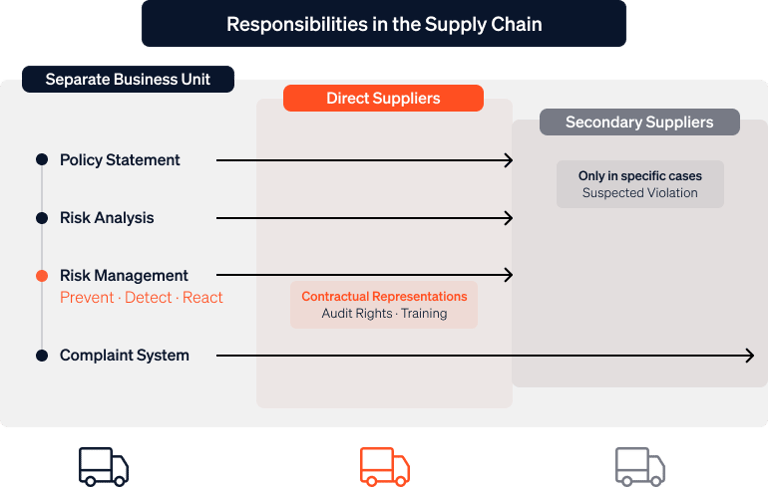
The law makes a crucial distinction regarding the depth of the supply chain. Your level of responsibility varies:
Compliance with the Supply Chain Act is monitored by the Federal Office for Economic Affairs and Export Control (BAFA). This agency has far-reaching powers: It can enter business premises, request information, and order the necessary measures. Companies are required to submit their reports to the BAFA annually. You can find more information on this directly in the information and guidelines provided by the responsible Federal Office for Economic Affairs and Export Control (BAFA).
In the event ofa violation of due diligence obligations, the BAFA may impose substantial fines. These can amount to up to 800,000 euros or, for companies with an annual turnover exceeding 400 million euros, up to 2% of global turnover. In addition, a serious violation may result in exclusion from public procurement for up to three years.
While Germany has taken a pioneering role with the LkSG, efforts to promote greater corporate responsibilityare now being elevated to the European level. After lengthy negotiations , the European Parliament finally approved the Corporate Sustainability Due Diligence Directive (CSDDD) in April 2024 . This directive aims to avoid a patchwork of differing national regulations and to create a level playing field within the EU single market. For German companies, this means that the existing requirements will soon be expanded and tightened. The CSDDD must be transposed into national law within two years , which will inevitably lead to changes to the Supply Chain Act.
The EU directive goes significantly beyond the German LkSG in several key areas. A direct comparison shows that companies must prepare for more comprehensive obligations. It is crucial to understand these differences now in order to set the course for the future in a timely manner and adapt your own compliance strategy. The following overview summarizes the key stricter requirements.
These stricter requirements demonstrate that the path toward sustainable and fair value chains continues. Companies that have already established robust processes for the LkSG have a clear advantage. Nevertheless, even they must adapt their systems, particularly with regard to expanded liability and the analysis of the downstream supply chain. The transposition of the directive into German law will be the crucial next step, which you should monitor closely.