![Fabian von Kleinsorgen [VP Growth & Sales Operations]](https://simplesystem.com/hs-fs/hubfs/Autoren_Blog/Fabian_vin_kleinsorgen_autor.png?width=200&name=Fabian_vin_kleinsorgen_autor.png)

09.09.2026

![Fabian von Kleinsorgen [VP Growth & Sales Operations]](https://simplesystem.com/hs-fs/hubfs/Autoren_Blog/Fabian_vin_kleinsorgen_autor.png?width=100&name=Fabian_vin_kleinsorgen_autor.png)

When you think of procurement in your company, what comes to mind first? Probably placing orders, getting quotes or managing stock. These tasks matter, but they are only the tip of the iceberg, the operational part. The real value lies deeper: in strategic procurement.
This guide explains what strategic procurement means, what goals it pursues, how it differs from operational procurement and how to set up the process in seven steps.
Strategic procurement decides over the long term what is bought from which vendors on which terms. It analyzes markets, selects and develops vendors, manages risk and aligns procurement with business goals. That creates the framework within which operational procurement handles day-to-day business. Learn more in our article on strategic procurement: definition, process and tools.
While operational procurement meets current demand, strategic procurement sets the course for future success. Clear goals are the first step:
The two areas interlock but differ in tasks, goals and time horizon. Operational procurement reacts to existing demand, strategic procurement acts proactively and with foresight.
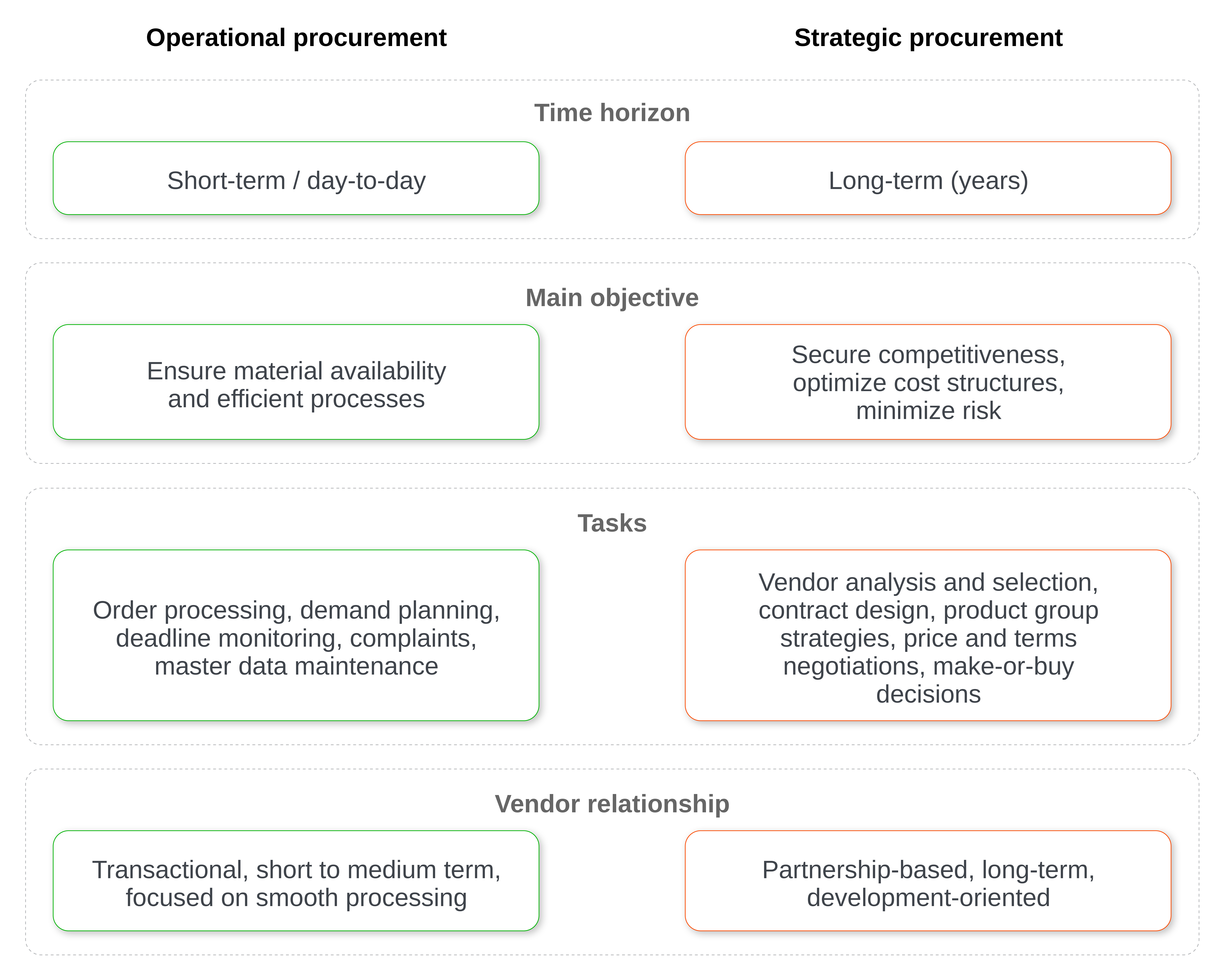
| Strategic procurement | Operational procurement | |
|---|---|---|
| Time horizon | Long term | Short term, day-to-day |
| Focus | What, from whom, on which terms | The right goods at the right time in the right place |
| Tasks | Market analysis, vendor selection, contracts, risk management | Ordering, approval, goods receipt, invoice checking |
| Success criteria | Value contribution, security of supply, innovation | Efficiency, speed, process costs |
Without strategic direction, operational efficiency gains go nowhere. Conversely, the best strategy has no effect if people order around the agreed terms in everyday business.
Find out how in our free e-procurement report. Download it now, free and without obligation.
Read nowSuccessful strategic procurement is the result of a systematic, data-driven process. The following model gives you a clear roadmap.
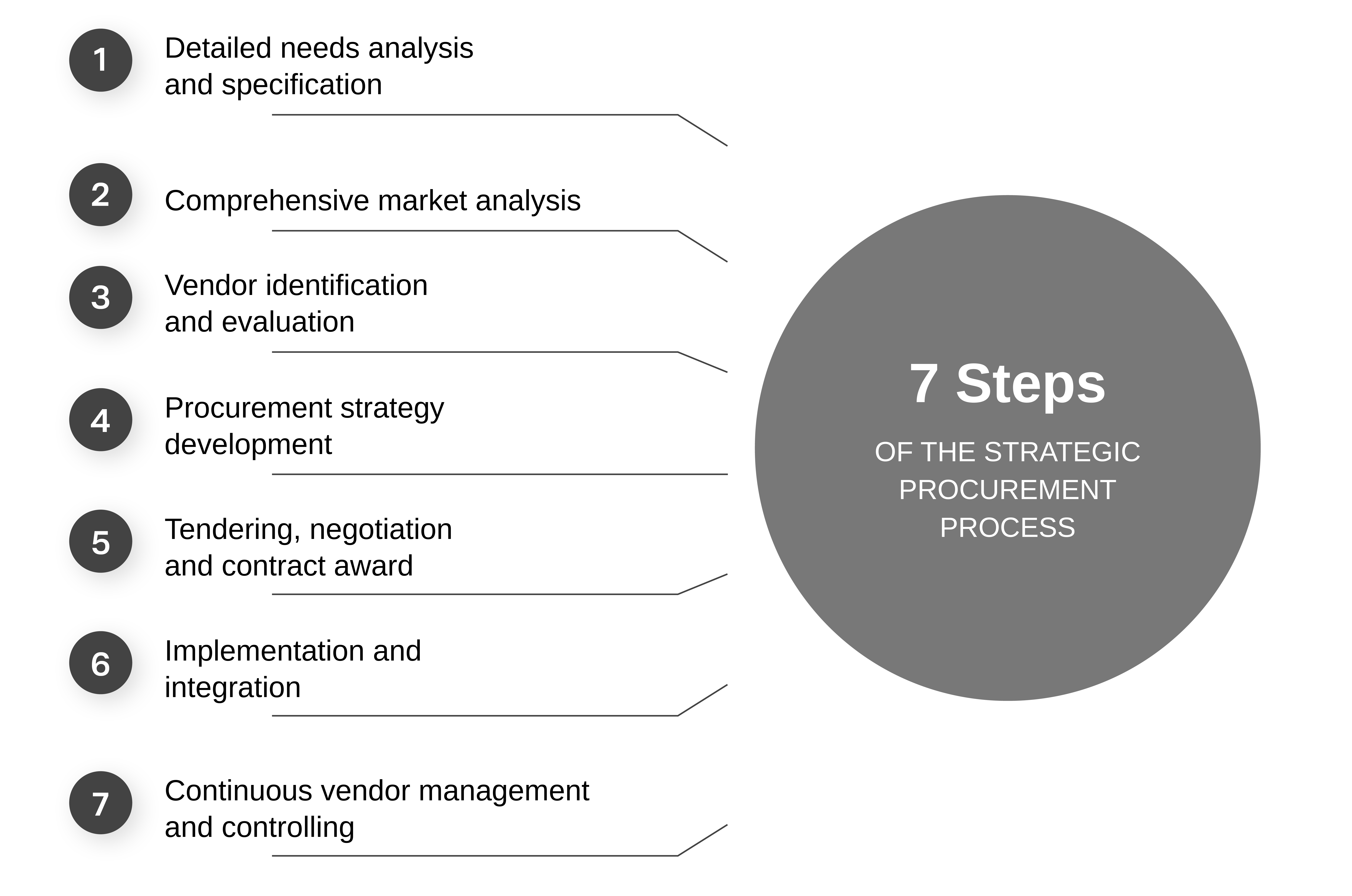
What exactly is needed, in what quantity and quality, and when? The analysis also covers technical specifications, logistics requirements and long-term demand planning. Unclear specifications almost always lead to poorer vendor selection and higher total costs.
Who are the potential vendors? Is it a buyer's or seller's market? What trends, new materials or risks are there? Studies by industry associations such as the German BME (Bundesverband Materialwirtschaft, Einkauf und Logistik e. V.) provide valuable insights.
The market analysis produces a longlist of possible vendors, which you evaluate against defined criteria: price, quality, reliability, financial stability, innovation and sustainability. The result is a shortlist for negotiations. Learn more in our article on vendor evaluation.
Now set the strategy per category. Single sourcing to bundle volumes and get better terms? Or multiple sourcing to spread risk? Long-term partnership or standardized tender? The Kraljic matrix helps you decide.
Shortlisted vendors are invited to submit offers (request for proposal, RFP). Negotiations cover not only price but also payment terms, delivery times and service levels. The result is a legally sound vendor contract.
New contracts and vendors have to be introduced in the company. All departments need to be informed, and the new processes have to fit into everyday work. This often includes connecting the vendor technically so that orders and invoicing run automatically.
Once the contract is signed, active vendor management begins. Performance is monitored with KPIs, there are regular feedback meetings and joint improvements. That way you spot deviations early and can take action.
Step 6 decides whether the strategy reaches daily business. On simple system, more than 28,000 buyers order from over 1,000 vendors through one access point, at their own negotiated terms. Approvals and budgets run digitally, and order data goes straight into the ERP. So departments automatically order from the vendors that strategic procurement has selected. According to HTWK Leipzig, full digitalization also reduces process costs per order from €146 to €86.
Strategic procurement turns purchasing from a cost center into a key value driver. Planning proactively and relying on strong partnerships reduces risk and secures long-term market advantages. The 7-step process gives you a clear roadmap.
Want to enforce your procurement strategy in everyday ordering? Try simple system free for 30 days or book a demo.