![Andy Freund [Head of Growth & Customer Management]](https://simplesystem.com/hs-fs/hubfs/Autoren_Blog/Andy_Freund_autor.png?width=200&name=Andy_Freund_autor.png)

09.09.2026

![Andy Freund [Head of Growth & Customer Management]](https://simplesystem.com/hs-fs/hubfs/Autoren_Blog/Andy_Freund_autor.png?width=100&name=Andy_Freund_autor.png)

Do your procurement processes often feel slow, confusing and expensive? Manual orders, lengthy approvals and unclear vendor conditions make it difficult to control costs and tie up resources. Many companies lose money and competitive advantages as a result.
This practical guide shows you how you can optimize your procurement process: from determining requirements, selecting vendors and ordering through to invoice verification. The aim is to reduce costs, increase efficiency, create transparency and lay the foundations for the digital transformation of your procurement. An optimized process reduces manual effort, strengthens vendor relationships and makes your company more agile and future-proof.
Procurement process optimization refers to the systematic analysis, redesign and automation of all the steps a company goes through to procure goods and services. The aim is to make the entire process, from determining requirements, selecting vendors and ordering through to invoice verification and payment, more efficient, transparent and cost-effective. An optimized process minimizes manual effort, improves vendor relationships and strengthens the strategic position of procurement.
An unoptimized procurement process is more than just a nuisance, it is a strategic disadvantage. Inefficiencies in procurement have a direct impact on your company's profit margin and responsiveness. The need to optimize procurement stems from several key challenges facing procurement departments:
Digitalization offers an effective lever here. The German Mittelstand-Digital Zentrum Handel also sees e-procurement as an important lever for increasing efficiency. The automation of routine tasks not only simplifies operational processes but also frees up space for strategic procurement management. A well-structured procurement process is therefore the basis for resilient and competitive procurement.
To optimize the procurement process, you first need to understand its individual components. Each step has its own challenges, but also specific levers for greater efficiency and transparency. A typical process, often referred to as the purchase-to-pay (P2P) process, can be divided into seven core phases. By analyzing these phases, you can uncover weak points and introduce targeted improvements. A structured procurement process is the foundation for successful optimization.
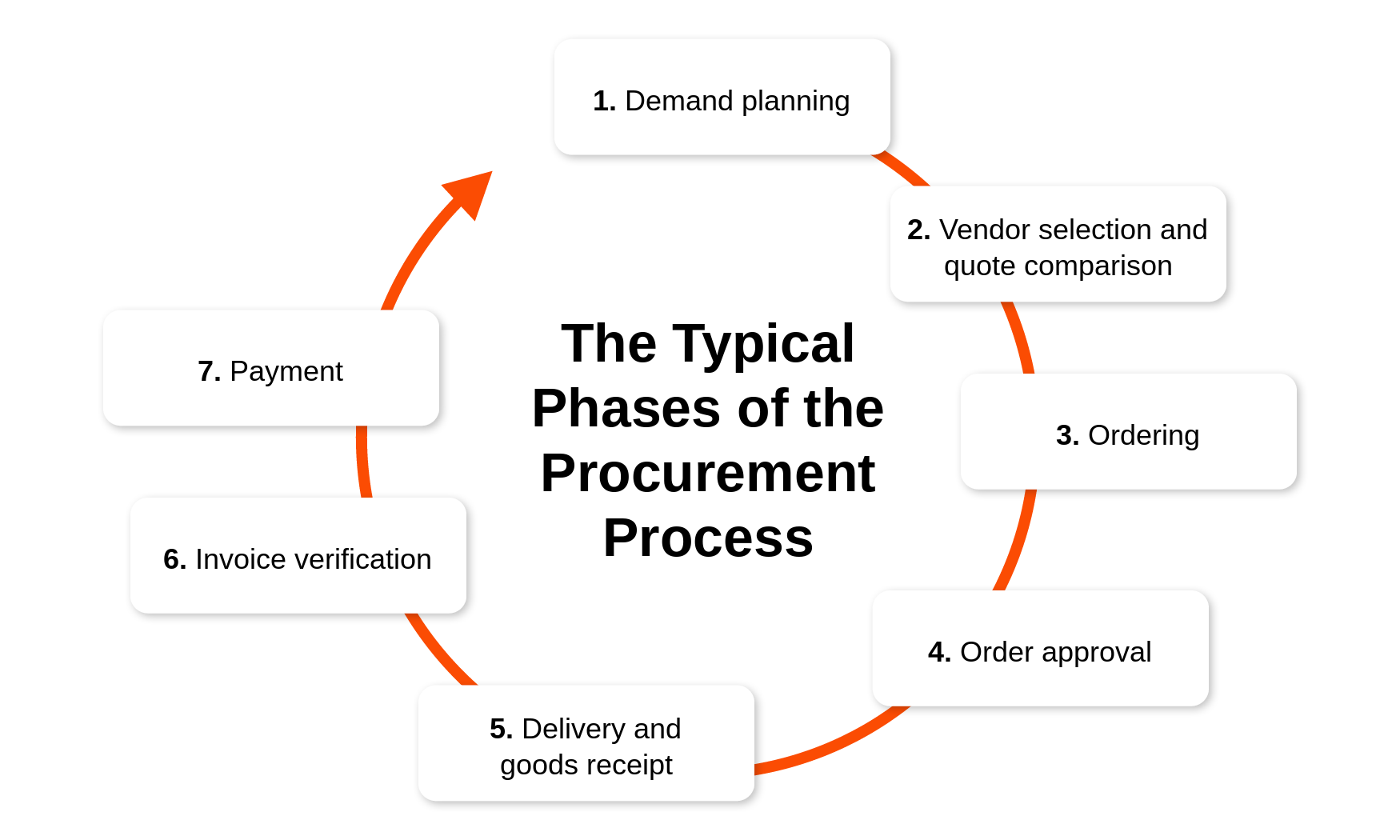
It all starts with a requirement. An employee or department determines that a product or service is required. In non-optimized processes, this often happens uncontrollably by e-mail, on demand or via informal lists. This leads to "maverick buying", procurement outside of agreed channels and conditions. Optimization begins here with the standardization of requirements determination, for example, through digital catalogs with approved product ranges, from which employees can create their purchase requisitions simply and in accordance with the rules.
Once the requirements have been determined, the right vendor must be found. Manual searches and obtaining quotes by phone or email are time-consuming and make it difficult to compare conditions objectively. Employees often fall back on familiar vendors out of habit and miss out on better offers. A central, digital vendor management system with stored framework agreements and performance evaluations provides a remedy here. In this way, vendor selection is data-supported and strategically aligned.
The actual order is the formal act of commissioning. Manually created orders are prone to errors and lead to media disruptions if they are sent by fax or e-mail. Automation automatically converts an approved purchase requisition into a purchase order and transmits it directly to the vendor's system. This seamless transition minimizes errors and speeds up the entire process considerably.
Order approval is a major bottleneck in many companies. Paper-based signature folders circulate for days through various departments; the status is unclear, and delays occur. Digital approval workflows solve this problem elegantly. Based on preset rules (e.g. according to value limits or product groups), the order is automatically forwarded to the responsible persons, who can approve it with one click, even on the move.
When the goods arrive, they must be checked to see whether the delivery corresponds to the order. This manual comparison of the delivery bill and order is time-consuming. A digitalized goods receipt makes it possible to scan deliveries and automatically compare them with the open purchase order. Shortages or incorrect deliveries are recognized immediately, and the process is documented transparently.
Checking incoming invoices ties up enormous resources in the accounting department. The invoice must be manually compared with the purchase order and goods receipt (three-way match). In the event of discrepancies, a lengthy search begins. E-procurement systems can largely automate this process. The system checks the digital invoice automatically. Manual intervention is only necessary in the event of discrepancies, which drastically reduces throughput times.
The final phase is the payment of the invoice. After successful verification, the invoice data is released for payment. An optimized process ensures a seamless transfer of the approved data to the accounting or ERP system. This eliminates the need for manual data entry, ensures timely payment and makes the use of cash discount benefits the rule rather than the exception. The entire purchase-to-pay cycle thus closes efficiently.
Find out how in our free e-procurement report. Download it now, free and without obligation.
Read nowNow that the seven phases of the purchase-to-pay process are clear, the crucial question is: where do you start with optimization? An isolated, selective approach rarely leads to success. What you need is a systematic strategy to transform your procurement from a reactive administrative function to a proactive, value-creating engine of the company. The following strategies provide a proven framework for increasing efficiency, gaining control and sustainably reducing costs.
The most effective lever for optimizing the entire procurement process is the introduction of a central e-procurement system. Such a platform standardizes and digitalizes the entire process, from requirements to payment. Instead of chaotic orders by email or on demand, employees can access digital catalogs with pre-negotiated items and conditions. This effectively prevents maverick buying and ensures that every purchase complies with the rules.
Approval workflows are automated on the basis of defined rules, making manual follow-up obsolete. The result is a "single source of truth": a central system in which all procurement processes are documented in a complete, transparent and traceable manner. This not only simplifies the operational process, but also provides a robust database for strategic decisions. Find out how simple system digitalizes and automates your procurement.
With C-parts in particular, process costs quickly exceed the value of the goods. With simple system, employees order from more than 1,000 vendors through a single access point, approvals run digitally according to your rules, and order data goes straight to the ERP. According to HTWK Leipzig, digital procurement reduces process costs per order from €146 to €86.
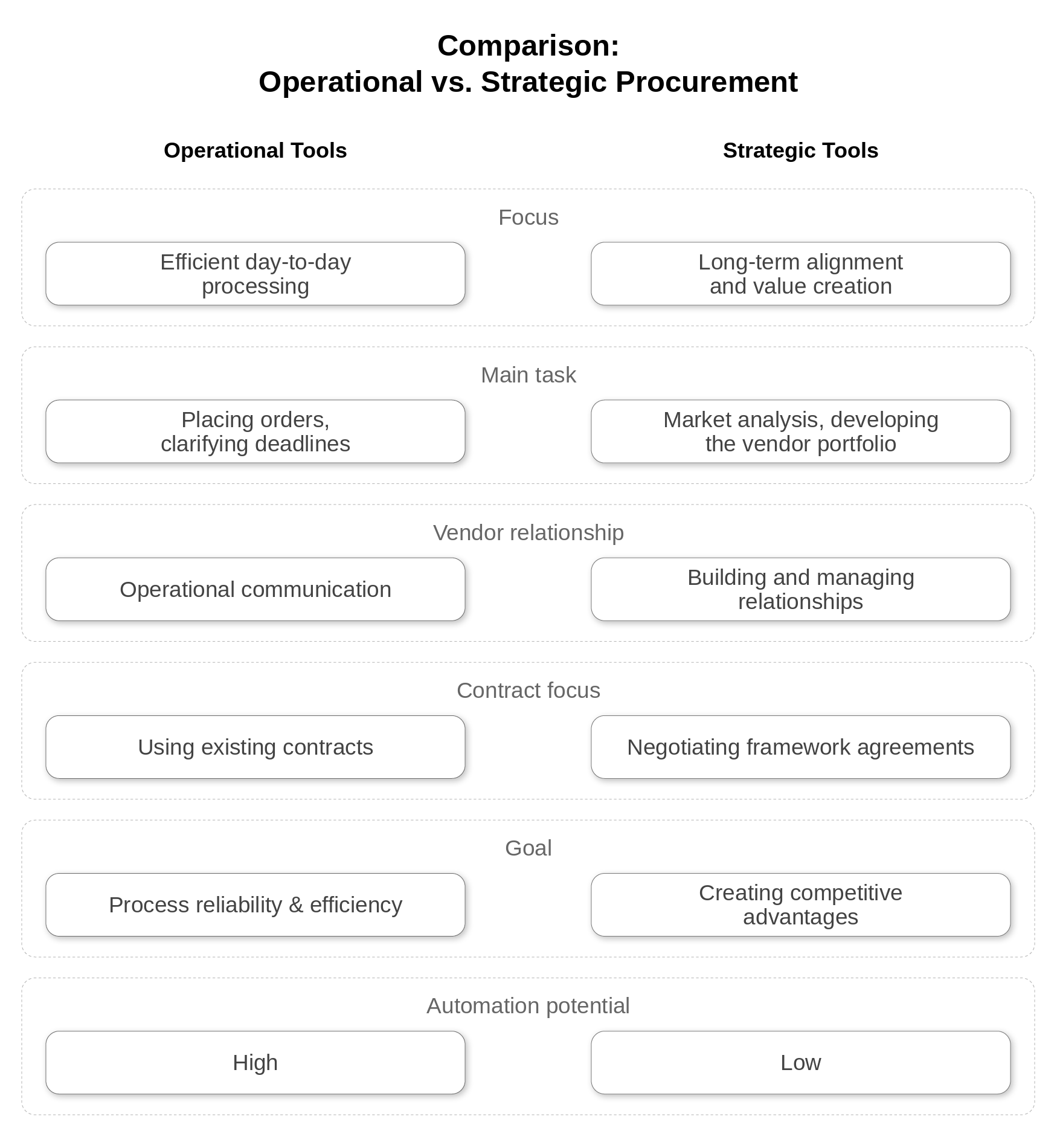
A common problem in non-optimized procurement departments is that valuable specialists are overloaded with operational tasks such as triggering orders and clarifying delivery dates. There is no time for strategic activities that create real added value. An important optimization step is therefore the clear separation of these two areas.
By automating routine tasks, you create space for your team to focus on these strategic issues. The very concept of procurement points in this direction. The term "procurement" itself covers more than just buying and includes strategic aspects. This reorientation turns procurement from a pure cost center into a strategic partner for the entire company.
A digitalized procurement process generates a wealth of data. Do not leave this treasure unused. The systematic analysis of procurement data is the basis for continuous improvement. Define meaningful key performance indicators (KPIs) to measure your success and uncover weaknesses.
The evaluation of these key figures enables you to identify bottlenecks in the process in a targeted manner, objectively evaluate the performance of vendors and conduct negotiations on a solid data basis. This makes procurement data-driven and your decisions more informed.
Your vendors are more than just service providers; they are partners who have a direct influence on your quality, costs and ability to innovate. An optimized procurement process therefore, always includes active vendor management. Instead of looking for the cheapest vendor for each individual requirement, build long-term partnerships with reliable vendors.
Use data from your system to classify vendors (e.g. into strategic A-vendors, regular B-vendors and C-parts vendors) and develop them accordingly. Regular performance evaluations, joint target setting and transparent information sharing strengthen the relationship and open up potential for better conditions, innovation and increased resilience of your supply chain. This strategic approach ensures that you not only procure cheaply, but above all intelligently.
As explained, optimizing the procurement process is far more than just an efficiency measure, it is a strategic necessity. Unstructured, manual processes are not only cost drivers, but also block valuable resources and prevent an agile response to market changes.
By consistently analyzing the individual phases and implementing targeted strategies, above all, digitalization through e-procurement, the separation of operational and strategic tasks and data-supported vendor management, you can transform your procurement. It develops from a reactive administrative department into a proactive, value-creating engine of the company.