![Magdalena Pentek [Senior Brand Strategy Manager]](https://simplesystem.com/hs-fs/hubfs/Autoren_Blog/Magdalena_pentek_autor.png?width=200&name=Magdalena_pentek_autor.png)
13.10.2026

![Magdalena Pentek [Senior Brand Strategy Manager]](https://simplesystem.com/hs-fs/hubfs/Autoren_Blog/Magdalena_pentek_autor.png?width=100&name=Magdalena_pentek_autor.png)

In modern materials management, high inventory levels and unpredictable demand pose costly challenges. How can you ensure that you have the right items in stock at the right time without tying up unnecessary capital? Precise inventory control is crucial for ensuring delivery capability while keepinginventory costs as low as possible.
This is where XYZ analysis comes into play. This business management method helps you classify products not by their value, but by the frequency of their consumption. In this article, we’ll explain in simple, easy-to-understand terms what XYZ analysis is, how to perform the calculation, and how combining it with ABC analysis can help you make valuable strategic decisions for your inventory management.
XYZ analysis is a materials management method that classifies materials and products based on the consistency of their consumption. The primary goal of XYZ analysis is to evaluate the forecasting accuracy of demand planning and to optimize strategic procurement. Unlike ABC analysis, which focuses on value share, this tool focuses on consumption fluctuations and the predictability of individual products.
Based on the results, you can develop well-founded strategies for inventory management and procurement planning. Goods with consistent consumption require a different approach than those with highly fluctuating or only sporadic demand. Thus, the analysis enables differentiated control, leading to the optimization of inventory levels and the minimization of tied-up capital. The XYZ analysis is therefore a central component of efficient inventory management.
Conducting the XYZ analysis categorizes your items into three main material classes: X, Y, and Z. Each class represents a different consumption pattern and requires specific measures in inventory management and planning. This classification of materials forms the basis for the targeted optimization of your logistics processes.
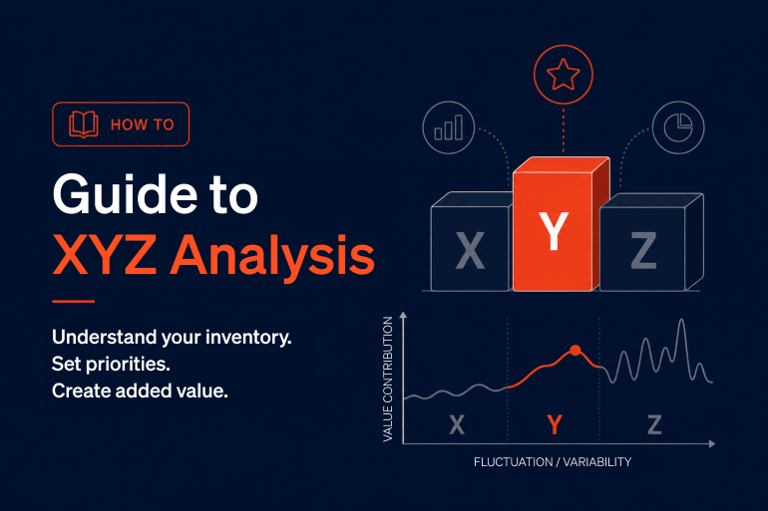
The XYZ analysis is based on historical consumption data. To perform a meaningful classification, you need the consumption or sales volumes of your items over a defined period, such as the last 12 months. The key metric for the calculation and classification is the so-called coefficient of variation.
The key to classifying your items is the coefficient of variation. This statistical metric compares the dispersion of consumption values (standard deviation) to the average consumption (mean). The result is a relative measure that allows you to objectively compare the degree of fluctuation among different items, regardless of their absolute consumption volumes.
The formula for the calculation is:
This calculation can be easily performed in programs such as Microsoft Excel. After exporting the consumption data, you can quickly calculate the coefficient of variation for each item using the formulas `STABW.S` (for the standard deviation) and `MITTELWERT`.
Once you have calculated the coefficient of variation for each item, you can assign them to classes X, Y, or Z. To do this, you must define fixed class boundaries. Although these limits can be customized for each company depending on the industry and product range, the following guidelines have become established in practice:
This data-driven classification forms the basis for all further strategic decisions. Items with a low coefficient of variation are easy to plan for, while items in the Z category require special handling to avoid supply bottlenecks or unnecessarily high inventory levels and the associated costs.
XYZ analysis only reaches its full potential when combined with ABC analysis. While XYZ analysis evaluates the consistency of consumption, ABC analysis classifies your products according to their value share of total consumption or sales (A-products: high value share, B-products: medium value share, C-products: low value share). Combining both methods provides you with a two-dimensional view of your product range and enables far more nuanced management.
The result of this combined analysis is a 9-cell matrix that assigns each item to a specific class (e.g., AX, AY, AZ, BX, etc.). This detailed segmentation serves as the basis for derivingthe optimal procurement and inventory management strategyfor each product group , thereby specifically increasing efficiency in your logistics and materials management.
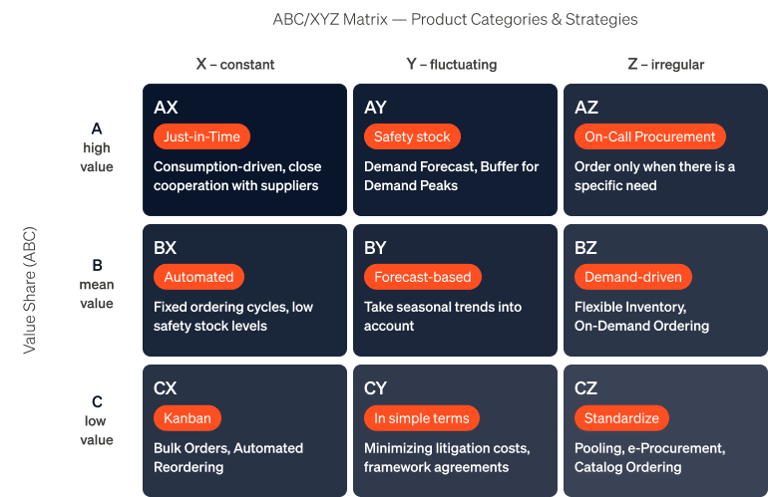
For each field of the matrix, specific recommendations for inventory management and procurement can be derived. Below are the most important strategies for the key product classes: