![Magdalena Pentek [Senior Brand Strategy Manager]](https://simplesystem.com/hs-fs/hubfs/Autoren_Blog/Magdalena_pentek_autor.png?width=200&name=Magdalena_pentek_autor.png)
13.10.2026

![Magdalena Pentek [Senior Brand Strategy Manager]](https://simplesystem.com/hs-fs/hubfs/Autoren_Blog/Magdalena_pentek_autor.png?width=100&name=Magdalena_pentek_autor.png)

Every day, needs arise in every company: a new office chair for an employee, raw materials for production, or an external service for a project. But how does a simple need turn into an official purchase order? The crucial first step in a structured procurement process is the purchase requisition, often abbreviated as PR. It serves as the formal starting point that ensures all purchases are controlled, approved, and traceable.
This article provides a comprehensive introduction to the topic. You’ll not only learn exactly what a purchase requisition is, but also how the associated process works, what challenges lurk in manual workflows, and how an electronic purchase requisition (ePR) can revolutionize your procurement. Optimize your procurement processes and gain efficiency and transparency.
A purchase requisition (PR) is an internal document through which a department or employee formally notifies the responsible purchasing department of a need for materials, products, or a service. It contains all necessary information, such as the item description, quantity, desired delivery date, and cost center. The PR does not yet trigger a purchase order with the supplier; rather, it initiates an internal review and approval process that, upon successful approval, leads to the creation of an official purchase order.
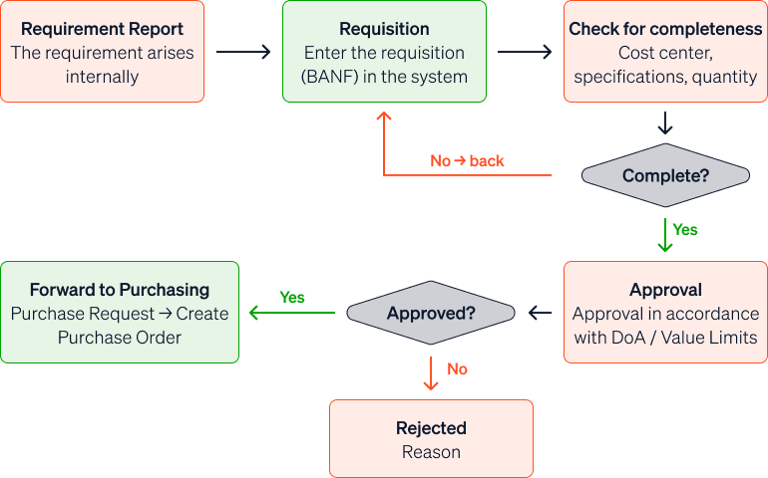
The process from the initial request to the final purchase order follows a structured workflow designed to ensure that expenditures are controlled and traceable. Although the details may vary depending on the company and organization, the key process steps can be summarized as follows:
1. Submission of a Requirement
An employee or department identifies a need for a product or service. This can range from office supplies to complex machinery or consulting services.
2. Creating the Purchase Requisition
The requester fills out a (often standardized) form—the actual purchase requisition. All relevant information is recorded here: the exact description of the item, the item number (if known), the quantity needed, the desired delivery date, and the cost center to which the purchase is to be posted.
3. Review and Approval
The completed request is forwarded to the responsible supervisor or a designated authority for review and approval. Depending on the value or type of procurement, this approval workflow may involve multiple stages. The request is reviewed to ensure the need is justified and covered by the budget.
4. Forwarding to Purchasing
Once approved, the purchase requisition is forwarded to the purchasing department. The purchasing department is now officially tasked with carrying out the procurement.
5. Conversion to a Purchase Order
The responsible buyer checks the purchase requisition for completeness, selects a suitable supplier (if not already specified), negotiates the terms if necessary, and converts the purchase requisition into a legally binding purchase order, which is sent to the supplier.
This structured process ensures that purchasing is managed centrally and that compliance guidelines are followed.
The way purchase requisitions are created and processed has a huge impact on the efficiency of the entire procurement process. Here, the traditional, paper-based approach is pitted against the modern, digital solution.
In many companies, purchase requests are still submitted manually via paper forms, email, or Excel spreadsheets. This approach is error-prone and inefficient.
Imagine an employee in production urgently needs a replacement part. He fills out a paper form, which is sent via internal mail to the department head. However, the department head is away on a business trip. The form is set aside. Upon his return, he approves it, but the handwriting is illegible. This leads to follow-up inquiries. Eventually, the form reaches the purchasing department, but the part number is missing. The buyer has to look it up. This delay results in a machine shutdown. A classic example of how a manual process generates unnecessary costs and frustration.
The biggest drawbacks are:
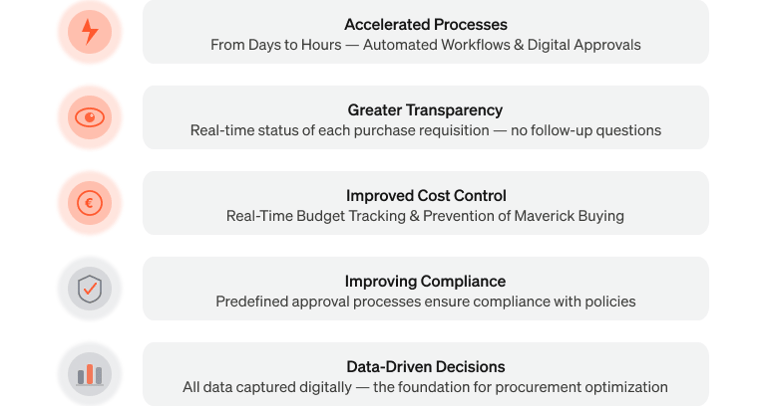
An electronic purchase requisition (ePR) digitizes and automates the entire process within a single software solution. Employees fill out the requisition in a system that automatically forwards the data to the appropriate approver. The result is a fast, transparent, and efficient workflow.
The key advantages of a digital solution are:
The purchase requisition is not just an isolated step, but the critical starting point of the entire Purchase-to-Pay (P2P) process. This process describes the complete workflow from the submission of a purchase requisition to the payment of the supplier invoice. An optimized purchase requisition lays the foundation for a smooth P2P cycle.
An efficient digital procurement process, which begins with a clean e-purchase requisition, ensures that all subsequent steps—ordering, goods receipt posting, and invoice verification—are based on accurate and validated data. This not only speeds up processes but also enables a high degree of automation. The strategic importance of digitization in procurement is also recognized by Deloitte, as it helps companies remain competitive.
The transition to a digital purchase requisition is an important step toward optimizing procurement. To ensure a successful implementation, you should keep the following points in mind:
The requisition is far more than an administrative form; it is the linchpin of efficient and transparent procurement. The transition from a manual to a digital process (ePR) is not merely an IT project, but a strategic decision. It enables your company to accelerate processes, precisely control costs, and ensure long-term compliance. By optimizing this first step in the purchase-to-pay process, you lay the foundation for a high-performing and future-proof procurement function.