![Fabian von Kleinsorgen [VP Growth & Sales Operations]](https://simplesystem.com/hs-fs/hubfs/Autoren_Blog/Fabian_vin_kleinsorgen_autor.png?width=200&name=Fabian_vin_kleinsorgen_autor.png)
09.09.2026

![Fabian von Kleinsorgen [VP Growth & Sales Operations]](https://simplesystem.com/hs-fs/hubfs/Autoren_Blog/Fabian_vin_kleinsorgen_autor.png?width=100&name=Fabian_vin_kleinsorgen_autor.png)

Purchasing by email, spreadsheet and paper order often costs more than the goods themselves, especially for indirect materials with many small orders. E-procurement moves this process onto a digital platform and lowers the cost per order. This article explains what e-procurement is, how it works, what its benefits and limits are and where the biggest lever lies.
E-procurement (electronic procurement) is the digital handling of the purchasing process via internet-based systems, from ordering through electronic catalogs to the connection with the ERP system. The goal is not a lower item price but an automated process that reduces process costs per order.
Key points at a glance:
E-procurement is the electronic procurement of goods and services via internet-based systems. Instead of paper, email and manual data entry, all purchasing runs through a central platform with stored catalogs, fixed terms, clear roles and digital approvals.
The term stands for "electronic procurement" and covers the complete procurement process from demand through ordering to invoicing. The focus is not on buying individual items but on digitalizing the process around them.
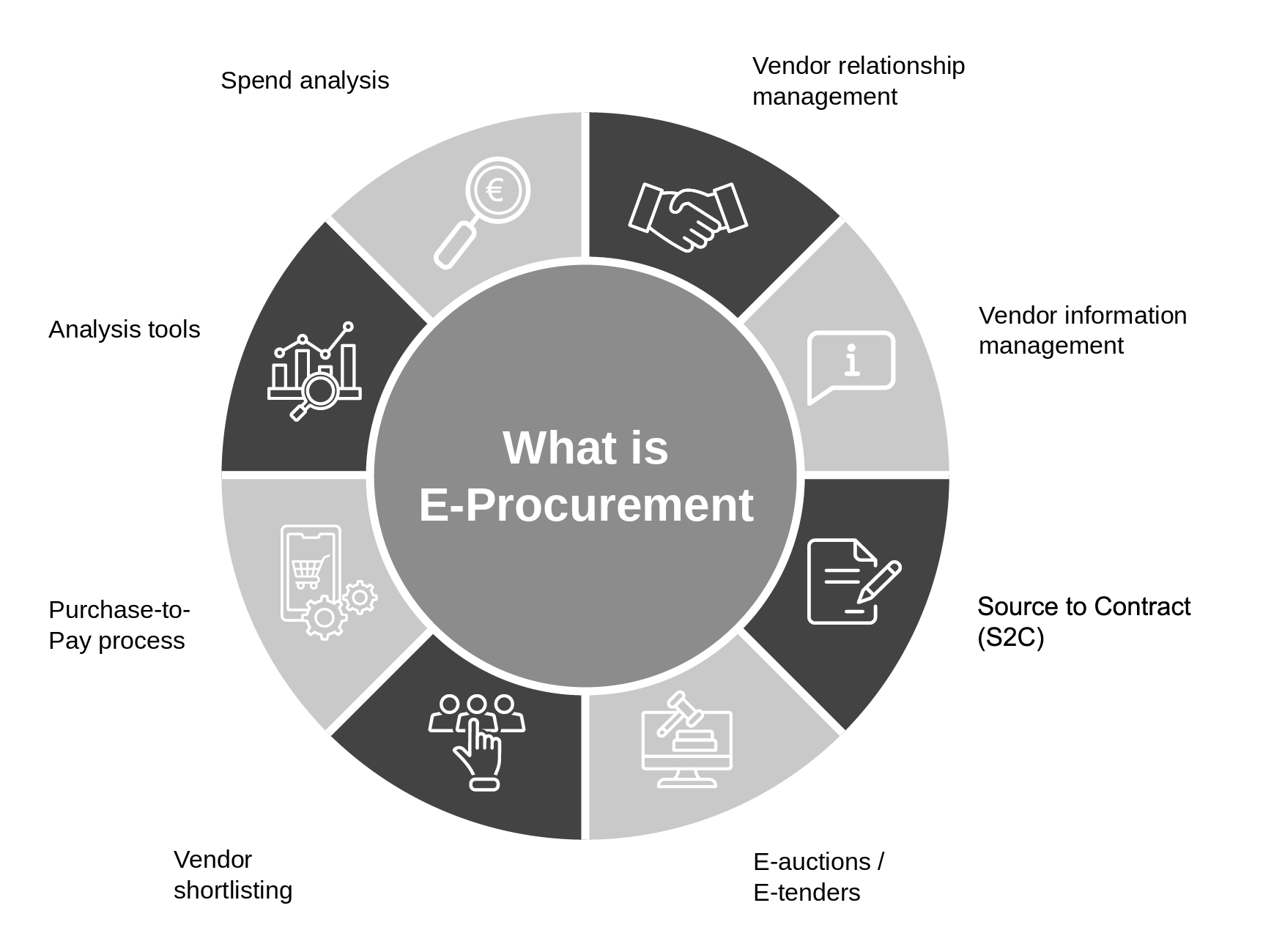
Definition: E-procurement is the digital handling of the corporate purchasing process via internet-based systems, from ordering through electronic catalogs to the connection with the ERP system, with the aim of reducing process costs per order.
The difference between e-procurement and traditional procurement lies not in what is bought but in how: companies buy the same things, but the process runs digitally, based on rules and without media breaks instead of manually by email, phone and paper.
In traditional procurement, purchasing enters every order by hand, requests approvals by email and transfers data several times between systems. This is exactly where errors, delays and most of the process costs arise. E-procurement automates these steps.
| Criterion | Traditional procurement | E-procurement |
|---|---|---|
| Ordering channel | Email, phone, paper | Digital platform with catalog |
| Data entry | Manual, often repeated | Once, automatically into the ERP |
| Approvals | Informal, hard to trace | Digital approval workflows |
| Terms | Scattered, hard to control | Stored, binding |
| Process costs per order | High (around €146) | Low (around €86) |
| Compliance | Prone to maverick buying | Controllable by rules |
E-procurement works by combining the individual steps of purchasing (demand, order, approval, goods receipt and invoice) into one continuous digital process. The buyer selects items from a stored catalog, the system knows the terms, approval runs via workflow and order data flows into the ERP without being entered again.
Tip: When introducing e-procurement, start by digitalizing indirect materials with many small orders. That is where the lever on process costs is greatest.
Typical examples of e-procurement are found in indirect procurement: wherever many small orders of low unit value occur and the administrative effort exceeds the item value.
The common denominator: it is not the individual product that is expensive, but the manual process behind it.
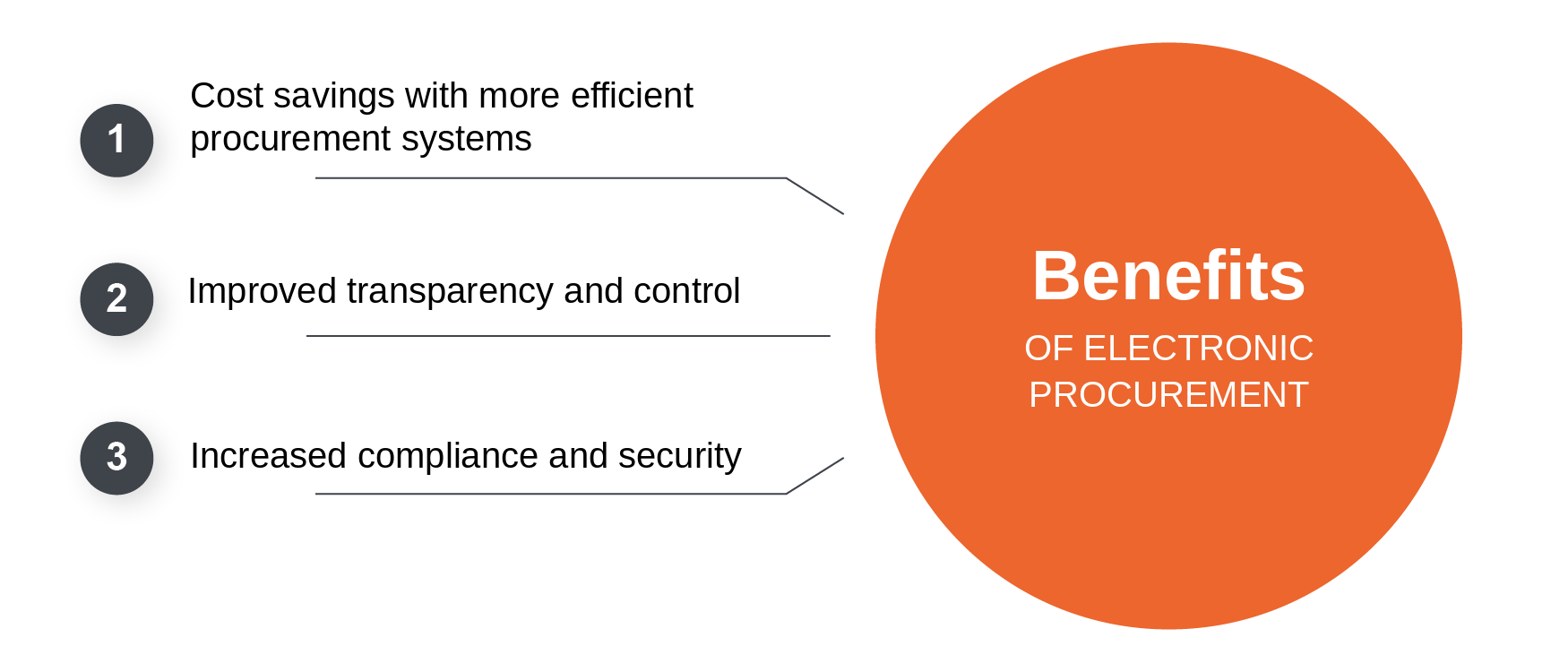
The central benefit of e-procurement is lower process costs per order, not a lower item price. This is where many companies have their biggest, often overlooked savings potential.
Good to know: According to a study by HTWK Leipzig, a manually processed order costs around €146, a digitally processed one only about €86. That is a difference of €60 per transaction, regardless of the value of the goods.
An example from manufacturing shows the effect in practice: the share of uncontrolled orders fell from 35 to 1 to 2 percent, with savings of around €136,000 per year, as described in the use case on SAP integration.
Download the e-procurement report: all figures and levers in detail
E-procurement also has challenges. The biggest are not in the technology but in the introduction: in the data quality of the catalogs, the ERP connection and acceptance within the team.
These points are manageable. What matters is a solution that is ready to start quickly and maps existing vendor relationships instead of replacing them.
E-procurement is best introduced step by step: first digitalize the area with the biggest process cost lever, then expand. This produces visible results quickly without overwhelming operations.
Checklist for the introduction:
This is where simple system comes in: the platform maps existing framework agreements and terms 1:1 digitally, integrates with SAP and Microsoft Dynamics via OCI and, thanks to its B2C-like interface, is ready in around 30 days from start to go-live. simple system does not act as a retailer itself, so procurement remains neutral and transparent.
Book a live demo: see e-procurement in practice
E-procurement systems differ above all in one point: do they broker new vendors, or do they map existing vendor relationships digitally? This question determines terms, transparency and control over your own vendor base.
| Criterion | Open marketplace | Closed platform |
|---|---|---|
| Vendor base | Marketplace providers | Your own regular vendors |
| Terms | Market prices, open price competition | Negotiated framework agreements, mapped 1:1 |
| Catalogs | Visible to all participants | Customer-specific, invisible to competitors |
| Role of the operator | Sometimes acts as a retailer itself | Pure intermediary, no own trading |
| Target metric | Lowest item price | Lowest process costs |
Which system fits when: An open marketplace helps when you are looking for new vendors or there is no framework agreement for a need yet. If you have negotiated terms with existing partners, however, you lose exactly this advantage there: the terms cannot be mapped, and the vendor faces open price comparison next to competitors.
simple system works as a closed system. Vendors store customer-specific catalogs and prices that competitors cannot see. simple system does not act as a retailer and has no private labels: the platform brokers, it does not trade itself.
E-procurement is the shift from manual to digital, rule-based purchasing, and the biggest lever lies in process costs, not item prices. Starting with indirect materials and C-parts delivers measurable results quickly.
Thomas Au, Managing Director & CFO at simple system. Has supported procurement teams in mid-sized companies in digitalizing their C-parts procurement for more than 10 years. "We operate an e-procurement platform for indirect procurement and C-parts management in German mid-sized companies, for more than 26 years."