![Andy Freund [Head of Growth & Customer Management]](https://simplesystem.com/hs-fs/hubfs/Autoren_Blog/Andy_Freund_autor.png?width=200&name=Andy_Freund_autor.png)

23.10.2026

![Andy Freund [Head of Growth & Customer Management]](https://simplesystem.com/hs-fs/hubfs/Autoren_Blog/Andy_Freund_autor.png?width=100&name=Andy_Freund_autor.png)

In a globalized economy, companies are under constant pressure to increase their competitiveness. Procurement plays a crucial role in this regard. Global sourcing—the strategic alignment of procurement with international markets—has become a key driver of cost reduction and innovation. But how does this global procurement strategy work in practice?
This article provides a comprehensive overview of the goals, advantages, disadvantages, and risks of global sourcing and shows you how to successfully implement this strategy for your company.
Global sourcing is a procurement strategy in which a company deliberately and systematically expands its procurement activities to the global market. Instead of limiting itself to local or national sources, suppliers are sought out and selected from around the world. The primary goal is to capitalize on global advantages such as lower purchase prices, access to innovative technologies, or the development of exclusive raw materials, thereby sustainably strengthening the company’s market position.
The decision to adopt a global sourcing strategy has far-reaching implications and should be based on a careful analysis of the potential opportunities and risks. Global sourcing offers significant advantages, but it also presents challenges for procurement and the entire supply chain that should not be underestimated.
Successful implementation requires well-thought-out, strategic planning. The following five steps will help you build your global sourcing program in a structured way.
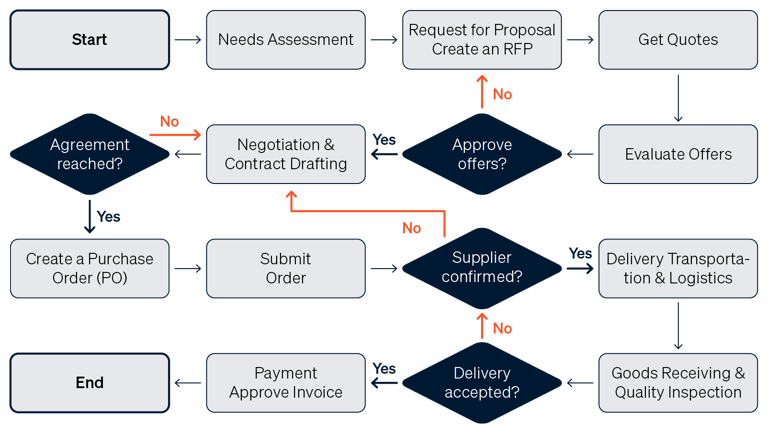
1. Needs Analysis and Goal Definition: Clearly define which products or services you want to source globally and what goals you are pursuing (e.g., a 15% cost reduction). A detailed specification of needs and requirements forms the foundation here.
2. Market Analysis: A thorough analysis of global sourcing markets is crucial for identifying potential supplier countries and regions, such as Eastern Europe or Asia.
3. Supplier Search and Evaluation: Search for and evaluate potential suppliers based on criteria such as price, quality, capacity, and reliability.
4. Negotiation and Contract Drafting: Conduct contract negotiations and ensure clear legal safeguards as well as planning for the entire logistics chain.
5. Risk Management and Compliance: Establish processes to monitor and minimize risks. When building global supply chains, companies must also comply with the legal framework, such as the Supply Chain Due Diligence Act (LkSG).
The alternative to global sourcing is local sourcing—procuring from local suppliers. While global sourcing focuses on cost advantages, local sourcing offers shorter delivery times, greater flexibility, and easier communication. Strategies such as just-in-time procurement are often easier to implement with local sourcing. Choosing the right sourcing strategy depends heavily on the industry, the product, and the company’s specific goals. Often, a hybrid strategy that combines both approaches is the best solution.
Global sourcing is far more than just purchasing from abroad. It is a strategic decision that can unlock enormous potential for cost reduction, innovation, and competitiveness. The key to success, however, lies in careful planning, proactive risk management, and the use of digital tools to manage complex processes. Companies that master these three pillars can sustainably optimize their global supply chains and secure decisive advantages in the global marketplace.