![Fabian von Kleinsorgen [VP Growth & Sales Operations]](https://simplesystem.com/hs-fs/hubfs/Autoren_Blog/Fabian_vin_kleinsorgen_autor.png?width=200&name=Fabian_vin_kleinsorgen_autor.png)

23.10.2026

![Fabian von Kleinsorgen [VP Growth & Sales Operations]](https://simplesystem.com/hs-fs/hubfs/Autoren_Blog/Fabian_vin_kleinsorgen_autor.png?width=100&name=Fabian_vin_kleinsorgen_autor.png)

In a dynamic market environment, strategically aligned procurement is no longer an optional extra, but a critical success factor for every company. To standardize processes, control costs, and comply with legal requirements, you need a centralized management tool. This is exactly where the purchasing policy comes into play. It serves as the foundation for all procurement activities and ensures that every transaction aligns with your business objectives. In this guide, you’ll learn everything you need to know about creating, implementing, and maintaining an effective purchasing policy.
A purchasing policy is an internal, binding document that establishes the principles, rules, and procedures for all procurement activities within a company. It serves as a central guide for all employees involved in purchasing and defines clear responsibilities, processes, and standards—from requisitioning to supplier selection to invoice approval. The main goal is to make procurement processes transparent, efficient, cost-effective, and compliant.
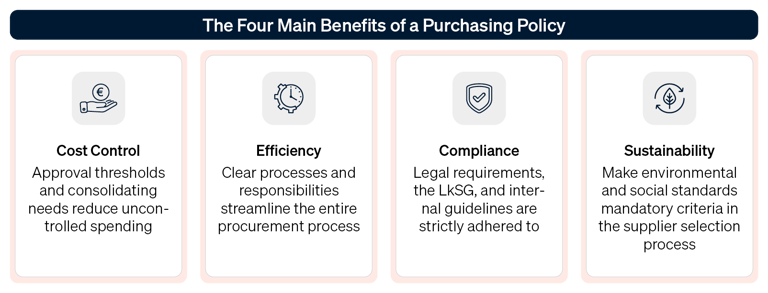
Implementing a well-thought-out policy goes far beyond mere bureaucracy. It is a strategic management tool that directly influences your company’s profitability and sustainability. By defining clear guidelines for purchasing, you not only ensure budget compliance but also lay the foundation for sustainable and risk-aware procurement. The key benefits can be divided into four core areas:
The exact content of a procurement policy must always be tailored to the specific needs and size of your company. Nevertheless, there are fundamental building blocks that no such document should lack in order to ensure comprehensive management of procurement. These core elements form the framework for your entire procurement processes.
Clearly define which employees, departments, and types of procurement the policy applies to. Also specify who holds which roles in the procurement process. This includes a clear distinction between strategic procurement (e.g., supplier negotiations) and operational procurement (e.g., order processing). Every employee must be aware of their authority and responsibilities.
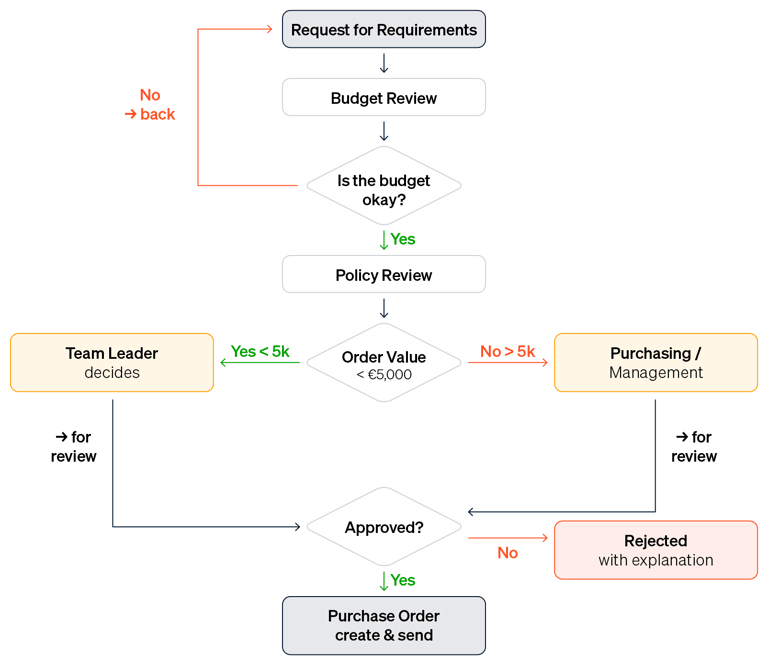
Describe the standardized process from identifying a need through payment. A key point here is value-based approval thresholds. Specify who is authorized to approve orders up to a certain value independently and when approval from a higher authority is required. A real-world example: By defining clear approval limits, a mechanical engineering company was able to reduce maverick buying—that is, purchasing that bypasses official processes—by 20%.
The policy should include criteria for the selection, evaluation, and development of suppliers. In addition to economic factors such as price and delivery capability , sustainability criteriaare becoming increasingly important. Your guidelines for supplier selection can be based on recognized standards. A helpful resource for this is the Federal Government’s Sustainability Compass from the German federal government, which provides information on sustainability labels and standards.
This section ensures that your company complies with all relevant laws and regulations. These include anti-corruption guidelines, data protection regulations, and, in particular, the requirements of the Supply Chain Due Diligence Act (LkSG). Detailed information on legal obligations can be found directly at the Federal Office for Economic Affairs and Export Control (BAFA). These compliance regulations are essential for modern management.
Rules for budget planning, allocation, and monitoring are crucial for the financial management of procurement. The procurement policy should specify how budgets are requested, approved, and monitored. Regular review of expenditures is a core component of purchasing controlling and helps achieve cost-saving targets and increase efficiency.
Drafting a policy is only half the battle. Success depends on systematic implementation and acceptance throughout the company. Take a methodical approach:
A carefully crafted and consistently implemented procurement policy is far more than a collection of rules. It is a strategic tool that helps your company reduce costs, optimize processes, and minimize risks. By establishing clear, transparent, and binding rules for your entire procurement function, you lay the foundation for a resilient, sustainable, and economically successful future. Don’t view the policy as a restriction, but rather as a compass that guides you safely through the complex waters of global procurement.