![Michael Petri [CEO]](https://simplesystem.com/hs-fs/hubfs/Autoren_Blog/Michael_Petri_autor.png?width=200&name=Michael_Petri_autor.png)
23.10.2026

![Michael Petri [CEO]](https://simplesystem.com/hs-fs/hubfs/Autoren_Blog/Michael_Petri_autor.png?width=100&name=Michael_Petri_autor.png)

Let’s be honest: Operational procurement is often viewed primarily as an executive function that handles day-to-day operations—a department that processes orders and tracks delivery dates. But this perspective falls short. In reality, operational procurement is the beating heart of your supply chain—it’s what enables all operational processes to run smoothly and ensures that a company’s needs are consistently met.
Without efficient operational procurement, production comes to a standstill, services cannot be provided, and customer promises cannot be kept. In this comprehensive guide, we’ll show you the key tasks that operational procurement fulfills, how it differs from strategic procurement, and—most importantly—how you can unlock the full potential of this critical business function through targeted optimization.
Operational procurement encompasses all executive and short-term activities within a company’s procurement process. Its primary goal is to ensure the efficient and timely availability of materials and the supply of goods and services to keep day-to-day operations running smoothly. Core tasks include determining demand, placing orders, monitoring delivery dates, communicating with suppliers regarding ongoing transactions, and handling administrative tasks such as invoice verification and processing complaints.
To fully understand the role of operational procurement, it is essential to distinguish it from strategic procurement. While the operational side focuses on the here and now—the daily ordering and management of deliveries—strategic procurement operates with a long-term perspective. It is responsible for shaping the fundamental purchasing policy, the selection and development of suppliers, conducting price and contract negotiations, and analyzing procurement markets.
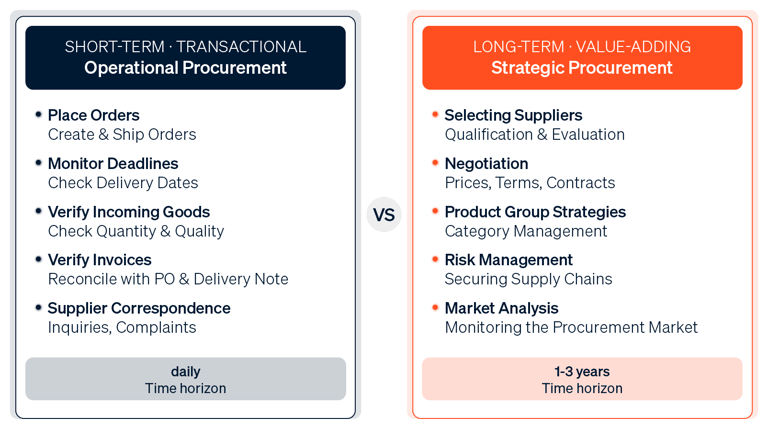
In practice, this means a clear division of labor within the purchasing department: Strategic purchasing sets the framework by, for example, qualifying suppliers and negotiating framework agreements. The operational buyer then operates within this framework, selecting from among the approved suppliers and placing orders under the predefined terms. Close collaboration with the strategic function is key to maximizing competitiveness. Modern digitalization in procurement provides the technological foundation for this by automating routine operational tasks, thereby freeing up more time for strategic tasks.
The operational buyer is the key player in day-to-day operations. Their primary responsibility lies in the error-free and timely execution of the entire ordering process, from the requisition to the receipt of goods. They ensure that the right materials and services are in the right quantity at the right time and in the right place to maintain operational processes.
This role requires a high degree of organizational skill, precision, and strong communication skills. The operational buyer acts as the central interface between internal demand drivers (e.g., production, IT) and external suppliers and is therefore key to smooth collaboration with suppliers.
The operational procurement process, often referred to as “Procure-to-Pay” or the “P2P process,” follows a clear, recurring logic. Each step builds on the previous one and is crucial to the efficiency of the entire supply chain. A well-defined purchasing policy forms the foundation for this and ensures that all actions are carried out in compliance with the rules.
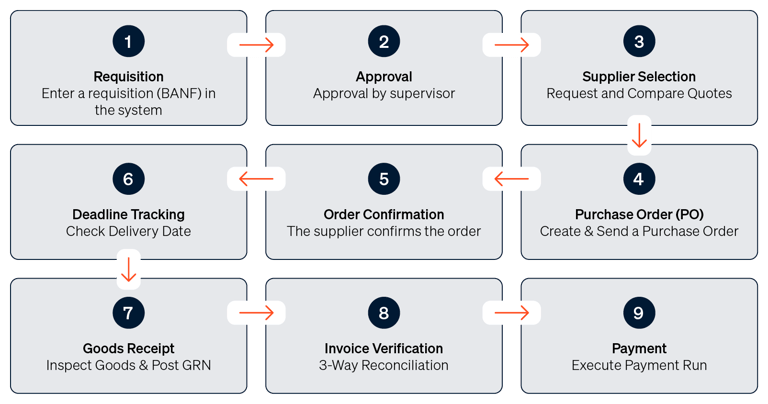
The process begins as soon as a need is identified within the company and ends with the payment of the supplier’s invoice. Typically, the process can be divided into the following core phases, which are significantly supported and documented through the use of an ERP system. The exact structure of the procurement process may vary depending on the company and product group, but it essentially follows this outline.
It all starts with a need. A business unit—whether Production, Marketing, or IT—determines that a material, product, or service is required. This need is formally recorded in the ERP system as a purchase requisition (BANF), which includes details such as the item, quantity, and desired delivery date.
The purchase requisition is sent digitally to the operational purchasing department. Here, an initial critical review takes place: Is the request plausible? Is all the information complete? Is the budget available? This step serves as an important control mechanism to prevent unplanned expenditures and ensure compliance with internal processes.
After approval, the operational buyer selects the appropriate supplier from the supplier master predefined and qualified by strategic purchasing. A binding purchase order is then generated from the purchase requisition, incorporating all terms and conditions from the existing framework agreement.
The purchase order is transmitted to the supplier. A crucial step for the operational buyer is to insist on a written order confirmation. This document formalizes the agreement and, most importantly ,confirms the delivery date, which is essential for further planning.
The work is not done once the order is placed. The operational buyer proactively monitors the agreed-upon delivery dates. For critical goods, “expediting”—that is, actively following up on and driving the delivery process—is one of the most important tasks for preventingbottlenecks in the company’s own supply chain.
The goods arrive at the company. In the warehouse or directly in the requesting department, the shipment is checked for completeness and visible defects. The goods receipt is recorded in the ERP system, which serves as a signal for the subsequent process steps.
The supplier’s invoice arrives either simultaneously with or after the goods are received. The operational purchasing department or accounting matches the invoice against the purchase order and the delivery note (known as a “three-way match”). If the information matches, the invoice is approved for payment.
As the final step in the procure-to-pay process, the financial accounting department arranges for the invoice to be paid on time. This completes the operational procurement process for this individual transaction and ensures it is properly documented.