B2B Trading Platforms Explained: A Guide for Procurement Leaders
Author
Fabian von Kleinsorgen VP Growth & Sales Operations
Digital B2B commerce platforms are revolutionizing commerce by integrating supply chains, improving transparency and offering tailored solutions. With features such as automation, personalized offers and data analytics, they increase efficiency, reduce costs and optimize business strategies.
B2B trading platform - The benefits of digital B2B platforms for retailers and buyers
Advancing digitalization and global networking make it more important than ever to design effective and competitive trading processes. Digital B2B trading platforms, which act as an interface between retailers and buyers, play a key role in this.
These platforms are not only revolutionizing traditional trading methods, but also offer a variety of benefits that go far beyond mere transactions. They enable seamless integration of supply chains, improve transparency and offer customized solutions that meet the individual needs of business partners.
At a glance
Effective trading processes are crucial in the digitalized and globally networked business world
Core features of B2B platforms: Marketplace functionality, Supply chain integration, Automation and efficiency, Advanced search and filter functions, Transparency and traceability, Personalized offers and prices, Security and trust
B2B platform functionality: registration and verification, product and service offering, search and discovery, ordering process, payment processing, order management, shipping and delivery, customer service and support, data analysis and reporting, additional services
Benefits of a digital B2B marketplace: Expanded market access, increased efficiency, cost reduction, transparency and traceability, improved communication and collaboration, access to data and analytics, security benefits, sustainability
Indirect demand: Goods and services that are not directly incorporated into the end product.
C-parts: Products with low value but great importance to the business.
What is a B2B trading platform?
A B2B (business-to-business) trading platform is a digital portal that helps companies to do business with each other. In contrast to B2C (business-to-consumer) platforms, which enable trade between companies and end consumers, B2B platforms are specifically designed to meet the needs of business customers. These platforms offer a variety of functions and services that make the entire trading process from wholesalers to buyers more efficient and transparent.
Marketplace functionality: B2B platforms provide a one-stop shop where companies can offer their products and services and potential buyers can browse and purchase them.
Supply chain integration: These platforms enable seamless integration and collaboration along the entire supply chain, from production to distribution to the end customer.
Automation and efficiency: Many tasks that used to be done manually, such as ordering, invoicing and payment processing, are automated, increasing efficiency and reducing errors.
Advanced search and filter functions: Users can search and filter products and services specifically to find exactly what they need. This optimization of procurement is one of the reasons why more and more companies are buying on procurement platforms.
Transparency and traceability: B2B platforms often provide real-time information on availability, prices and the status of orders, which increases transparency and facilitates planning.
Personalized offers and prices: Because B2B business relationships are often long-term and complex, many platforms offer the ability to create customized pricing and special offers for repeat customers.
Security and trust: By implementing secure payment systems and verifying merchants and buyers, a high level of security and trust is ensured.
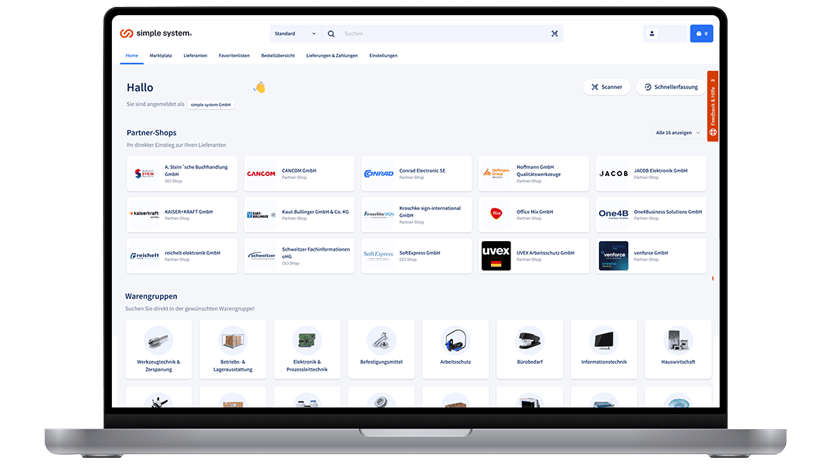
B2B sales platform simple system
How does a B2B trading platform work?
A B2B trading platform functions as a digital marketplace that makes the trading process between companies efficient and transparent. There are a few key steps and functions that make up the operation of a typical B2B platform:
Registration and verification
Registration: Companies (both sellers and buyers) register on the procurement platform and create a company profile.
Verification: Many platforms carry out a verification process to ensure the identity and integrity of the registered companies.
Range of products and services
Listing products: Sellers list their products or services with detailed descriptions, specifications, prices and images.
Catalog management: Online trading allows sellers to easily manage and update their product catalog.
Search and discovery
Advanced search functions: Buyers can search and filter products based on various criteria such as category, price, availability or delivery time.
Recommendation systems: Some platforms offer personalized recommendations based on previous purchasing behavior or similar users.
Order process
Shopping cart and checkout: Buyers place products in their shopping cart and complete the purchase process via a checkout system.
Price negotiations: In many B2B transactions, buyers and sellers can make contact and negotiate individual prices and conditions.
Payment processing
Payment options: Digital platforms offer various payment methods, including credit cards, bank transfers and sometimes payment terms or credit lines.
Security: Secure payment processing through encryption and other security measures.
Order management
Order overview: Buyers and sellers can track the status of their orders in real time.
Order management: Sellers can manage orders, print shipping labels and organize deliveries.
Shipping and delivery
Logistics services: Some platforms offer integrated logistics and shipping solutions to facilitate the shipping process.
Shipment tracking: Buyers can track the shipping status of their orders and view suppliers and delivery dates.
Customer service and support
Communication channels: Platforms provide tools for direct communication between buyers and sellers, such as messaging functions or integrated chat systems.
Support services: Access to customer service for technical support, dispute resolution and general inquiries during the procurement processes.
Data analysis and reporting
Analysis tools: Sellers have access to analytics tools that show sales statistics, revenue, customer behavior and market trends.
Reports: Regular reports help companies to carefully optimize their business strategies and make better decisions.
Additional services
Marketing and advertising: Opportunities to advertise and promote products within the platform.
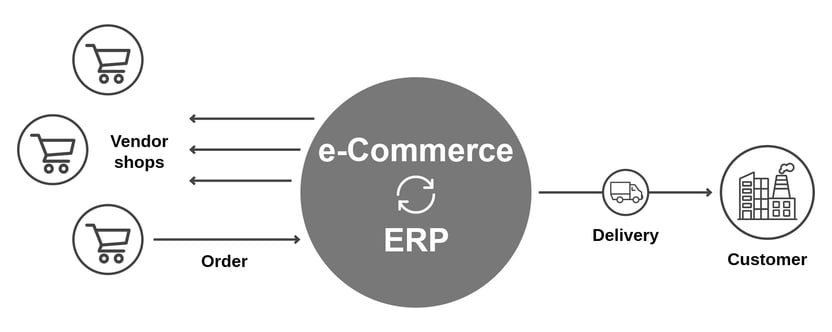
Integrations: Interfaces to ERP systems, accounting software and other business solutions for seamless integration and data synchronization.
What are the advantages of a digital B2B marketplace?
A digital B2B marketplace offers numerous benefits for retailers and buyers, making the entire trading process more efficient, transparent and cost-effective. Here are some of the key benefits:
Expanded market accessGlobal access allows retailers to offer their products to a worldwide audience, while buyers can choose from a global offering. This digital transformation creates new business opportunities as marketplaces continue to open up new markets.
Increased efficiencyThe automation of many processes (such as order processing, invoicing and payment processing) increases efficiency and reduces errors. The entire purchasing process is accelerated as information is available in real time and transactions are carried out digitally.
Cost reductionThrough automation and digital processes, companies can reduce the costs of manual processes and paperwork and thus benefit from the chosen platform. B2B e-commerce marketplaces also allow buyers to compare offers from different commercial suppliers and find the best prices.
Transparency and traceabilityAccess to up-to-date information on stock, prices and the status of orders also gives retailers the opportunity to act more agilely in the face of competitors thanks to real-time information. The tracking functions of online marketplaces also enable better transparency throughout the entire delivery process.
Improved communication and collaborationSome platforms offer integrated messaging and communication systems that facilitate direct exchange between retailers and companies or collaboration within companies.
Access to data and analyticsSellers can access data and analytics that provide insights into market trends and customer behavior. The extensive reporting and analysis functions also help companies to make well-founded business decisions and optimize their strategies.
Security benefitsBy implementing security measures such as encryption and verification processes, the security of transactions is guaranteed. In addition, many platforms review and rate their members to ensure a high level of trust and reliability for B2B commerce.
SustainabilityThe digital processing of transactions and documents conserves resources and reduces environmental impact. More efficient supply chains and logistics processes contribute to more sustainable business practices.
The importance of B2B e-commerce
B2B e-commerce, or electronic commerce between companies, is becoming increasingly important due to digital transformation and globalization. This development is revolutionizing how companies conduct business, make purchasing decisions and interact with each other.
User-friendly trading platforms that provide products are also becoming increasingly important for indirect demand.
Indirect demand and C-parts
Indirect demand and C-parts play an important role in the procurement management of companies, although they are often less in the spotlight than direct materials and A- and B-parts. Here is an explanation of what these terms mean and why they are relevant to companies:
Indirect demand
Indirect requirements include all goods and services that are not directly incorporated into the end product or the direct manufacturing process. Typical examples are office supplies, cleaning materials, IT equipment, work clothing, but also services such as building maintenance or training. Although these products and services are often less costly than direct materials, they can still have a significant impact on operational efficiency and costs.
The challenge with indirect requirements often lies in the heterogeneous nature of the products and services and the different requirements of the various departments within a company. Efficient management of indirect requirements can help to reduce costs, streamline procurement and increase productivity, for example by simplifying ordering processes and ensuring the availability of required goods.
C-parts
C-parts are a specific category within indirect requirements and usually include low-value products that are essential to the smooth running of a business. Typical examples are screws, seals, small parts, fastening materials or consumables such as gloves or lubricants. These parts are often standardized and have low unit prices, but their importance lies in the fact that they are needed in large quantities and a shortage of them could severely disrupt operations.
Proper management of C-parts is crucial to avoid unnecessary inventory and control costs while ensuring that these items are available at all times so as not to hinder production or operations.
Through B2B trading platforms, C-parts can be sourced cost-efficiently and easily.
Importance for companies
Both indirect requirements and C-parts play a key role in a company's overall efficiency and cost control:
Cost management: effective procurement and inventory management help to avoid unnecessary spending and optimize budgets.
Operational efficiency: A reliable supply of indirect goods and C-parts supports smooth processes and minimizes downtime.
Risk management: By ensuring the continuous availability of these goods, companies reduce the risk of interruptions in production or operational bottlenecks.
Process optimization: Automated procurement processes and the use of digital platforms can simplify and optimize the management and access to indirect goods and C-parts.
Summary
Digital B2B trading platforms play a crucial role in today's business world, which is characterized by digitalization and global networking. They are revolutionizing traditional trading methods and offer numerous benefits that go beyond mere transactions. These platforms promote the seamless integration of supply chains, improve transparency and offer customized solutions that meet the individual needs of business partners.
They facilitate the entire commerce process through features such as marketplace functionality, automation, advanced search and filter options, transparency, personalized offers, secure transactions and extensive data analytics. These benefits make B2B Commerce indispensable tools for retailers and buyers to increase their efficiency, reduce costs and optimize their business strategies.
Frequently asked questions
B2B marketplaces are online platforms that enable companies to sell and buy products and services directly to other companies.
Visibility on B2B platforms works through search engine optimization (SEO), paid advertising, good reviews and active participation on the platform.
Features of a B2B marketplace include specialized products and services, wholesale quantities, complex pricing and often integrated negotiation and payment functions.
A B2B platform differs from a B2C platform in its focus on business relationships, larger transaction volumes, specialized products and services and longer sales cycles.
Yes, B2B platforms are suitable for SMEs as they offer access to a broader market, better purchasing conditions and the opportunity to expand their reach and business contacts.
![Fabian von Kleinsorgen [VP Growth & Sales Operations]](https://simplesystem.com/hs-fs/hubfs/Autoren_Blog/Fabian_vin_kleinsorgen_autor.png?width=200&name=Fabian_vin_kleinsorgen_autor.png)


![Fabian von Kleinsorgen [VP Growth & Sales Operations]](https://simplesystem.com/hs-fs/hubfs/Autoren_Blog/Fabian_vin_kleinsorgen_autor.png?width=100&name=Fabian_vin_kleinsorgen_autor.png)