![Jörg Schmidt [Head of Vendormanagement]](https://simplesystem.com/hs-fs/hubfs/Autoren_Blog/Joerg_schmidt_autor.png?width=200&name=Joerg_schmidt_autor.png)
14.10.2026

![Jörg Schmidt [Head of Vendormanagement]](https://simplesystem.com/hs-fs/hubfs/Autoren_Blog/Joerg_schmidt_autor.png?width=100&name=Joerg_schmidt_autor.png)

In a globally interconnected economy, the stability of your supply chain is a critical competitive factor. But what happens if a single supplier fails? The consequences range from costly production stoppages and supply bottlenecks to lasting damage to your reputation. Recent global crises have starkly highlighted the fragility of supply chains and shown that reactive management is no longer sufficient. Many companies underestimate the potential risks lurking within their supplier base.
Proactive supplier risk management is therefore no longer an option but a strategic necessity for sustainable business success. The key is to identify and assess risks early on and take targeted measures to mitigate them. This guide provides you with a comprehensive overview and concrete recommendations for action to professionalize supplier risk management in your company and strengthenthe resilience of your entire supply chain.
Supplier risk refers to the danger that an event or development associated with a supplier will have a negative impact on your company’s operational processes, financial stability, or reputation. Such a disruption can range from a simple delivery delay to a complete production shutdown and poses a significant risk to the entire supply chain.
The days when procurement could focus solely on price negotiations are over. The increasing complexity of global supply chains and growing geopolitical instability require a shift in thinking. Effective management of supplier risks is key to safeguardinga company’s production and business success. The need for proactive action is underscored by several factors.
First, lawmakers have significantly tightened companies’ responsibilities regarding their supply chains. Regulations such as the German Supply Chain Due Diligence Act (LkSG) require companies to actively address potential risks, particularly in the areas of human rights and the environment. Compliance violations can not only result in severe penalties but also cause lasting damage to a company’s reputation. Structured risk management is therefore also a matter of legal protection.
On the other hand, the business consequences of supply chain disruptions are immense. A failure on the part of a critical supplier can lead to production stoppages, lost revenue, and dissatisfied customers. Poor quality, delivery delays, or a sudden supply shortage directly impact your operational performance. Proactive supplier risk management helps you identify such scenarios early on and ensurethe stability of your supply chain.
To manage supplier risk, you must first understand it. The risks posed by suppliers are diverse and require a nuanced approach. The process of identification, followed by a structured risk assessment, forms the foundation of any effective mitigation strategy. Categorization helps you maintain an overview and develop targeted measures.
Once you have identified the potential risks, the crucial step follows: the assessment. Not every risk and not every supplier carries the same weight. The goal of risk assessment is to create an objective basis for directing your attention and resources specifically toward the most critical issues. Conducting risk assessments systematically is at the heart of any professional supplier risk management.
A proven tool for this is the risk matrix. In this process , each identified risk is evaluated based on two dimensions: the probability of occurrence and the potential extent of damage to your company. Probability of occurrence estimates how likely it is that the risk will materialize, while the extent of damage quantifies the severity of the negative consequences (e.g., financial losses, production downtime).
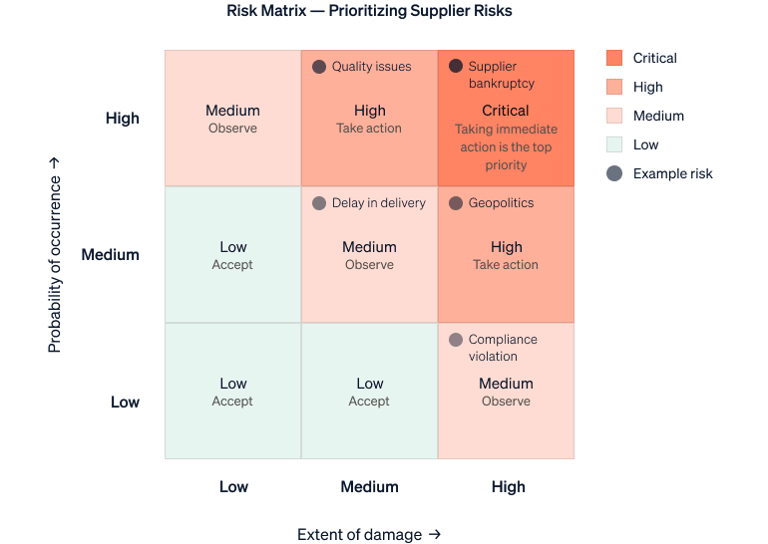
By combining both factors, supplier risks can be categorized into different levels of criticality. This allows you to see at a glance where urgent action is needed. The assessment is typically conducted using a grid that identifies clear priorities for risk mitigation.
In parallel with the risk assessment, you should segment your supplier base. The ABC analysis is a classic method for classifying suppliers based on their strategic importance to your company. This helps you tailor the effort required for monitoring and management to the supplier’s importance.
The true strength lies in combining both methods: An A-supplier classified as high-risk in the risk matrix poses an immediate threat and requires immediate risk mitigation measures. In contrast, a high risk associated with a C-supplier may, depending on your company’s risk tolerance, be acceptable or mitigated using simple measures. This ensures the efficient allocation of your resources in risk management.
Practical Help for Your Risk Management
Use our tried-and-true template to systematically evaluate your suppliers and identify risks early on.
Identifying and assessing risks is only half the battle. The crucial step that transforms your risk management from a mere exercise into a valuable control tool is the implementation of targeted risk mitigation measures. The growing importance of proactive risk management is also underscored by studies such as those conducted by the Fraunhofer Institute for Material Flow and Logistics (IML). The key is to develop a suitable strategy for each critical risk.
There is no one-size-fits-all solution; the right measures depend on the nature of the risk, the strategic importance of the supplier, and your own risk tolerance. The following best practices have proven particularly effective in practice for increasing supply chain resilience and driving the minimization of these risks.
These risk-mitigation measures are not one-time actions but must be embedded in a continuous process. After all, the risk landscape is constantly changing.
Effective supplier risk management does not end after the initial assessment and the implementation of mitigation strategies. Continuous monitoring of your supplier base is crucial for identifying new or evolving risks at an early stage. The global economy is dynamic; a supplier that is stable today may already pose a risk tomorrow. This also includes new threats such as cyberattacks on partners’ IT systems.