![Michael Petri [CEO]](https://simplesystem.com/hs-fs/hubfs/Autoren_Blog/Michael_Petri_autor.png?width=200&name=Michael_Petri_autor.png)
14.10.2026

![Michael Petri [CEO]](https://simplesystem.com/hs-fs/hubfs/Autoren_Blog/Michael_Petri_autor.png?width=100&name=Michael_Petri_autor.png)

Rising expenses, shrinking margins—a scenario familiar to many companies. Often, it’s not the obvious production costs that weigh on profitability, but a hidden cost driver: overhead costs. These indirect costs—ranging from office rent to accounting salaries—are essential to operations, but can become a real burden if left unchecked.
In this guide, you’ll learn not only how to understand your overhead costs, but also how to systematically analyze them and develop effective cost-cutting strategies. We’ll show you how to increase efficiency and thereby secure your company’s long-term competitiveness.
Overhead costs, also known as indirect costs, are all costs incurred by a company that cannot be directly allocated to a single cost object—that is, a specific product or service. They are incurred to maintain general business operations and are often allocated to the various cost centers using an allocation formula. Examples include rent, insurance, and administrative salaries.
The key difference lies in allocability. While direct costs—such as material costs for a specific product—are directly traceable, overhead costs are incurred for the business as a whole. Imagine you’re manufacturing tables: The wood is a direct cost. However, the rent for the production hall, where chairs are also manufactured in addition to tables, is classified as an overhead cost. This clear distinction is the first step toward successful cost optimization.
To reduce overhead costs, you must first know where they occur. This cost category is extremely diverse and permeates nearly every area of the business. A structured cost analysis therefore begins with categorizing the various cost blocks. This is the only way to identify the biggest cost drivers and implement targeted optimization measures. Below, we present the most common types of overhead costs that are relevant in most companies.
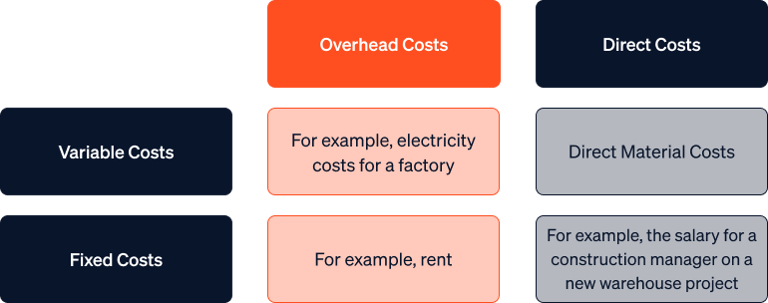
These are the costs incurred for the organization and management of the entire company. They form the backbone of day-to-day operations but cannot be attributed to any single product. Streamlining administrative processes is a key strategy for reducing these costs.
These items are often viewedas fixed costs, but upon closer analysis, they offer significant potential for sustainable cost reduction.
All expenses related to the marketing and sale of your products or services that cannot be directly attributed to a specific unit sold fall into this category. They are crucial for generating revenue but must be closely monitored to avoid jeopardizing profitability.
In manufacturing companies, these are costs incurred during the production process but cannot be allocated to a specific productlike direct material costs. They are often allocated to the various cost centers using an allocation formula.
A clear distinction from direct costs is essentialhere for accurately calculating the company’s total costs and for competitive pricing.
Simply knowing the cost categories is only half the battle. To reduce overhead costs, you must establish a systematic process for cost analysis. This is the only way to create the transparency needed to identify inefficiencies and make informed decisions. The following step-by-step guide will help you examine your cost structure and set the course for targeted optimization.
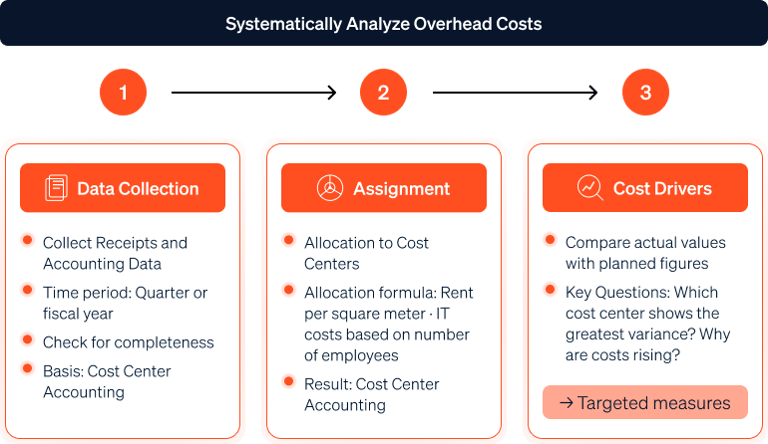
The foundation of any sound analysis is a clean database. To achieve this, collect all relevant documents and information from your accounting system for a defined period, such as the last quarter or fiscal year. The goal is to obtain a complete picture of all indirect costs incurred before assigning them to individual cost centers. Ensure completeness, as this is the only way to accurately reflect the company’s total costs.
The operating cost allocation sheet (BAB) is the classic controlling tool used to allocate overhead costs to the various cost centers based on the principle of causation. This process transfers costs that cannot be directly attributed from cost-element accounting to cost-center accounting. This makes it clear which business unit incurs which costs.
Allocation is performed using logical allocation keys. For example, rent costs can be allocated to departments based on the floor space used (in m²), while IT costs are distributed per employee. This makes abstract cost blocks tangible and creates a fair basis for internal activity-based costing and budgeting.
Once the data has been prepared, the actual analysis begins. Compare the actual figures with the budgeted figures from your budgeting process or with figures from past periods. Where are there significant variances? Which cost centers have the highest or fastest-rising overhead cost shares? Especially in times when the Federal Statistical Office (Destatis) reports a continuous rise in producer prices, precise control of the internal cost structure is essential to ensure your own competitiveness in the market.
Examine the drivers behind the numbers: Are high energy costs the result of outdated machinery? Are administrative costs rising due to inefficient processes? This in-depth analysis of root causes is the crucial step in moving from mere observation to active management and implementing effective measures to reduce overhead costs.
After a thorough analysis of your cost structure, it’s time to take action. However, reducing overhead costs is not merely about cutting expenses; it is a strategic process aimed at improving efficiency. The goal is not to blindly cut necessary expenses, but to eliminate waste and use resources more intelligently. The following tried-and-true strategies will help you sustainably increase profitability without jeopardizing your company’s operational performance.
It is often in administration that the largest—yet most invisible—cost drivers lie hidden. Manual data entry, cumbersome approval processes via email, or paper-based filing systems are not only slow but also error-prone and labor-intensive. These inefficient processes tie up valuable work time that is then lacking elsewhere. Various studies confirm that high administrative costs, in particular, place a significant burden on small and medium-sized businesses and undermine their competitiveness.
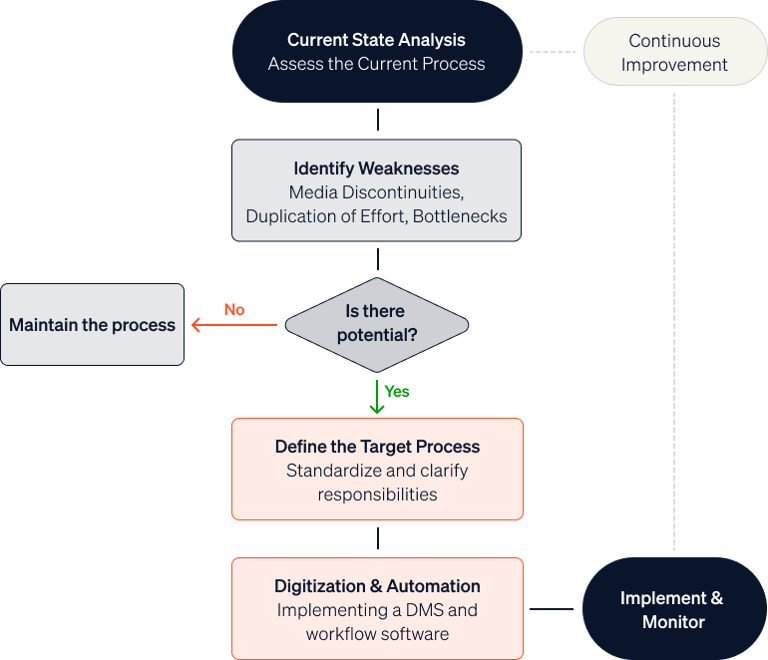
The key to optimization lies in consistent standardization and automation. Implement a document management system (DMS) to minimize the exchange of paper documents. Use software to automate recurring accounting tasks, such as invoice processing. Every process step that is digitized reduces the error rate, speeds up workflows, and frees up capacity for more value-added activities. Maximizing administrative efficiency is a direct way to reduce your fixed costs.
Your expenses for supplies, office materials, or external services account for a significant portion of your overhead costs. Often, contracts with suppliers are signed once and then continue unchanged for years, even though market prices have long since changed. Regularly reviewing and renegotiating your purchasing terms is therefore essential for reducing costs.
Analyze your order volume and assess whether consolidating orders with fewer suppliers could lead to better prices. Conduct benchmarks to compare your current terms with market rates. A professional procurement approach considers not only the purchase price but also the total costs along the entire supply chain. Through strategic negotiations and the establishment of long-term partnerships, you can sustainably optimize your material costs and other operating expenses.
Personnel costs—particularly salaries and social security contributions in administrative departments—are often one of the largest fixed cost categories. Rigid work schedules and an oversized workforce can drive costs up unnecessarily. Flexible workforce planning is therefore a crucial factor in making the cost structure more agile and enabling you to respond to fluctuations in order volume.
Examine where it makes sense to use part-time employees or freelancers, or to introduce flexible work schedules and remote work models. The latter can not only increase employee satisfaction but also reduce the need for expensive office space and the associated operating costs. This allows you to dynamically adjust your staffing levels to actual demand.
Another strategic option is to outsource tasks that are not part of your core business. Areas such as accounting, payroll, or IT support can often be outsourced to external service providers at a lower cost and with greater expertise. This allows you to convert fixed personnel costs into variable costs that are incurred only when services are used, while simultaneously enhancing professionalism.
Energy costs account for a significant portion of manufacturing overheads, especially in manufacturing companies. Outdated equipment, inadequate insulation, or a lack of awareness regarding energy consumption can drive up your operating costs without you even noticing. Targeted reduction of energy consumption therefore directly contributes to cost savings.
Invest in energy-efficient technology and conduct regular energy audits to identify areas for improvement. At the same time, predictive maintenance is an effective strategy. Instead of reacting to breakdowns, proactively budget for maintenance costs. This minimizes costly downtime, extends the service life of your machines, and ensures a consistently efficient production process.