![Jörg Schmidt [Head of Vendormanagement]](https://simplesystem.com/hs-fs/hubfs/Autoren_Blog/Joerg_schmidt_autor.png?width=200&name=Joerg_schmidt_autor.png)

09.09.2026

![Jörg Schmidt [Head of Vendormanagement]](https://simplesystem.com/hs-fs/hubfs/Autoren_Blog/Joerg_schmidt_autor.png?width=100&name=Joerg_schmidt_autor.png)

Today, a stable and reliable supply chain is no longer an advantage, but an absolute necessity. The success of your company depends largely on the quality and reliability of your suppliers. But a good supplier relationship does not happen by chance. It is based on a solid foundation: a professionally drafted supplier contract. This document is much more than a formal agreement; it is the strategic roadmap for a successful and long-term collaboration.
However, many companies neglect contractual safeguards and rely on verbal agreements or brief email correspondence. This is a serious mistake that can quickly lead to misunderstandings, delivery failures and expensive legal disputes. A well-drafted supplier contract protects both parties by defining clear rules and ensuring transparency. In this comprehensive guide, you will learn everything you need to know to create a legally compliant and practical supplier contract that protects your company's interests and increases the efficiency of your business relationships.
A supplier contract is a formal, legally binding agreement between a company (the customer) and a supplier. It regulates the terms of the business relationship and sets out the rights and obligations of both parties in detail. Essentially, the contract defines the purchase and delivery of certain products or services. It serves to clearly formulate the expectations of both parties in order to avoid misunderstandings and create a solid basis for cooperation. Such a supply contract is therefore the central management tool for any professional supplier relationship.
Relying solely on trust in a new business partner is risky in professional purchasing. Without a written contract, both parties are on uncertain ground. Verbal promises are difficult to prove in the event of a dispute and vague wording in emails leaves too much room for interpretation. A detailed supplier contract is therefore not a sign of mistrust, but of professionalism and foresight. It ensures that expectations of the products or services are aligned from the outset and provides a clear framework for action should problems arise.
The strategic benefits of a carefully drafted contract go far beyond mere hedging. They are a fundamental building block for effective supplier management. The most important advantages include
Our experience in supplier management has shown that companies with standardised and detailed supplier contracts are less likely to be affected by unexpected disruptions in the supply chain. They can react more quickly to breaches of contract and maintain more stable and successful supplier relationships overall.
There is no specific "supplier law" in the German legal system. Instead, the legal provisions for supplier contracts are based on various pieces of legislation. Different regulations apply depending on the structure of the contractual relationship. In most cases, supplier contracts are classified as purchase contracts (Section 433 BGB) or contracts for work and materials (Section 650 BGB). As the B2B context involves transactions between merchants, the provisions of the German Commercial Code (HGB) play an equally decisive role. These can deviate from the general rules of the BGB and, for example, stipulate stricter obligations to inspect the goods immediately and to give notice of defects.
It is therefore essential that your supplier contract is specifically tailored to the requirements of your company and the concrete business relationship. The legal requirements merely form the framework, which must be filled in by individual contractual agreements. International regulations such as the Incoterms or the UN Convention on Contracts for the International Sale of Goods (CISG) must also be observed, particularly in the case of cross-border supply chains. The German Federal Office of Justice offers a valuable resource for the basics of German business transactions with the German Commercial Code (HGB), which is available online.

Find out how it works in our free e-procurement report. Download now free of charge and without obligation.
Read nowA supplier contract is only as strong as the clauses it contains. A contract with gaps offers a false sense of security and leaves crucial questions unanswered in an emergency. To ensure a solid and resilient business relationship, the rights and obligations for both parties must be clearly defined. The following elements should be included in every professional supplier contract in order to precisely regulate the cooperation between your company and its suppliers.
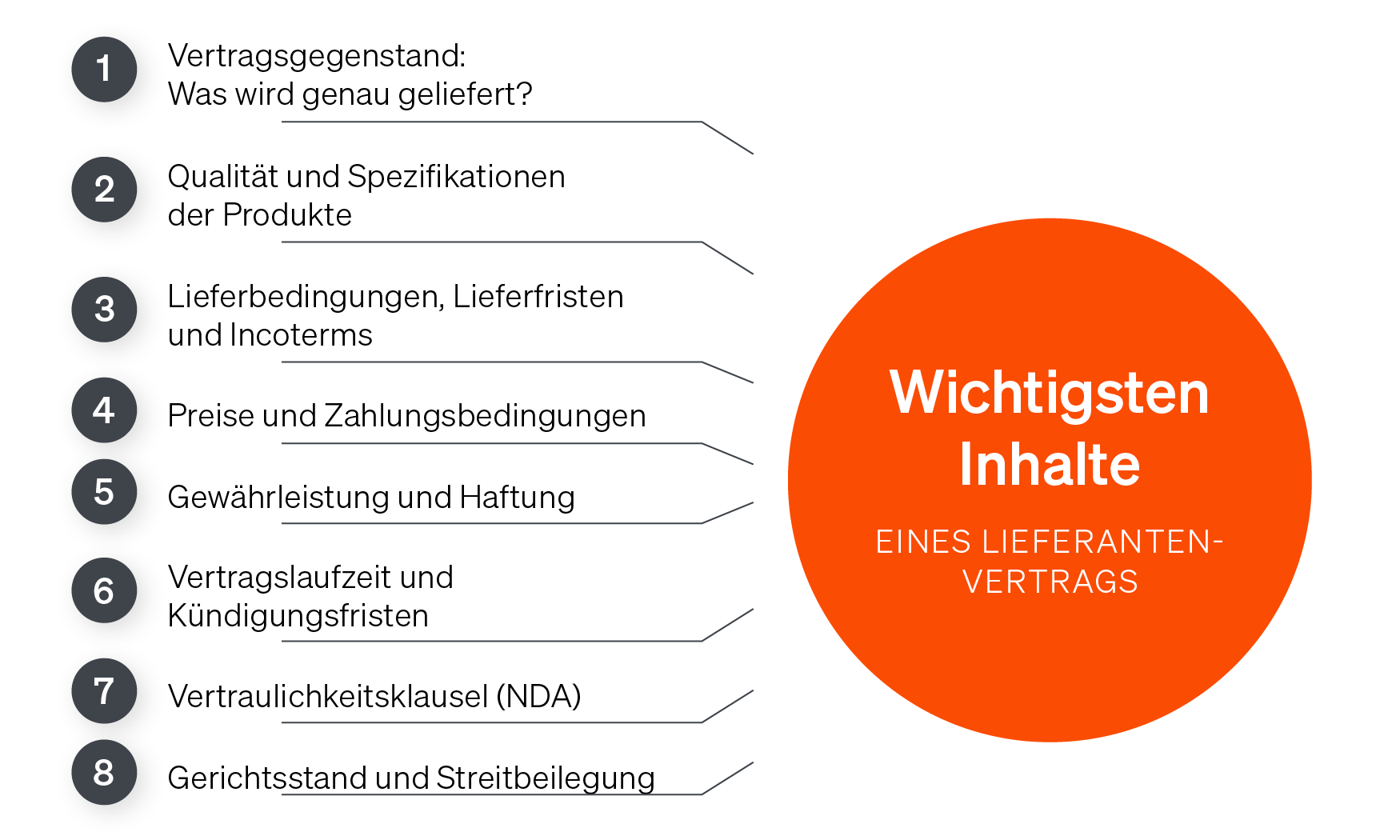
The subject matter of the contract must be described as precisely as possible. It is not enough to simply agree on "screws" or "IT services". List exact article numbers, type designations, quantities and a detailed description of the products or services owed. In the case of services, you should clearly define the scope of services, so-called "service levels". The more precise the description, the lower the risk of a subsequent misunderstanding about the scope of services.
The quality of the delivered goods is closely linked to the subject matter of the contract. Define binding quality standards. These can be recognised standards (e.g. DIN, ISO), technical data sheets or reference samples. It is good practice to contractually stipulate the regular review of these standards as part of a supplier evaluation. Also, ensure that the consequences of quality defects are clearly regulated, for example, through claims for rectification, a reduction in price or the right to a replacement delivery.
This point regulates the entire logistics. Clarify clearly when and where the delivery is to be made. Fixed delivery deadlines are essential for your planning stability. Equally important is the regulation on the transfer of risk: at what point does the buyer bear the risk of loss or damage to the goods? The use of internationally recognised Incoterms is recommended here. These clauses define standardised delivery conditions and clarify the responsibilities for transport, costs and insurance.

The price agreement must be transparent and comprehensible. Is it a fixed price or a variable price? Are there price adjustment clauses that react to raw material prices or inflation rates? The terms of payment specify by when and how the purchase price is to be paid. Typical provisions include payment terms (e.g. 30 days net), discounts for quick payment or the agreement of down payments or installment payments.
What happens if the delivered goods are defective? The warranty regulates the buyer's claims in the event of defects. While the statutory regulations provide a basis, contractual agreements can extend or (to a certain extent in the B2B sector) also restrict these. The liability clauses define the extent to which a contracting party is liable for damages resulting from breaches of contract. A contractual penalty can also be agreed for certain cases, such as delayed delivery, in order to increase the pressure to fulfil the contract.
A supply contract can be concluded for an indefinite period or for a limited period. Specify the term clearly and define the conditions for ordinary termination, in particular, the notice period. It is equally important to include a clause for extraordinary termination for good cause (e.g. in the event of repeated serious breaches of contract or insolvency of the partner). This ensures that you can part ways with an unreliable supplier with legal certainty in the event of problems.
As part of the business relationship, the contractual partners often exchange sensitive information, such as technical drawings, price lists or customer information. A non-disclosure agreement (NDA), which is integrated into the contract as a clause, is therefore essential. It regulates the protection of sensitive information and prohibits the disclosure of data marked as confidential to third parties.
Ideally, a dispute should never arise. However, if it does, it is important that the place of jurisdiction is determined in advance. The jurisdiction clause determines which court has jurisdiction for legal action arising from the contractual relationship. An alternative to state jurisdiction is dispute resolution through arbitration. This can be quicker and more discreet in many cases. Clarify which law (e.g. German law) applies to the contract, especially in the case of cross-border supply chains.
Careful drafting of these clauses forms the foundation for a successful supplier relationship. Model contracts can serve as a guide. The IHK Frankfurt am Main, for example, provides an overview of various model contracts that can serve as a basis for your individual agreement. Remember, however, that each model must be adapted to the specific requirements of your company.
A professional supplier contract is far more than a bureaucratic necessity. It is the strategic backbone of a stable and crisis-proof supply chain. Investing time and care here not only creates legal certainty but also the basis for a trusting partnership of equals.
Clearly defined rules prevent misunderstandings before they arise and allow both parties to focus on the essentials: mutual business success. Therefore, do not view the contract as a sign of mistrust, but as an instrument for quality assurance and risk minimisation. Proactive contract design always pays off in the long term - through smooth processes, predictable costs and a business relationship that endures even in challenging times.