![Andy Freund [Head of Growth & Customer Management]](https://simplesystem.com/hs-fs/hubfs/Autoren_Blog/Andy_Freund_autor.png?width=200&name=Andy_Freund_autor.png)
23.10.2026

![Andy Freund [Head of Growth & Customer Management]](https://simplesystem.com/hs-fs/hubfs/Autoren_Blog/Andy_Freund_autor.png?width=100&name=Andy_Freund_autor.png)

Purchasing is often viewed solely as a cost center, but this perspective is too narrow. Professional procurement is a key driver of business success. To harness this potential, you need transparency and control. This is exactly where procurement controlling comes in: It enables data-driven planning, management, and optimization of all processes and makes the value contribution of procurement measurable. This guide shows you how to apply the most important methods and key performance indicators.
Purchasing controlling is a subfield of management controlling that focuses on the planning, management, and control of all procurement activities. It involves the systematic analysis of processes and data to make the efficiency and effectiveness of purchasing measurable. The main goal is to provide management with a sound basis for decision-making and to demonstrate the value that procurement contributes to the company’s success.
Cost reduction is an important outcome, but the goals of effective procurement controlling go far beyond that. A modern approach aimsfor the holistic optimization of the department. The goal is to measurably increase performance and make a strategic contribution to achieving the company’s objectives. Our experience shows that this is where the greatest leverage for sustainable improvement lies.
In summary, procurement controlling bridges the gap between day-to-day operations and strategic planning. It ensures that procurement not only operates efficiently but also actively contributes to value creation throughout the entire company.
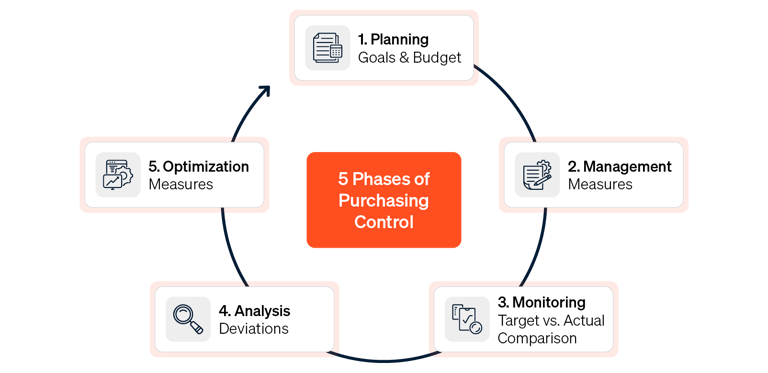
Purchasing controlling can be divided into two central areas: the strategic and the operational components. While strategic controlling ensures long-term alignment, operational controlling ensures smooth implementation in day-to-day business. Both levels are closely interlinked and essentialfor the holistic management of purchasing. Only when working together do they achieve their full impact.
At the strategic level, the focus is on setting the course for the future. This is where fundamental decisions are made that have a lasting impact on the performance and organization of procurement. The goal is to optimally align procurement with overarching corporate objectives and secure long-term competitive advantages. The controller acts as a sparring partner for managementin this context .
Operational controlling focuses on monitoring and managing daily procurement processes. It supports short- to medium-term planning and control to ensure efficiency and quickly identify deviations from targets. The data obtained here is an important indicator of the department’s performance and forms the basis for operational procurement.
To fulfill its strategic and operational tasks, procurement controlling draws on a broad spectrum of methods and tools. There is no single “perfect” tool; success lies in the intelligent combination of different approaches. The goal is always to extract actionable insights from a flood of data in order to improve procurement performance in a targeted manner. In practice, the use of the following tools has proven effective:
The tools used for this include simple Excel spreadsheets, but increasingly also professional BI (Business Intelligence) tools and specialized e-procurement platforms. Modern software solutions automate reporting and enable continuous, real-time monitoring—a decisive advantage over manual data maintenance.
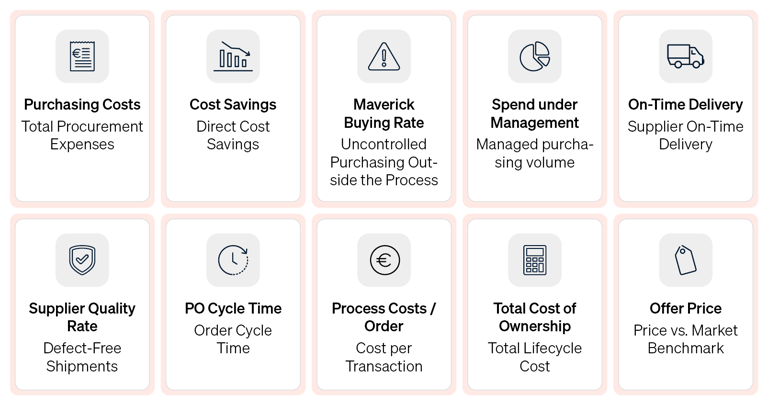
Key Performance Indicators (KPIs) are at the heart of any controlling system. They translate overarching goals into measurable metrics and make it possible to objectively evaluate the performance of the procurement function. But be careful: the goal is not to collect as much data as possible. What matters is selecting the right KPIs—those that actually provide meaningful insight into goal achievement and can serve as a basis for strategic decisions.
Measuring savings is the classic discipline in procurement controlling. A saving is typically calculated as the difference between an old price (baseline) and the newly negotiated price, multiplied by the quantity purchased. It is important to distinguish between “cost avoidance” (e.g., preventing a price increase) and “hard savings” (direct reductions that impact the budget).
Another key metric is the Total Cost of Ownership (TCO). This approach considers not only the purchase price itself, but also the total costs of a product over its entire lifecycle. This includes costs for logistics, storage, training, maintenance, and disposal. TCO analysis enables far more informed and cost-effective procurement decisions.
The Maverick Buying Rate measures the percentage of purchases made outside of official processes and framework agreements (“maverick buying”). A high rate is an indicator of a lack of process compliance and wasted savings potential, as economies of scale and negotiated terms are not being utilized. Reducing this rate is a clear efficiency goal.