![Andy Freund [Head of Growth & Customer Management]](https://simplesystem.com/hs-fs/hubfs/Autoren_Blog/Andy_Freund_autor.png?width=200&name=Andy_Freund_autor.png)
23.10.2026

![Andy Freund [Head of Growth & Customer Management]](https://simplesystem.com/hs-fs/hubfs/Autoren_Blog/Andy_Freund_autor.png?width=100&name=Andy_Freund_autor.png)

In today’s globalized economy, procurement departments face increasing cost pressures, complex supply chains, and growing risks. Simple cost savings are no longer enough to remain competitive. The strategic response to these challenges is digitalization in procurement. But what do buzzwords like “Procurement 4.0” really mean? This guide takes you from the definition, through the benefits and technologies, to a concrete implementation strategy for your digital transformation.
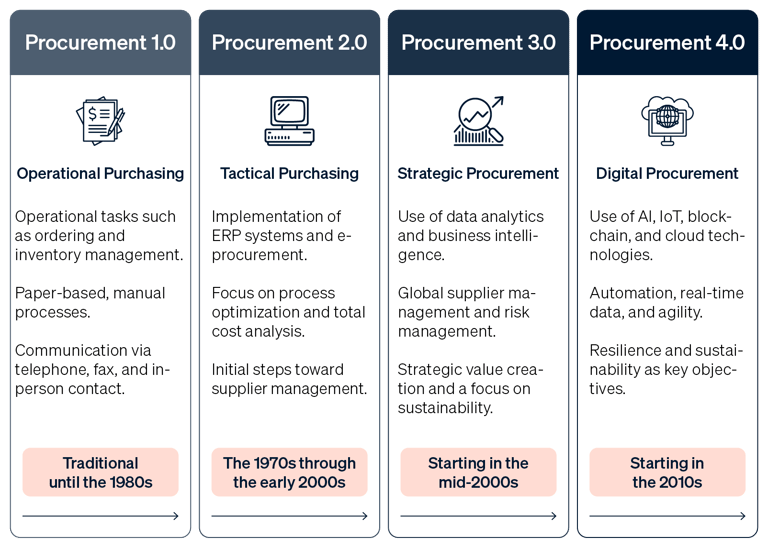
Digitalization in procurement, often referred to as Procurement 4.0, is far more than simply introducing e-procurement solutions. It involves a fundamental transformationof procurement, in which digital technologies and data-driven approaches are used to intelligently connect, automate, and optimize the entire procurement process—from demand identification to payment (procure-to-pay). At its core, the goal is to evolve procurement from a reactive, administrative function into a proactive, strategic value driver within the company. This development is closely linked to the concept of Industry 4.0 and applies its principles to procurement and supply chain management.
The question is no longer whether, but how quickly you will digitize your procurement. Companies that cling to outdated, manual processes not only risk higher costs but also fall behind the competition. Digital transformation enables procurement to fundamentally transform its role and create measurable added value for the entire company. The potential is enormous and spans several key areas:
We observe among our clients that the greatest leverage lies in taking a holistic view of processes. Digital transformation is not merely an IT project, but a strategic shift that encompasses culture, processes, and technology in equal measure. The goal is to establisha new, data-driven mindset throughout the entire procurement function.
The transformation to Procurement 4.0 is not the result of a single software tool. Rather ,it is the intelligent integration and orchestration ofvarious digital technologies that fundamentally reshape the procurement process. Each technology plays a specific role and only realizes its full potential when working in tandem with the others. The following technological building blocks form the backbone of digital procurement.
Modern e-procurement platforms are the foundation of every digitalization strategy in procurement. They digitize the entire procure-to-pay (P2P) process, from requisitioning through ordering and goods receipt to invoice verification and payment. By standardizing procurement processes, they create a unified database and ensure compliance with internal guidelines.
Key elements here include electronic catalogs, which provide employees with easy and compliant access to the agreed-upon product range. The entire ordering and approval workflow is digitized, which drastically reduces process costs and increases efficiency. Further information on the basics is available, for example, on the Mittelstand-Digital Center’s information portal.
While e-procurement systems generate the data, big data analyticsextract the true value from this treasure trove of data. By analyzing large volumes of data (spend analysis), you can recognize spending patterns, uncover savings potential, and identify maverick buying. You gain a 360-degree view of your procurement activities and create a transparent basis for decision-making.
Predictive Analytics takes this a step further: Based on historical data and external market information, algorithms can predict future price trends, demand, or potential supply chain risks. This enables proactive rather than reactive management and data-driven optimization of your negotiation strategies with suppliers.
Artificial Intelligence (AI) takes automation to a new, more intelligent level. Unlike purely rule-based systems, AI applications can learn and adapt to new circumstances. In strategic procurement, AI helps analyze unstructured data—such as contracts or request for proposal (RFP) documents—to automatically identify risks and opportunities.
In operations, AI-powered chatbots can answer employee inquiries, or algorithms can suggest the most suitable suppliers for a specific request. The use of AI is a key factor in makingprocurement intelligent —not just digital —and thus creating real added value for supply chain management.
RPA bots are digital “robots” specialized in performing highly repetitive, manual tasks by mimicking human interactions with software systems. A typical use case in procurement is the automatic transfer of data from a purchase order to an ERP system or the verification of invoices against purchase orders and goods receipts.
RPA relieves your employees of time-consuming routine tasks, reduces the error rate, and accelerates digital processes. It is a pragmatic technology for quickly achieving efficiency gains, particularly at interfaces between different systems that are not yet fully integrated and require manual data entry.
Although not yet widely adopted, blockchain technology offers enormous potential for the future of procurement. Its strength lies in the creation of a decentralized, tamper-proof database. It enables seamless traceability of products throughout the supply chain, which is particularly crucial for ensuring proof of origin or quality standards.
In addition, so-called smart contracts can automate the processing of transactions. Payments are triggered automatically as soon as predefined conditions (e.g., receipt of goods) are met and recorded on the blockchain. This technology significantly increases security and efficiency in supplier management and minimizes the risk of fraud or errors.
The digital transformation of procurement is not a sprint, but a strategic marathon. A structured approach is the key to success in managing complexity and reliably achieving your goals. The following roadmap, divided into five logical phases, serves as a proven guide for implementing digitalization in your procurement department. It ensures that technology adoption and organizational change go hand in hand.
Every transformation begins with an honest assessment of the current state. Conduct a detailed analysis of your current procurement processes, systems, and capabilities. Where do you stand in terms of digitalization? A spend analysis reveals what you’re spending your money on and with whom. Based on this, define a clear target state: What specific, measurable goals (KPIs) do you want to achieve through digitalization? Secure top management’s commitment to this vision—it is the foundation for the entire transformation.
A common mistake is purchasing software before the processes have been clarified. The guiding principle is: Process before Technology. Analyze and optimize your existing procurement processes before digitizing them. Eliminate redundant steps and design workflows to be lean and efficient. Only then should you select the appropriate digital technologies that optimally support your redesigned processes. Pay particular attention to integration capabilities and interfaces with existing systems, such as your ERP.
Avoid a “big bang” approach where everything is changed all at once. Instead, start with a manageable pilot project in a selected area, such as a specific product category or department. This allows you to test the chosen solution in practice, gather valuable feedback from users, and iron out any teething problems. These agile learning experiences are invaluable for the subsequent, phased rollout across the entire company.
The introduction of new technologies is, above all, a cultural shift. Even the best software is useless if employees don’t embrace it. Professional change management is therefore essential. Communicate the goals and benefits of the transformation transparently, involve your employees early on, and take their concerns seriously. Invest in targeted training to build the necessary digital skills within the team and foster acceptance of the new processes and digital tools.
Digital transformation does not end with the go-live. Establish a process of continuous improvement. Use the data gained through digitization to continuously monitor and analyze the performance of your procurement function. Identify further opportunities for automation, optimize your strategies, and scale successful initiatives. This will ensure that your procurement function remains agile and continues to build its strategic value over the long term.