09.04.2026

Strategic Supplier Segmentation: Optimizing Your Supply Chain

Fabian von Kleinsorgen VP Growth & Sales Operations
Supplier Segmentation ✔ A Strategic Guide to Your Supplier Management

Does your company manage hundreds or even thousands of suppliers? Then you know: not every supplier has the same strategic importance for your success. While some are indispensable for operations, others merely supply interchangeable standard products.

The assumption that all suppliers must be treated equally is a widespread but costly misconception. It leads to inefficient processes, untapped savings potential, and increased supply chain risk. The solution lies in a systematic approach: strategic supplier segmentation. This guide shows you how to effectively structure your supplier base and take your supplier management to the next level.

What is supplier segmentation?
A definition

Supplier segmentation is a strategic process in procurement and supply chain management in which a company's entire supplier base is divided into different groups or segments. This categorisation of suppliers is carried out based on predefined criteria such as purchasing volume, supply risk, strategic importance to the company, or innovation potential. The goal is no longer to manage all suppliers according to a one-size-fits-all principle, but to develop an appropriate management and development strategy for each segment. This approach enables differentiated control of supplier relationships and a more targeted use of resources.

Why is strategic segmentation of your suppliers indispensable?

The transition from reactive, administrative procurement to proactive, value-adding partner management is hardly conceivable without well-thought-out segmentation. It forms the foundation for effective supplier management (SRM) that goes far beyond mere ordering. By understanding which supplier holds which significance, you can precisely align your strategy and achieve significant competitive advantages. The benefits are diverse and directly impact your company's efficiency and resilience.

  • Focusing resources: Not every supplier requires the same attention. Through segmentation, you can specifically focus your time and personnel on cultivating relationships with strategic partners, while minimising the effort for transactional suppliers through automation.
  • Effective risk management: Segmentation helps you identify suppliers with high supply risk (e.g., monopolists for critical components). This allows you to take proactive risk mitigation measures, such as establishing secondary suppliers or developing contingency plans. This strengthens the resilience of your entire supply chain.
  • Optimisation of supplier relationships: You can develop tailored strategies for collaboration. While close cooperation in innovation and development is the focus for strategic partners, leverage suppliers primarily involve optimising prices and conditions. Differentiated supplier relationship management leads to better results for both sides.
  • Increasing efficiency and cost savings: By adapting procurement processes to the respective segment, you reduce administrative effort. Automated ordering platforms are suitable for C-parts from routine suppliers, while strategic goods require intensive negotiations and joint planning processes. This not only leads to efficiency gains but also to direct cost savings.
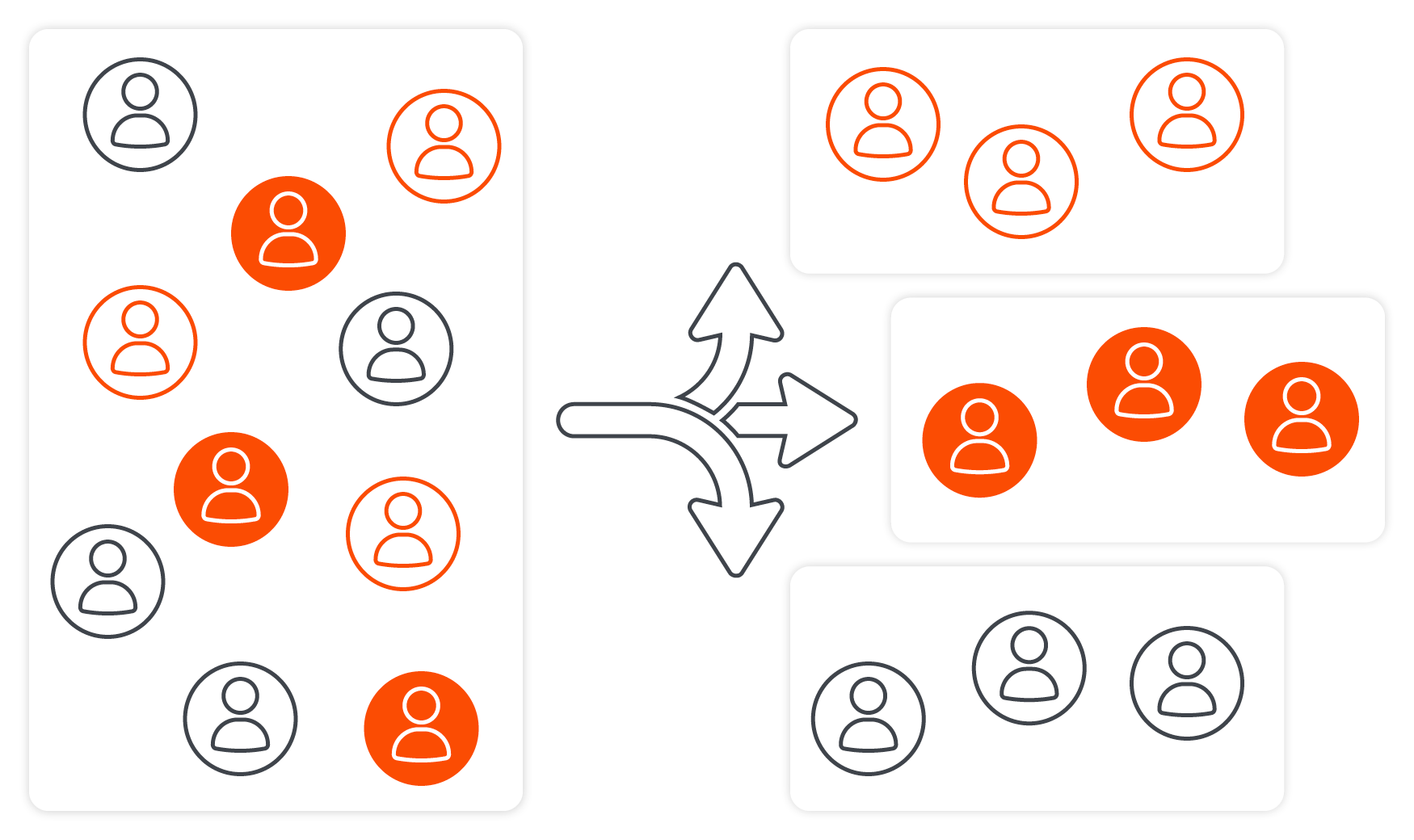
Infographic showing the process of supplier segmentation from an unsorted group to classified supplier categories.

The supplier segmentation process: A guide in 4 steps

Successful supplier segmentation is not a one-time project, but a dynamic process that must be regularly reviewed and adjusted. It can typically be divided into four clearly defined phases. A systematic approach ensures that the segmentation of suppliers is based on valid data and supports the strategic goals of your company.

Step 1: Define objectives and collect data

Before you begin the actual analysis, you need to clearly define the objectives of your segmentation. What do you want to achieve? Is it primarily about minimising risks, realising cost savings, fostering innovation, or a combination thereof? These objectives determine which criteria are relevant for the classification. The next step is to collect the necessary supplier data. A comprehensive spend analysis is often the starting point here.

It provides information on how much money you spend with each supplier. Other important data points include delivery performance (e.g., delivery reliability, quality), contractual conditions, certifications, and audit ratings. The quality of your segmentation stands and falls with the quality and completeness of your data. A clean, centralised database is therefore an essential prerequisite for the entire process.

Step 2: Select a segmentation model and define the criteria

Once the database is in place, you need a structured model to categorise your suppliers. The choice of model depends on the previously defined objectives. For an initial, simple prioritisation, the ABC analysis can serve, which often classifies suppliers according to the Pareto principle: a small portion of suppliers (A-suppliers) is responsible for a large part of the purchasing volume. However, this approach is one-dimensional and neglects critical factors such as supply risk.

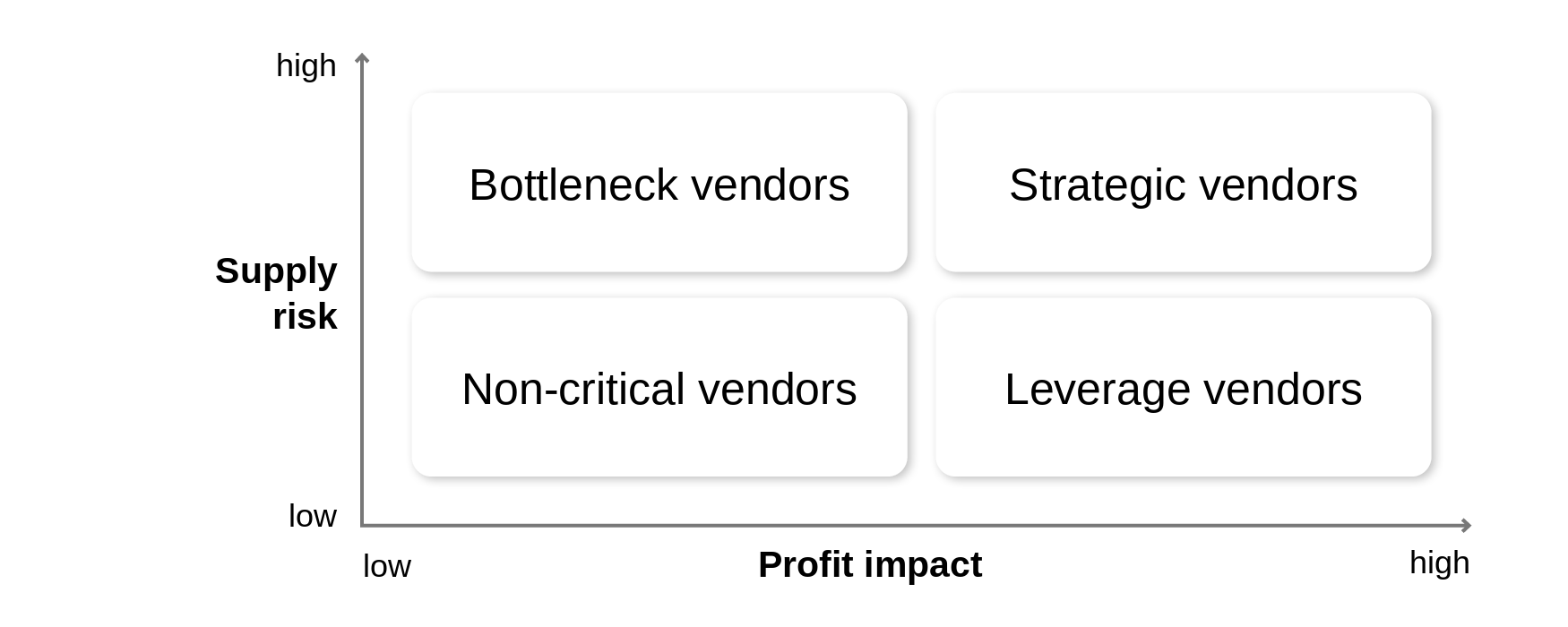
For a strategically sound segmentation, the Kraljic matrix has established itself as the gold standard. This model evaluates suppliers based on two decisive dimensions:

  • Profit impact / strategic importance: How strongly does the procured good affect the profitability or quality of the end product? Factors such as purchasing volume, value contribution to the margin, and differentiation in the market play a role here.
  • Supply risk/complexity of the procurement market: How difficult is it to procure the good? Criteria here include the number of available suppliers, logistical complexity, monopoly positions, or market volatility.
The Kraljic matrix with the four quadrants: Strategic suppliers, leverage suppliers, bottleneck suppliers, and routine suppliers, divided according to the axes of supply risk and profit impact.

From the combination of these two axes, four segments emerge that enable clear prioritisation and strategic alignment: leverage, strategic, routine, and bottleneck suppliers. For a detailed examination of this model, we recommend our in-depth article on the Kraljic matrix.

Step 3: Analyse and assign suppliers

In this phase, the actual operational assignment of suppliers to the defined segments takes place. Evaluate each relevant supplier based on the criteria of your chosen model. This process requires a careful analysis of the collected supplier information and should ideally not be carried out by procurement alone. Involve experts from other departments such as production, quality assurance, and research & development to ensure a holistic and precise evaluation. This not only correctly assesses the criticality of components but also takes into account the innovation potential of a supplier.

The evaluation of risks is becoming increasingly important. Legal requirements such as the German Supply Chain Due Diligence Act (LkSG) require an even more precise analysis of supplier risks, particularly with regard to human rights and environmental standards along the supply chain. While the assignment can still be done manually in tables for a small supplier base, the use of SRM software or e-procurement platforms is essential for hundreds or thousands of suppliers. Such tools automate data collection and analysis, ensure consistent evaluations, and make segmentation traceable and dynamically adjustable.

Step 4: Develop and implement segment-specific strategies

Segmentation is not an end in itself. Its true value unfolds only through the derivation and implementation of tailored strategies for each segment. The goal is to deploy resources in a targeted manner and optimise relationships with key suppliers, while minimising the effort for non-critical suppliers. For the four quadrants of the Kraljic matrix, the following action strategies typically emerge:

  • Strategic suppliers (build a partnership): These suppliers are critical to success. Here, the goal is to build long-term, collaborative partnerships. Invest in joint development projects, close process integration, and regular strategic alignment. The management of these relationships falls to the top management level.
  • Leverage suppliers (utilise competition): With these suppliers, you have a strong negotiating position due to low supply risk and high purchasing volume. Use this leverage through regular tenders, volume bundling, and tough price negotiations to achieve cost savings.
  • Bottleneck suppliers (secure supply): The main focus here is on ensuring availability. Examine measures such as building up safety stocks, qualifying secondary suppliers (second sourcing), or standardising components to reduce dependency and minimise risk.
  • Routine suppliers (automate processes): For these suppliers with low risk and low value contribution, process efficiency is the priority. The goal is maximum automation of ordering and processing operations, e.g., through the use of e-procurement systems, catalogs, or P-cards, to drastically reduce administrative effort.

Conclusion

Moving away from the watering-can principle in supplier management is much more than an organisational measure. It marks the decisive step from a pure administrative function to strategic value creation. Those who view their suppliers in a differentiated way not only gain cost advantages but, above all, create one thing: focus.

By automating routine tasks and specifically investing resources in success-critical partnerships, you strengthen the innovative power and resilience of your company. Dynamic segmentation is therefore the navigation system that safely steers you through the complexity of global markets. Begin structuring your supplier base and turn your procurement into a real competitive advantage.

Fabian von Kleinsorgen VP Growth & Sales Operations
Learn more about Fabian
Fair. Transparent. Honest.

Try it free for 90 days!

No risk, no obligation, no payment details required.

Experience the entire platform – from your first shopping cart to the automated invoice. Discover how easy digital shopping can really be.