![Fabian von Kleinsorgen [VP Growth & Sales Operations]](https://simplesystem.com/hs-fs/hubfs/Autoren_Blog/Fabian_vin_kleinsorgen_autor.png?width=200&name=Fabian_vin_kleinsorgen_autor.png)

09.09.2026

![Fabian von Kleinsorgen [VP Growth & Sales Operations]](https://simplesystem.com/hs-fs/hubfs/Autoren_Blog/Fabian_vin_kleinsorgen_autor.png?width=100&name=Fabian_vin_kleinsorgen_autor.png)

They exist in every company: the countless small and irregular purchases that are made outside of strategic procurement. This expenditure, often referred to as "tail spend", quickly adds up to a considerable cost factor and harbors hidden risks. Many purchasing departments focus on the large contracts and overlook the enormous potential that lies in optimizing this C spend. However, effective tail spend management is not rocket science, but a decisive lever for greater efficiency, compliance and significant cost savings across your entire procurement.
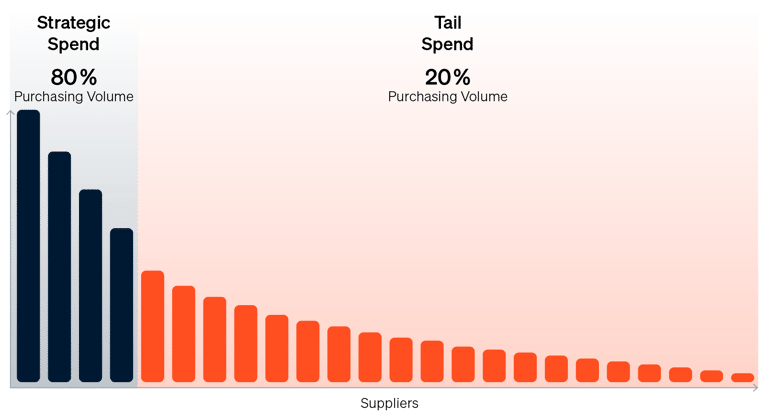
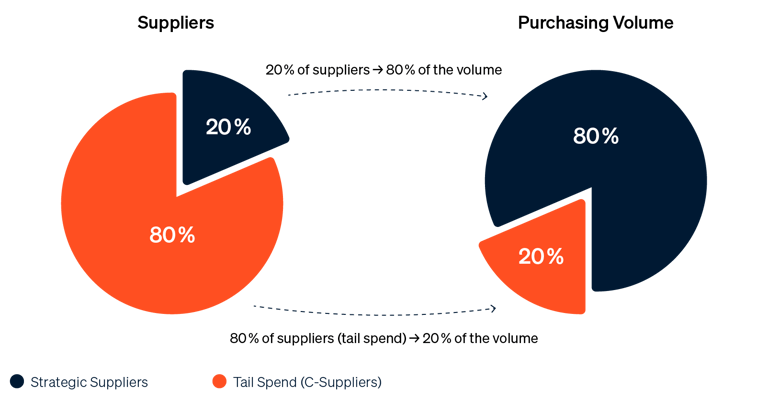
Tail spend management refers to the strategic management and control of an organization's spend that has a high volume of transactions but a low value per transaction. The term is derived from the " long tail" of spend analysis, which is often based on the Pareto principle, also known as the 80/20 rule. While 80 % of the purchasing volume comes from only 20 % of suppliers (A and B suppliers), the remaining 20 % of the volume is distributed among 80 % of suppliers. This confusing area of C-suppliers and one-off purchases is the tail spend. Targeted management of this spend aims to bundle, standardize and control it in order to reduce process costs and increase transparency.
At first glance, the individual low-value orders may seem harmless. However, in aggregate, tail spend turns out to be a source of significant inefficiencies and risks. Without strategic management, many companies face the same challenges.
Effective tail spend management requires a structured approach. It is about regaining control over the countless small expenses and making them more efficient. The following strategic pillars are central to this.
The first step is to bring light into the darkness. Gather data from all available sources - credit card statements, expense reports, invoices - to understand your spending patterns. A thorough spend analysis will help you identify the categories, departments and suppliers that account for the majority of your tail spend. This data transparency is the basis for all further optimization measures.
The key to reducing high process costs lies in automation. Instead of processing every transaction manually, you should rely on digital solutions. As the BME barometer for electronic procurement shows, companies are increasingly investing in e-procurement in order to streamline processes. A central platform with guided approval processes ensures that every order is processed in a compliant and efficient manner.
The high number of C-suppliers is a key driver of inefficiency. The aim of supplier management in Tail Spend is to drastically reduce the number of active suppliers. Bundle your demand and channel it to a smaller group of preferred suppliers or a marketplace provider. This not only simplifies the operational process, but also strengthens your negotiating position.
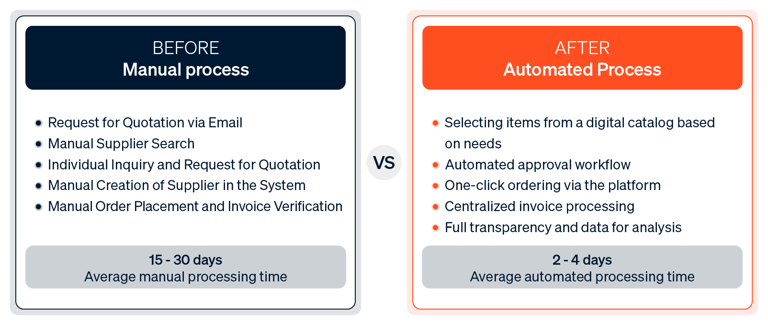
The theory is clear, but operational implementation is a challenge for many companies. Managing thousands of transactions from hundreds of suppliers cannot be done manually. This is where modern e-procurement platforms come into play, acting as the central nervous system for your tail spend management.
Such a platform offers a simple purchasing experience similar to Amazon Business, but with the full control and compliance of a professional procurement system. Employees can order from approved catalogs while the system ensures compliance with procurement guidelines in the background. The entire process from request to payment is digitized and automated, reducing administrative effort to a minimum. Discover how you can regain full control of your procurement solutions with a central platform like simple system.
To reap the full benefits of Tail Spend Management, we recommend a step-by-step implementation based on data analysis, technology and continuous improvement.
Managing tail spend is much more than an administrative chore. It is a strategic task which, if implemented correctly, can unleash enormous potential. By transforming uncontrolled expenditure into a structured and transparent process, you not only increase efficiency, but also ensure compliance and achieve sustainable cost savings. The key to success lies in the combination of three elements: Transparency through data analysis, automation through technology and control through standardized processes. Start optimizing this often neglected area of your procurement today.