![Fabian von Kleinsorgen [VP Growth & Sales Operations]](https://simplesystem.com/hs-fs/hubfs/Autoren_Blog/Fabian_vin_kleinsorgen_autor.png?width=200&name=Fabian_vin_kleinsorgen_autor.png)
13.10.2026

![Fabian von Kleinsorgen [VP Growth & Sales Operations]](https://simplesystem.com/hs-fs/hubfs/Autoren_Blog/Fabian_vin_kleinsorgen_autor.png?width=100&name=Fabian_vin_kleinsorgen_autor.png)

Hidden costs in a company are like small leaks in a ship: Taken individually, they seem insignificant, but collectively they can jeopardize the course. Nowhere is this more evident than in procurement process costs. While the focus is often on the raw material price, the costs of the procurement process itself often remain hidden and quietly erode your margin—especially in indirect procurement.
This guide shows you how to uncover these invisible cost drivers, analyze them systematically, and reduce them sustainably. We’ll walk you through the process—from definition and calculation to proven strategies—that will help you procurement more efficiently and free up valuable resources for strategic tasks.
Process costs in purchasing encompass all costs incurred through the administrative and operational processing of a purchase order, regardless of the value of the goods themselves. They are part of the total procurement costs but are often overlooked because they do not appear on the supplier’s invoice. Instead, they are incurred internally within the company and tie up personnel and system resources.
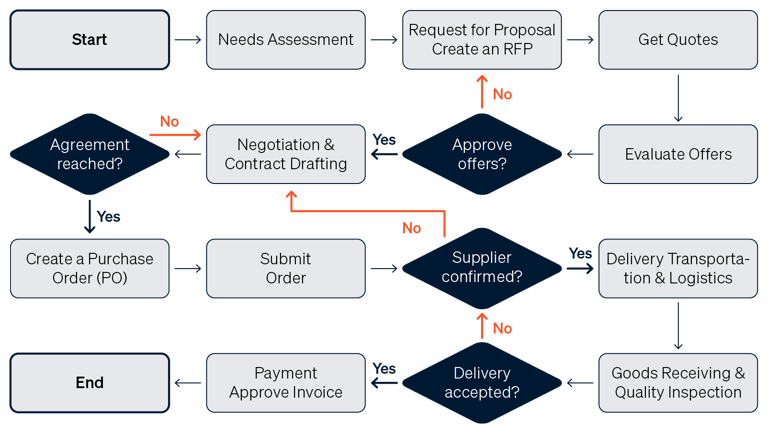
These costs associated with individual processes range from demand planning to supplier selection, placing the order, monitoring the delivery, and receiving the goods, all the way to invoice verification and approval. Each of these process steps requires personnel and time , representing a measurable cost component.
The real inefficiency is often hidden in unstructured and manual workflows, which have a particularly significant impact when procuring low-value items—so-called indirect purchasing. Here, process costs quickly exceed the actual order value. To realizecost-saving potential, you must first identify the primary cost drivers.
Typical cost drivers in the process chain include:
To reduce process costs, you must first measure them. Activity-Based Costing (ABC) is the method of choice for this. It allows you to allocate costs to individual activities based on who generated them. Even a simplified calculation can already provide significant transparency.
Follow these steps to determine the costs per order:
This approach reveals the true costs of an order and shows where the greatest potential for optimization lies.
Analysis is the first step; implementation is the second. Controlling and reducing process costs is achieved through a combination of organizational and technological measures. The greatest potential for improvement lies in digitalization, as it automates manual tasks and creates standardized, efficient workflows for comprehensive procurement optimization.
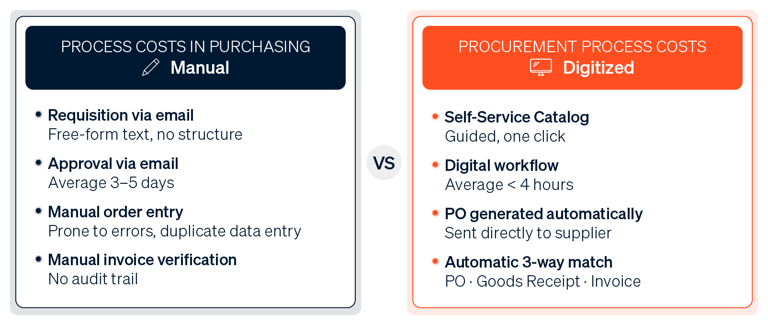
By automating routine tasks, your procurement professionals gain valuable time that they can devote to strategic tasks such as supplier development, negotiations, or risk management. The optimization of procurement processes is a key lever, as confirmed by the Fraunhofer Institute for Material Flow and Logistics (IML) in its research.
By integrating your systems, you can achieve a seamless process chain without data silos. Learn how to fully digitize your procurement.
A centralized e-procurement platform is the most effective tool for reducing process costs. It consolidates all procurement-related activities in one place and automates time-consuming process steps. Instead of manually managing requests, orders, and invoices, these processes run through defined digital workflows.
This is also evident in practice: By digitizing its procurement process with simple system, our client—a medium-sized machinery manufacturer—was able to reduce its process costs by 45% and cut the turnaround time per order from 30 minutes to less than 5 minutes. This not only generates cost savings but also improves service quality for internal users.
High process costs in procurement do not have to be accepted. They are the direct result of inefficient, often historically evolved workflows. The key to sustainable cost reduction lies in a three-pronged approach: Analyze your existing processes, optimize your workflows through standardization, and digitize your entire process chain. This is how you transform your procurement from a cost center into a strategic value driver for your company.