09.11.2026


Twenty suppliers, twenty online stores, twenty logins, and at the end of the month, a stack of invoices that no one can match to an order. This is what the procurement process looks like in many medium-sized companies. This guide shows where time is being wasted, what solutions are available, and how you can consolidate your orders into a single process in five steps—without giving up a single supplier.
Optimizing a procurement process means routing all orders through a single channel. Instead of placing orders individually through multiple supplier online stores, integrate your existing suppliers—along with their catalogs and terms—into a procurement platform. There, you’ll have a single shopping cart, fixed approval rules, and an interface to accounting.
The most important points at a glance:
At simple system, Andy Freund works with procurement teams at midsize companies that are exactly at this stage. In this article, you’ll learn how to identify an overburdened ordering process, how the seven phases of the procurement process are interconnected, and which solution approach fits your situation.
Optimizing the procurement process means designing every step—from identifying a need to making payment—so that it takes less time, is transparent, and runs smoothly without any gaps in the workflow. In indirect procurement, the greatest leverage rarely lies in the item price, but rather in the number of ordering channels and manual steps involved.
Definition: Optimizing the procurement process refers to the analysis, simplification, and digitization of all steps from the request for procurement to payment, with the goal of reducing lead time, process costs, and errors in procurement.
In indirect procurement—such as office supplies, tools, occupational safety equipment, IT accessories, or replacement parts—individual order amounts are small and the number of orders is high. That is precisely why every minute saved per transaction is worthwhile here. Our article on procurement management describes how the procurement function is structured overall.
An ordering process is overburdened when the procurement team spends more time following up, sorting, and correcting errors than dealing with suppliers and terms and conditions. These symptoms almost always appear first:
If three of these points apply, the problem lies not with individual people but with the structure. According to the study “Managing Indirect Procurement” by HTWK Leipzig, around 40% of companies in indirect procurement still use tools like Excel, which are not designed for this task.
Chaos arises because each supplier’s online store works well on its own, but none of them are connected to the others. Twenty online stores mean twenty logins, twenty customer accounts, twenty invoice formats, and twenty places where order history is stored.
For the individual buyer, this is convenient. For procurement and accounting, it’s like flying blind. No approvals are required, no budgets are checked, and terms from the master agreement only apply if someone places an order using the correct account.
Key Fact: According to HTWK Leipzig (Prof. Dr. Holger Müller, 2025), a reference company with 2,500 orders, 3,000 goods receipts, and 3,000 incoming invoices per year spends approximately 5,600 hours on indirect materials, at an average of 38 minutes per order.
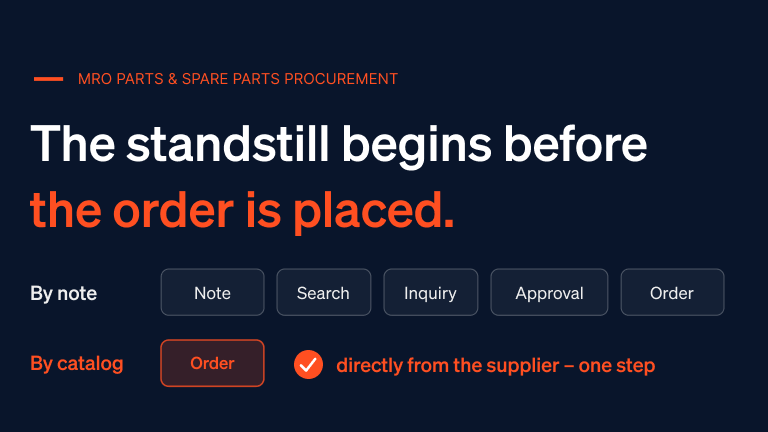
The solution, therefore, is not to eliminate suppliers. The solution is to replace the many ordering channels with a single one through which all suppliers remain accessible. The following comparison shows exactly what changes as a result.
|
Process Step |
Before: Many supplier web stores |
After: one procurement platform |
|---|---|---|
|
Search for items |
individually in each online store, with a separate login for each supplier |
A single search across all connected suppliers |
|
Compare prices |
Open tabs side by side, recall terms and conditions from memory |
Customer prices from the master agreement directly in the catalog |
|
Approval |
Email to supervisor, wait for response |
Rule applies automatically based on amount, product category, or cost center |
|
Order |
A separate checkout for each online store |
One shopping cart; items are automatically allocated to suppliers in the background |
|
Invoice |
Formats and delivery methods vary by supplier |
Electronic and linked to the order |
|
Overview |
Distributed across customer accounts and mailboxes |
One order history for the entire company |
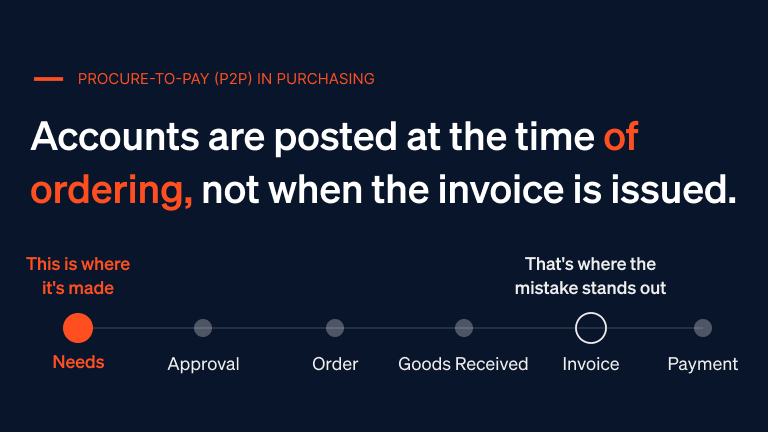
The operational procurement process in indirect purchasing consists of seven phases that are interconnected as part of the purchase-to-pay process: from identifying needs to payment. Each phase has a typical bottleneck and a digital lever.
|
Phase |
Typical Bottleneck |
Digital Lever |
|---|---|---|
|
1. Demand Identification |
Requests are submitted verbally or via email |
Orders placed directly from approved catalogs |
|
2. Supplier selection |
Everyone orders from suppliers they’re familiar with |
Pre-selected suppliers with pre-set terms and conditions |
|
3. Ordering |
One checkout per online store |
One shopping cart for all suppliers |
|
4. Approval |
Waiting period in the inbox |
Rules based on value threshold, product category, cost center |
|
5. Delivery and Goods Receipt |
Delivery note without a clear order reference |
Digital entry with reconciliation to the order |
|
6. Invoice Verification |
Manual assignment of each invoice |
Automatic reconciliation of purchase order, goods receipt, and invoice |
|
7. Payment |
Cash discounts expire; payments are delayed |
Transfer to ERP or accounting; timely payment |
The biggest time drain usually occurs in Phase 4. Our guide to the approval workflow in purchasing. The article on Procure-to-Pay provides a more in-depth look at the relationship between Phases 5 through 7 .
There are essentially four approaches to consolidating orders from multiple suppliers. They differ primarily in whether you retain your existing suppliers and in the amount of implementation effort required.
|
Approach |
How it works |
Existing Suppliers |
Suitable if … |
|---|---|---|---|
|
Retailer Marketplace |
Platform operators or retailers sell their own broad product range |
only if they sell on the marketplace |
They have few established suppliers and are primarily looking for a wide product range |
|
Neutral Procurement Platform |
Your suppliers are connected via a catalog or punchout; the platform itself does not sell anything |
Yes, with your own terms and conditions |
You want to keep your suppliers and consolidate your ordering processes |
|
Source-to-Pay Suite |
Covers not only ordering but also tenders, contracts, and supplier management |
Yes |
You want to digitize both operational and strategic procurement |
|
Procurement module in the ERP |
Purchase requisitions directly in the ERP; catalogs via interfaces |
Yes, often via additional integrations |
Your ERP is already centralized and is used by a small number of designated purchasers |
For the scenario “many supplier web stores, no overview,” the key question is: Do you want to switch suppliers or just simplify the process of ordering from them? If you’ve negotiated good terms with your regular suppliers, you don’t need a new vendor—you need shared access to the ones you already have. You can find an overview of specific providers in our e-procurement software comparison.
Tip: Ask every procurement platform provider whether your ten most important suppliers are already integrated and who will handle the integration of new suppliers. This answer determines the implementation effort more than any list of features.
A consolidated ordering process is established in five steps: assessment, supplier prioritization, integration, rules, and connection to the ERP. For the first steps, you don’t need an IT project—just an afternoon with your invoices from the past twelve months.
List all suppliers from whom you placed orders in the past year, and note the ordering method for each one: online store, email, phone, credit card. The accounts payable list from your accounting department is the quickest place to start. The result is an honest figure: that’s how many different channels currently lead into your company.
Sort the list by order frequency, not just by revenue. A supplier that generates ten small orders every week creates more work than one with a single large annual order. The rarely used suppliers at the bottom of the list are your tail spend. You’ll need a controlled, simple ordering process for them later on—not a separate framework agreement.
The most frequent suppliers are connected first, either via a catalog containing your customer prices or via punchout. With the OCI punchout integration, the buyer is redirected from the platform to the supplier’s online store, adds items to the shopping cart, and transfers the cart back to the platform. The online store thus remains in place; only the ordering process becomes centralized.
Specify the threshold amount, product categories, and cost centers for which approval is required. Orders below these thresholds from approved catalogs are processed immediately. This also prevents maverick buying, because the official route is faster than the workaround.
Connect the platform to your ERP or accounting system so that orders, cost centers, and invoices are imported automatically without manual data entry. Then regularly track a few key metrics:
In indirect procurement, the costs of the ordering process often exceed the value of the goods ordered. According to surveys, a manually processed order costs around 146 euros, while a digitally processed order costs around 86 euros. The difference of 60 euros applies to every single order, regardless of whether a package of cable ties or a laptop is ordered.
That’s why a discount of just a few percent on the item price yields less benefit for small orders than a streamlined process. Our article on the Processing Costs per Order.
simple system is a neutral procurement platform for indirect purchasing: It consolidates your existing suppliers in one place without acting as a retailer itself. There are no private labels and no proprietary product range that is given preferential display.
The use case below shows how companies with multiple parallel procurement channels can implement this change in practice Centralizing Procurement.
Bundle your ordering channels on a neutral platform and keep your suppliers and terms. Try simple system free for 30 days, no payment details required.
If you checked fewer than four boxes: Then your greatest leverage isn’t in the next price negotiation, but in the ordering process.
The procurement process in indirect purchasing isn’t accelerated by more control, but by fewer ordering channels. Those who consolidate their existing suppliers on a neutral procurement platform retain their terms and partners, but gain a clear overview, fixed approval rules, and invoices linked to orders. The first step is an honest assessment: How many different ordering channels are currently in use?
Tell us your key suppliers and we’ll show you which ones are already connected to simple system. You’ll also see what your ordering process could look like after the first two weeks.
You get an overview when all orders run through a single channel. A procurement platform connects your existing suppliers via catalog or punchout, so employees can search, order and request approval in one place. Purchasing sees all orders in one history.
No. With a neutral procurement platform, your existing suppliers and their terms stay in place. Only reseller marketplaces with their own product range require you to buy wherever the marketplace offers the goods.
An OCI punchout connection links a procurement platform or an ERP system to a supplier’s webshop. The buyer switches from their own system to the supplier webshop, fills the shopping cart there and transfers it back with prices and item data, where approval and ordering are handled centrally.
Whether a procurement platform pays off depends less on headcount than on the number of ordering channels. As soon as you regularly order from more than a handful of suppliers through different webshops and nobody knows the total spend, the process effort usually exceeds the cost of a platform.
The operational procurement process has seven phases: demand identification, supplier selection, ordering, approval, delivery and goods receipt, invoice verification, and payment. Together they form the purchase-to-pay process.
Five KPIs show the impact: the share of orders placed through the platform, lead time from requisition to order, invoices without a purchase order reference, the number of active suppliers, and process costs per order.