![Andy Freund [Head of Growth & Customer Management]](https://simplesystem.com/hs-fs/hubfs/Autoren_Blog/Andy_Freund_autor.png?width=200&name=Andy_Freund_autor.png)

09.09.2026

![Andy Freund [Head of Growth & Customer Management]](https://simplesystem.com/hs-fs/hubfs/Autoren_Blog/Andy_Freund_autor.png?width=100&name=Andy_Freund_autor.png)

In most companies, the focus of the purchasing department is clearly on optimizing direct procurement - i.e. the purchase of raw materials and components that flow directly into production. But what about all the other expenses? Office supplies, IT services, marketing, business travel - these items, known as indirect procurement, often make up a significant proportion of total expenditure but are strategically neglected. It is precisely here that an enormous, often untapped potential for increasing efficiency and reducing costs lies dormant.
This comprehensive guide will show you why indirect purchasing is a strategic goldmine for your company. We explain the fundamental differences to direct procurement, highlight the typical challenges and provide you with practical strategies that you canuse to optimize your indirect procurement, sustainably reduce costs and professionalizeyour procurement processes.
Indirect procurement refers to the procurement of all goods and services that are necessary for the daily operations of a company but are not directly incorporated into the end product or service for sale. Indirect procurement therefore supports internal processes and general business activities rather than contributing directly to value creation in the supply chain.
In order to fully grasp the strategic importance of indirect procurement, it is essential to clearly differentiate it from direct procurement. Although both areas pursue the goal of procuringrequired goods and services, they differ fundamentally in their function, their influence on the core business and the associated processes. A clear understanding of these differences is the first step to optimizing your overall procurement strategy.
Direct purchasing includes all materials, components and services that are directly required for the production process and therefore flow directly into the end product. These purchases have a direct influence on the production costs (cost of goods sold, COGS) and the quality of the final product. Errors or bottlenecks in direct procurement can bring production to a standstill.
Incontrast, indirect procurementfocuses on the acquisition of resources that keep business operations running. While these purchases are essential to the organization, they are not part of the end product. The challenge here often lies in the variety of categories, the high number of low-value orders and the decentralized nature of procurement, which makes the entire procure-to-pay process complex.
The diversity of goods and services is one of the most defining characteristics of indirect procurement. While direct procurement focuses on an often manageable number of strategic commodities, indirect procurement encompasses a wide range of requirements across all departments of a company. This range makes centralized management and bundling of requirements particularly challenging.
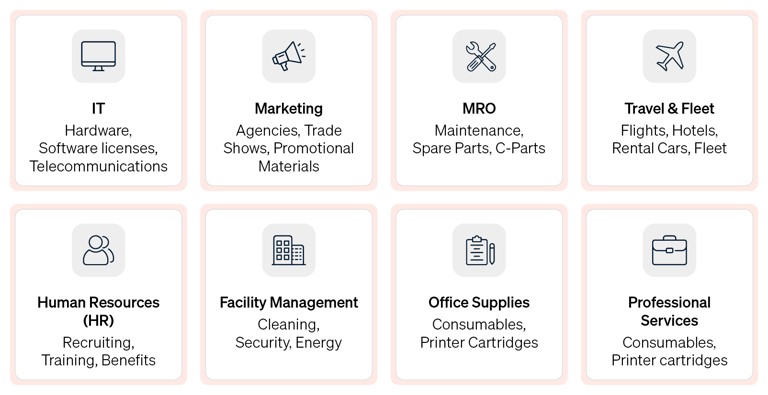
To give you a better overview, we have summarized the most important categories of indirect procurement:
This diversity means that indirect spend is often highly fragmented and carried out by many different employees without central coordination. It is precisely this characteristic that is at the root of the typical problems faced by companies in this area.
Although there is considerable potential for savings in indirect procurement, specific challenges often prevent their realization. Strategic neglect leads to inefficient processes, a lack of transparency and unnecessarily high costs. In order to optimizeyour indirect procurement, you must first recognize and understand these hurdles.
Taken together, these factors make it difficult to effectively manage indirect procurement and prevent companies from realizing the full benefits of a strategically aligned procurement system.
The good news is that each of these challenges can be overcome with the right strategic approach. Instead of viewing indirect procurement purely as a cost factor, you should see it as a strategic area that can be actively shaped. Successful management of indirect procurement aims to increase efficiency, reduce costs and minimize compliance risks. The following best practices have proven to be particularly effective in practice.
The most effective lever against maverick buying and fragmented spending is the centralization of purchasing activities. By bundling responsibility for indirect purchasing in one department or defining clear responsibilities, you create a central control body. This can consolidate requirements across departments, use the entire purchasing volume to negotiate better conditions with suppliers and drastically reduce the number of ordering processes. The result is a significant reduction in costs and administrative effort.
Managing countless small orders manually is almost impossible. This is where digital solutions come into play. Modern procurement software or an e-procurement platform automates and standardizes the entire procurement process. Employees order from pre-approved digital catalogs at negotiated prices, approval processes are automated and all expenditure is recorded digitally. This not only creates maximum transparency, but also significantly reduces the process costs per order and gives your procurement team more time for strategic tasks.
Instead of an unmanageable number of suppliers, you should maintain a consolidated and strategically selected supplier base. Active supplier management involves the systematic selection, evaluation and development of your partners. By negotiating framework agreements with preferred suppliers, you not only secure better prices and conditions, but also ensure quality and delivery reliability. This is a decisive step towards minimizing procurement risks.
Without clear rules, any attempt at control is doomed to failure. Define a binding purchasing guideline that specifies who may order what, how and from whom. This structured process must be known to all employees and consistently enforced. Clear guidelines for approval workflows, value limits and the use of the e-procurement platform are essential in order to curb uncontrolled purchasing. A strategically aligned procurement process is becoming increasingly important for the competitiveness of companies.
Implementing new strategies is only half the battle. In order to prove the success of your optimization measures and drive continuous improvements, you need data-supported performance measurement. Key performance indicators (KPIs) make progress in indirect procurement management transparent and provide management with convincing arguments for the strategic importance of procurement.
Selecting the right KPIs helps you to focus on the key objectives: reducing costs, increasing efficiency and minimizing risk. Instead of getting lost in the details, you should concentrate on a few, but meaningful KPIs.
The following five KPIs have proven to be fundamental for managing indirect purchasing:
Systematically recording and analyzing these key figures is crucial. For an even deeper analysis of success measurement, we recommend our further article, which deals specifically with the most important procurement KPIs. The data obtained forms the basis for the continuous development of your procurement strategies and helps the procurement team to make data-driven decisions.