![Michael Petri [CEO]](https://simplesystem.com/hs-fs/hubfs/Autoren_Blog/Michael_Petri_autor.png?width=200&name=Michael_Petri_autor.png)

09.09.2026

![Michael Petri [CEO]](https://simplesystem.com/hs-fs/hubfs/Autoren_Blog/Michael_Petri_autor.png?width=100&name=Michael_Petri_autor.png)

In strategic procurement and supply chain management, precision and clarity are crucial to success. But the world of procurement is full of acronyms that can pose challenges even for experienced managers. The terms RFI, RFP, and RFQ, in particular, often cause confusion. When do you use a request for information, and when do you use a request for proposal? What exactly are the differences between RFI, RFP, and RFQ?
This guide sheds light on the matter. We’ll explain in practical and detailed terms what each type of request entails, how they differ from one another, and how you can strategically use them in the RFx process. This will help you make informed decisions, find the best suppliers, and optimize your entire procurement process to secure the best offers.
Before we examine the differences in detail, it’s essential to clearly define these three terms. They are the key tools in the so-called RFx process (Request for x), the umbrella term for all structured requests within the context of tenders in eSourcing and eProcurement.
Each of these documents serves a specific purpose and is used at different stages of the procurement process. Choosing the right tool is crucial for efficiently obtaining the necessary information or proposals.
An RFI is the first, non-binding step in gathering information from potential suppliers. The primary goal is not to solicit a binding offer, but to gainan overview of the market. You want to understand what solutions and providers are available, assess their capacity, and conduct an initial evaluation of their qualifications. An RFI is ideal when you’re planning a new project but the available options are still unclear.
In our work with clients, we’ve found it effective to cast a wide net during the RFI process to compile a diverse list of suppliers . The suppliers’ responses help you better understand the market and refine the requirements for a potential RFP or RFQ. The RFI is therefore an important tool for preparing well-informed decisions.
The Request for Proposal comes into play when you’re looking for a solution to a specific, often complex problem, but the implementation hasn’t been predefined down to the last detail. You describe your problem and your goals, and potential suppliers present detailed concepts and strategies for how they would meet these requirements. An RFP is more than just a price inquiry; it is a call for vendors to demonstrate their expertise and creativity.
Typical use cases for RFPs include the procurement of software, complex consulting services, or marketing services. Proposals are evaluated not only on price but also on criteria such as the quality of the proposal, the provider’s experience, and the proposed approach. The RFP helps identify the most suitable partner for challenging projects.
A Request for Quotation (or Request for Quote) is used when the requirements for a product or service areclearly defined and specified. You know exactly what you want and now need binding price quotes from suppliers. The main goal of an RFQ is to directly compare prices. All vendors receive the same detailed specifications to ensure a fair and transparent comparison of the quotes.
An RFQ process is typical for the procurement of standard goods, components, or clearly defined services. Since the solution has already been determined, price is often the decisive criterion. The RFQ is the most efficient tool for securingthe best terms for a specific product or service and reducing costs.
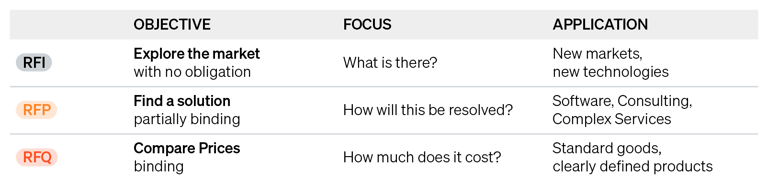
To clarify the distinctions, a direct comparison of the three types of requests is helpful. The following overview summarizes the key characteristics and makes it easier for you to choose the right document for your next request for proposals.
The three types of requests are not isolated tools; rather, they often build on one another and constitute the individual steps in the procurement process. A typical strategic workflow might look like this: The process begins with a broad RFI to understand the market. Based on the information gathered, a shortlist of suppliers is created, who then receive a detailed RFP. After evaluating the proposed solutions, the finalists may be asked in a final round to submit a specific price quote via an RFQ.
This structured approach is a core element of modern procurement and is part of every procurement manager. Such an approach to strategic procurement —as defined by the German Association for Materials Management, Purchasing, and Logistics (BME)—ensures that you find not only the best price, but also the best solution and the most suitable partner for the company’s needs. It minimizes risks and maximizes the value contribution of procurement.
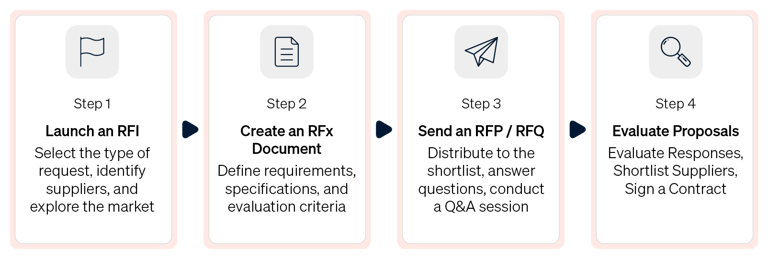
Implementing a systematic RFx process, ideally supported by digital solutions for eSourcing and eProcurement, offers companies significant advantages. A digital platform makes it easier to compare suppliers’ responses and ensures a transparent, traceable, and efficient process.
Distinguishing between an RFI, RFP, and RFQ is more than just an academic exercise—it’s the key to a successful and strategic procurement process. Remember this simple mnemonic: The RFI clarifies the “what” (What’s available on the market?), the RFP the “how” (How do you solve our problem?), and the RFQ the “how much” (How much does your clearly defined solution cost?).
By using the right tool at the right time, you ensure that you receive relevant information, make informed decisions, and ultimately create the greatest value for your company. A structured RFx process is therefore not a bureaucratic burden, but a strategic necessity for remaining competitive and sustainably increasing procurement efficiency.
Optimize Your Procurement Processes with simple system Today