![Andy Freund [Senior Growth Manager]](https://simplesystem.com/hs-fs/hubfs/Autoren_Blog/Andy_Freund_autor.png?width=200&name=Andy_Freund_autor.png)

09.09.2026

![Andy Freund [Senior Growth Manager]](https://simplesystem.com/hs-fs/hubfs/Autoren_Blog/Andy_Freund_autor.png?width=100&name=Andy_Freund_autor.png)

When you think of procurement, do you primarily think of simply ordering office supplies or just negotiating prices? This operational perspective is long outdated. In today’s business world ,the procurement manageris a key strategic figure who makes a decisive contribution to value creation, innovation, and ultimately the company’s competitiveness. He or she is far more than just a buyer—they are a manager of complex global supply chains.
This comprehensive guide explores the role of the procurement manager in all its facets. We’ll show you what challenging tasks await you, which skills are essential for a successful career, and how your salary can grow as you gain professional experience. Learn why this position has become indispensable to a company’s success.
A procurement manager, often referred to as a strategic buyer or purchasing manager, is responsible for the holistic procurement of goods, raw materials, and services that a company needs for its operations. This goes far beyond the operational ordering process. The modern role in procurement focuses on the strategic management of purchasing to ensure that all necessary goods are available in a cost-effective and quality-assured manner.
This strategic role involves optimizing the entire supply chain, managing supplier relationships, and proactively managing risks such as supply shortages or price volatility. At its core, the Procurement Manager ensures that purchasing not only saves costs but also makes a measurable contribution to the company’s overall success. They serve as the central interface between internal requesters, external suppliers, and company leadership.
What exactly are a Procurement Manager’s responsibilities? These responsibilities are diverse and have evolved from purely administrative tasks to highly strategic activities. The goal is not only to secure the best price but also to create sustainable value for the entire company. Collaboration with internal stakeholders from various departments—such as production, logistics, sales, and finance—is essential to this success.
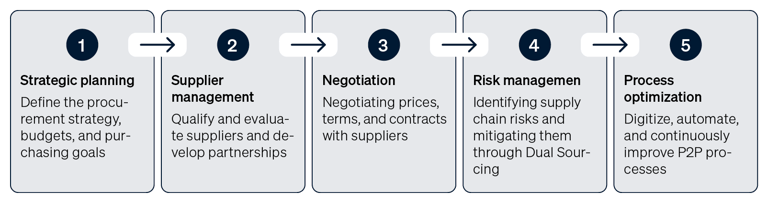
While the exact duties of a Procurement Manager vary depending on the industry, company size, and specific focus, the core responsibilities are consistently demanding. They serve as the central point of contact for all procurement matters—from start to finish. This involves not only responding to demand but also proactively shaping purchasing processes and ensuring a resilient supply chain. So, what exactly does a Procurement Manager do?
Core responsibilities include a mix of analytical, strategic, and communicative tasks. A Procurement Manager plays a central role in building stable supply chains and ensuring the company’s competitiveness. Key responsibilities include:
A Procurement Manager analyzes the market and internal needs to develop a long-term procurement strategy. This includes consolidating demand, standardizing products, and deciding between in-house production or external sourcing (make-or-buy). The strategic direction of procurement is crucial for realizing cost advantages and ensuring supply security. A deep understanding of the business and cost structures is essential here.
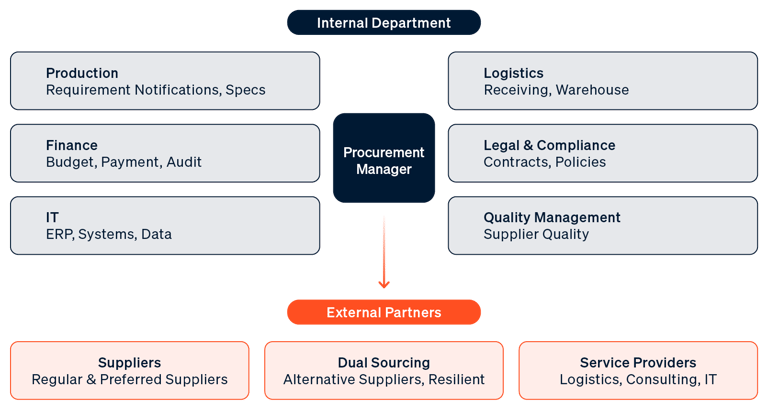
Effective supplier management is at the heart of this role. It begins with the systematic search for and qualification of suppliers, often supported by structured bidding processes. You can learn more about the differences between the common types of requests in our article on RFQ, RFP, and RFI. It also involves the continuous evaluation of supplier performance using key metrics and collaborative development to promote reliability and innovation. Building strategic partnerships secures long-term competitive advantages for the company.
Negotiation skills are among the most important competencies. Procurement managers conduct complex contract negotiations to secure not only the best price but also optimal terms regarding quality, delivery times, and payment terms. They draft and manage contracts and ensure that legal and commercial agreements are adhered to. This protects the company from risks and creates a reliable business foundation.
Another core responsibility is anticipating and managing risks. The procurement manager analyzes potential sources of risk in the global supply chain —from geopolitical instability and raw material shortages to financial instability among key suppliers. They develop contingency plans and identify alternative sourcing options (second sourcing) to strengthen the supply chain’s resilience and keep production running without interruption.
Procurement management is data-driven. Procurement managers define and monitor relevant key performance indicators (KPIs) to measure the efficiency and success of their strategies. According to the German Association for Materials Management, Purchasing, and Logistics (BME), cost savings, on-time delivery, and process costs are among the most important metrics. This data forms the basis for continuous process optimization. Digital tools are indispensable here for creating transparency and automating processes.
The role of a procurement manager is demanding and requires a broad range of skills. A successful career in this field is based on a solid mix of technical knowledge (hard skills) and personal competencies (soft skills). Only those who master both can handle the complex demands at the interfaces between internal departments, management, and external partners.
Technical expertise forms the foundation for strategic decisions. A deep understanding of the business, numbers, and processes is essential. The most important hard skills include:
In addition to technical expertise, it is often personal skills that determine success or failure. The procurement manager acts as a key communicator, negotiator, and strategist.
The position of Procurement Manager is generally not an entry-level role, but rather the result of several years of professional experience in the procurement field. The path to this role often involves operational and specialized positions. The salary prospects are correspondingly attractive, increasing in line with growing responsibility and strategic influence within the company.
A Procurement Manager’s salary is influenced by several factors. These include, in particular, the size of the company, the industry (e.g., automotive, pharmaceutical, mechanical engineering), the location, the complexity of the goods to be procured, as well as personal professional experience and any responsibility for managing a team.
Gross salary can vary significantly. While the starting salary after graduation and with initial practical experience often ranges between €48,000 and €60,000 gross per year, it increases significantly with growing experience. A Procurement Manager with several years of professional experience can expect an annual salary between €70,000 and €90,000. In larger companies, in booming industries, or when managing a team of several employees, salaries exceeding €100,000 are not uncommon.