What isn’t measured can’t be improved. This age-old adage applies particularly to procurement. Many companies still limit their measurement of procurement success to mere cost savings. But modern, strategic procurement achieves so much more. It ensures quality, optimizes processes, and drives innovation. To make this value contribution visible and manageable, you need the right metrics.
This guide walks you through the most important procurement KPIs. We’ll explain not only which metrics are relevant, but also how to calculate them and use them strategically. You’ll learn how to build a meaningful KPI system to sustainably improveprocurement performance and establish procurement as an indispensable partner for business success. In doing so, you’ll turn gut feelings into hard facts.
What Are Procurement KPIs?
Key Performance Indicators (KPIs) in procurement are quantifiable metrics used to measure, monitor, and analyze the performance of procurement processes. They help the procurement team evaluate the effectiveness and efficiency of its activities and ensure that its actions are aligned with the overarching procurement strategy and corporate goals. Unlike general metrics, which merely represent data points, KPIs are directly linked to strategic goals.
Why are KPIs in procurement more than just numbers?
The days when procurement was viewed primarily as an operational ordering department are over. Today, the procurement function is a strategic lever for overall success. As reports from McKinsey also show, leading procurement departments can contribute significantly to corporate growth. Procurement KPIs are the key tool for driving this transformation and making the value contribution of procurement transparent. They enable data-driven decision-making and continuous performance optimization.
- Objective Performance Evaluation: KPIs provide a clear, data-driven framework for measuring procurement performance and replacing subjective assessments with facts.
- Strategic Alignment: They ensure that procurement activities—from supplier evaluation to contract negotiation—contribute to overarching corporate goals.
- Process optimization: By tracking “operational KPIs,” weaknesses and inefficiencies in procurement processes can be identified and specifically addressed.
- Improved supplier management: Metrics for “supplier performance” help objectively evaluate the best partners, minimize risks, and strengthen collaboration.
- Demonstrating Value Contribution: Clear performance metrics, such as procurement ROI, highlight the financial contribution of the procurement department and justify investments in personnel and technology.
The challenge, however, does not lie in collecting a vast amount of data. The key to success is selecting the ideal KPIs—those metrics that truly provide actionable insights. It is crucial to understand how to measure these KPIs correctly and how to interpret the results in order to improve the procurement process in a targeted manner. Only the right selection and application transform raw data into valuable knowledge.
The Most Important Procurement KPIs by Category
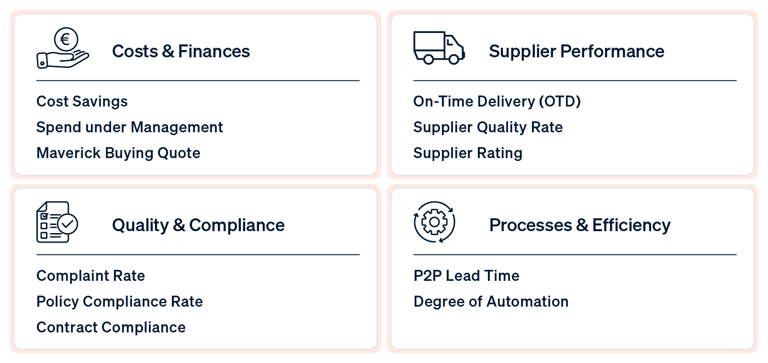
To maintain an overview and ensure balanced management, it is essential to organize your KPIs into logical categories. A one-dimensional focus—for example ,solely on cost savings—leads to a distorted picture and neglects critical aspects such as quality, risk, and supplier relationships. A holistic procurement strategy always takes multiple dimensions into account.
We present the most relevant metrics in the following four core areas, which provide a 360-degree view of your procurement performance. This allows you to ensure that procurement not only reduces costs but also creates sustainable value for the entire company.
1. Cost & Financial Metrics: The Foundation of Success
Financial metrics have traditionally been at the heart of measuring success in procurement. They are directly measurable, easy to understand, and demonstrate the immediate impact on the company’s bottom line. KPIs such as cost savings and ROI are crucial for evaluating the efficiency of your spending and clearly communicating the financial value that procurement contributes.
Cost Savings
- Definition: Measures the direct reduction in costs for purchased goods and services compared to a defined baseline (e.g., prior-year price, budget price, or initial quote).
- Calculation: `Baseline Costs – Actual Costs = Cost Savings`
- Strategic Significance: This procurement KPI is the classic measure of the procurement department’s negotiating skills and effectiveness. It has a direct, positive impact on the income statement and is the most tangible metric for most stakeholders.
Procurement ROI (Return on Investment)
- Definition:Procurement ROI compares the savings achieved and costs avoided to the operating costs of the procurement department (salaries, system costs, etc.).
- Calculation: `(Annual Cost Savings + Cost Avoidance) / Annual Operating Costs of the Procurement Department = Procurement ROI`
- Strategic Significance: This metric demonstrates that procurement is not merely a cost center but a profit center. A high ROI justifies investments in personnel and technology and highlights how procurement impacts profitability. Optimizing the entire procure to pay process is a key lever here.
Cost Avoidance
- Definition: Refers to measures that prevent future cost increases. Unlike cost savings, these are “soft” savings that are not directly visible on the income statement.
- Calculation: `(Anticipated cost increase – Actual cost increase) = Cost Avoidance`
- Strategic Significance: This is particularly crucial in volatile markets with high inflation. It demonstrates the proactive and strategic work of the procurement function, such as negotiating long-term fixed-price contracts or fending off unjustified price increases from suppliers.
2. Quality & Compliance: Securing the Value Chain
While financial KPIs measure the “what” of procurement success, quality and compliance metrics focus on the “how.” Poor quality or non-compliance with regulations can result in hidden costs that negate any savings—ranging from production downtime and product recalls to reputational damage. These procurement KPIs are therefore essential for sustainable risk management and a robust procurement strategy.
Supplier Defect Rate
- Definition: Indicates the percentage of delivered goods that do not meet the agreed-upon quality standards and are classified as defective.
- Calculation: `(Number of defective units / Total number of units delivered) * 100% = Supplier Defect Rate`
- Strategic Importance: A low defect rate is a direct indicator of a supplier’s reliability. Monitoring this KPI helps ensure the quality of end products, minimize rework costs and production delays, and increase customer satisfaction. It serves as an essential data foundation for distinguishing between top performers and high-risk suppliers during supplier evaluation.
Compliance Rate
- Definition: This metric measures the extent to which procurement processes and suppliers comply with contractual, legal, and internal requirements. This may refer to contractual compliance (ordering at agreed-upon prices), adherence to environmental regulations, or social standards.
- Calculation: `(Number of compliant transactions / Total number of audited transactions) * 100% = Compliance Rate`
- Strategic Importance: A high compliance rate minimizes risks. It ensures that your company benefits from negotiated terms and protects it from legal consequences. Compliance with internationally recognized standards such as ISO 9001 for quality management systems is often a key objective in this context and reinforces the company’s credibility.
On-Time Delivery (OTD)
- Definition: Measures the percentage of orders that arrive on time or before the agreed-upon delivery date.
- Calculation: '(Number of orders delivered on time / Total number of orders) * 100% = On-Time Delivery'
- Strategic Importance: High on-time delivery is crucial for stable production and low inventory costs, especially in just-in-time strategies. This KPI is a key component of supplier performance and directly influences the efficiency of the entire supply chain. Repeated delays can lead to costly production stoppages, contractual penalties, and lost revenue.
A network of reliable and high-performing suppliers is a strategic competitive advantage. Systematically measuring supplier performance is not merely a control function but the foundation for collaborative development. With the right supplier performance KPIs, you can identify your top performers, proactively manage risks, and continuously improve collaboration—which in turn leads to innovation and better results.
Supplier Availability / Reliability
- Definition: Measures a supplier’s ability to fulfill orders reliably and completely. It goes beyond mere on-time delivery and assesses whether the supplier can deliver the ordered quantity in the correct quality.
- Calculation: This is often measured using the “Perfect Order Index”: `(% on-time deliveries % complete deliveries % error-free deliveries * % correctly documented deliveries) = Perfect Order Index`
- Strategic Importance: High availability ensures a steady supply and minimizes the risk of production downtime. This KPI is particularly important for critical materials (A-parts) and helps assess the overall resilience of your supply chain. It enables you to identify high-risk suppliers early on and take corrective action.
Supplier Lead Time
- Definition: Describes the total time span from placing an order with a supplier to the physical receipt of the goods.
- Calculation: Date of goods receipt – Date of order = Supplier Lead Time
- Strategic Importance: Shorter lead times are an indicator of an agile and responsive supplier. They allow you to reduce safety stock, which directly improves cash flow and lowers inventory costs. Monitoring these KPIs is essential for precise production planning and inventory optimization. Consistent, reliable lead times are often more valuable than unpredictably short ones.
4. Process & Efficiency Metrics: Optimizing Operations
While the previous categories focused heavily on external factors such as costs and suppliers, these operational KPIslook inward. They measure the efficiency, speed, and costs of the procurement process itself. A lean, digitized procurement process not only reduces administrative overhead but also frees up valuable resources. This allows your procurement team to focus on strategic initiatives—such as supplier development and innovation—rather than routine transactional tasks.
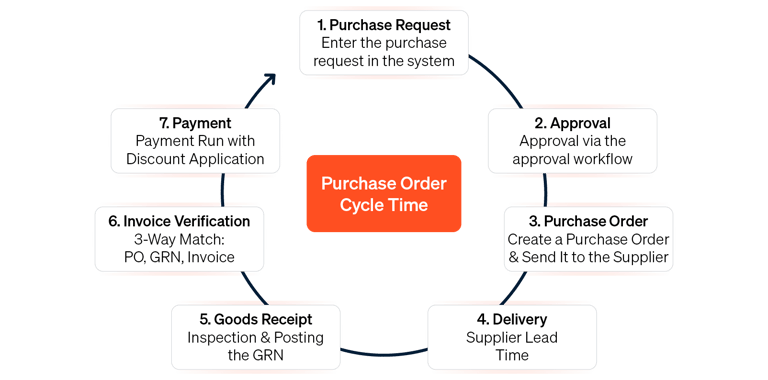
Purchase Order Cycle Time
- Definition: Measures the average time required for the entire ordering process—from the creation of a purchase requisition (BANF) through approval, conversion into a purchase order (PO), and goods receipt, all the way to final invoice verification and payment.
- Calculation: Date of invoice payment – Date the purchase requisition was created = Purchase Order Cycle Time
- Strategic Significance: A long cycle time is a clear warning sign of internal inefficiencies. Possible causes include complex approval workflows, manual data entry, or a lack of system integrations. Reducing this time not only increases internal satisfaction but also improves supplier relationships, as invoices are paid more quickly. This KPI shows how you can improve the core efficiency of your procurement.
Maverick Buying Rate (Percentage of Uncontrolled Purchases)
- Definition: The percentage of spending that occurs outside of defined procurement processes and without a formal purchase order. This “maverick buying” bypasses the expertise of the procurement department.
- Calculation: (Expenditures without a formal purchase order / Total indirect procurement volume) * 100% = Maverick Buying Rate
- Strategic Significance: Maverick buying is the natural enemy of strategic procurement. It leads to higher prices because negotiated discounts are not utilized, increases compliance risks, and weakens your negotiating position. A high rate often indicates that ordering systems are too cumbersome. A key objective is therefore to minimize this figure, which is essential for successful tail spend management .
Spend Under Management (Managed Procurement Volume)
- Definition: This KPI quantifies the percentage of total company spending that is actively managed, negotiated, and controlled by the procurement department.
- Calculation: (Procurement-Managed Spend / Total Spend) * 100% = Spend Under Management
- Strategic Significance: For procurement leaders, this is one of the most important performance metrics. It quantifies the influence and reach of the procurement function. A high value signals to management that the procurement department is fully exercising its control and management functions. Increasing this value—for example, by incorporating areas such as indirect procurement —is a clear sign of the department’s strategic development.
![Fabian von Kleinsorgen [VP Growth & Sales Operations]](https://simplesystem.com/hs-fs/hubfs/Autoren_Blog/Fabian_vin_kleinsorgen_autor.png?width=200&name=Fabian_vin_kleinsorgen_autor.png)


![Fabian von Kleinsorgen [VP Growth & Sales Operations]](https://simplesystem.com/hs-fs/hubfs/Autoren_Blog/Fabian_vin_kleinsorgen_autor.png?width=100&name=Fabian_vin_kleinsorgen_autor.png)