26.10.2026


Multi-step approval processes are intended to provide oversight but usually result in delays. The problem rarely lies with the system itself, but rather with the rule behind it: If every order must be approved, every order becomes slow. This article outlines the architecture that makes approval the exception—including a ready-to-use approval matrix and a system comparison.
Multi-level approvals only slow down procurement if every order goes through the workflow. The faster approach involves setting budget limits for each cost center: Orders within the limit are processed without approval; only orders that exceed the limit are routed through tiered thresholds. Approval thus becomes the exception rather than the rule.
Key points at a glance:
Introducing approval levels doesn’t solve a control problem—it just pushes it further down the queue. Every approval involves two steps: one for the requester, who has to wait, and one for the approver, who reviews an order to which they usually can’t contribute anything.
Definition: An approval workflow in purchasing is the chain of rules that determines which purchase orders, starting at a certain value, must be approved by which authority before they are sent to the supplier.
The crucial question, therefore, is not “How many levels do we need?” but “How many orders actually need to go through the workflow?” In practice, this number is significantly lower than what most purchasing guidelines stipulate. An order for screws totaling 40 euros from the catalog associated with a cost center that has a budget limit does not require a signature.
This is precisely where the connection to the actual problem lies: The more cumbersome the official route, the more attractive the unofficial one becomes. An overly strict approval process is one of the most reliable drivers of maverick buying.
Set the rules as early in the process as possible. Every level that takes effect in advance removes a decision from the workflow.
|
Rule Level |
What it determines |
Effect on Approval |
|---|---|---|
|
Product range |
which suppliers and items a team can see |
Incorrect orders are prevented from being placed in the first place |
|
Budget per cost center or user |
How much a unit is allowed to spend during a given period |
Orders within the budget are processed without approval |
|
value threshold |
At what amount, which authority must approve |
Only exceptions enter the workflow |
|
Cost center and general ledger account |
Where costs are allocated according to their source |
No follow-up work in accounting, no follow-up inquiries |
On our platform, these levels are handled by two modules: product range restrictions and approval workflows come from the Marketplace Package, while budgets and cost centers come from the Controlling Package. Budgets can be assigned to cost centers, users, or product groups and combined in any way—for example, a personal budget for personal protective equipment within a department’s budget.
Tip: Synchronize the cost center structure automatically from the ERP system instead of maintaining it twice in the procurement platform—otherwise, approvals will be processed against outdated cost centers.
An approval matrix assigns exactly one instance to each purchase order value. Three to four levels are sufficient for most medium-sized companies—each additional level extends the turnaround time without measurably reducing risk.
The following example is intentionally kept simple. Adjust the value thresholds to match your purchasing policy, but keep the first row: it’s the reason the process remains fast.
|
Order Value |
Approved by |
Typical turnaround time |
|---|---|---|
|
Within the cost center budget |
No approval required; order is sent directly to the supplier |
Immediately |
|
Up to €500 over the limit |
Person in charge of the cost center |
a few hours |
|
€500 to €5,000 |
Cost center and purchasing management |
one workday |
|
Over 5,000 € |
Cost center, purchasing management, and commercial management |
two workdays |
Three factors determine whether this matrix works in practice:
Bring your purchasing policy and we will compare it with the platform’s rule logic. In thirty minutes, you will know which approvals can be dropped in future and which will remain. No preparation, no documents needed.
A budget that only becomes visible at month-end is not a control tool, but merely a notification. That’s why a budget with real-time consumption data provides more control than any additional approval level ever could.
The mechanism behind it is simple: The spending status updates with every order. If a cost center reaches a critical threshold—say, 85 percent—those in charge see it on the dashboard. If the threshold is exceeded, orders are automatically halted and can only be placed again with special approval.
Key Fact: Our customers report 20 to 35 percent fewer budget overruns and 15 percent more accurate financial planning. For an indirect procurement budget of two million euros, this translates to approximately 300,000 euros in better-allocated funds—as detailed in the Budget Control in Procurement.
The case study on the Overview of Departmental Budgets. For companies with multiple plants, the case study on decentralized ordering with centralized approval provides a more detailed comparison.
All reputable procurement systems can handle multi-level approvals based on order value and cost center. The difference lies not in whether this is possible, but in the effort required to set up the rules—and in how much configuration you’ll be responsible for afterward.
|
System Type |
Approval Logic |
Introduction |
Suitable for |
|---|---|---|---|
|
Procurement Suite (SAP Ariba, Coupa, JAGGAER, Ivalua) |
Hierarchies of any depth, freely configurable, cross-process |
Months, typically as part of a consulting project |
Corporations with their own process organization |
|
ERP workflow (SAP, Microsoft Dynamics) |
Approval at the purchase requisition level in the ERP |
Depending on existing customizations |
Companies that want to manage all approvals within the ERP system |
|
Lean procurement platform (simple system, Onventis, Wucato) |
Budget limits plus tiered value thresholds, preconfigured |
Weeks, without a dedicated project team |
Mid-sized companies with limited IT resources |
|
Marketplace without purchasing logic (Amazon Business) |
Simple approval process, no cost center or budget logic |
Days |
Occasional needs, not intended as a purchasing system |
The honest assessment: If you need to map approvals across group companies, direct materials, and service contracts within a single set of rules, there’s really no getting around using a suite. For indirect materials and C-parts in medium-sized businesses, this scope of functionality is the reason why implementation projects fail—not the solution to the problem.
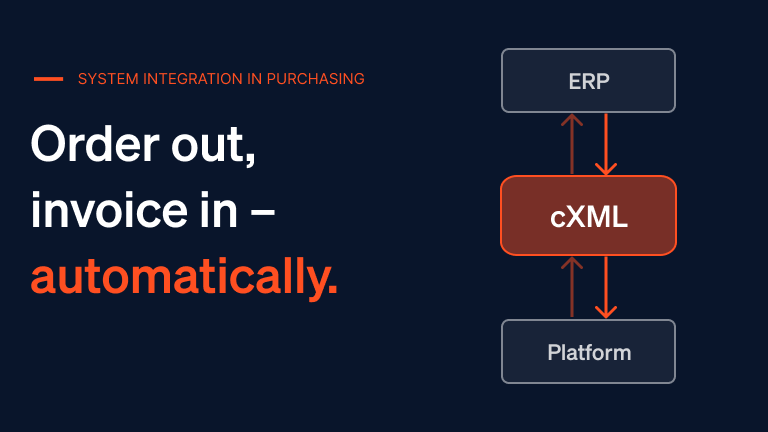
Those who want to keep approvals within the ERP system can combine both: via OCI Punchout and the SAP integration, the purchase requisition is created in SAP, the approval process takes place there, and the purchase order is then sent to the supplier via the platform.
The purchase requisition is created in SAP, the approval runs there, and only then is the order sent to the supplier via the platform. You don’t change any approval process, you just shorten the path that follows it.
An approval process is only as robust as its weakest link. In most companies, this isn’t catalog ordering, but rather the side channels: vending machines on the production floor, direct orders from small suppliers, and requests for quotes sent via email.
To prevent a compliance gap from arising there, the same rules must apply. External ordering systems are therefore integrated into the existing approval processes, and requests for quotes follow the same workflow from the initial request through to the order.
The fact that cost transparency in the indirect procurement sector remains one of the greatest untapped opportunities is also confirmed by the Deloitte’s global CPO survey. Anyone wishing to quantify the effort behind individual ordering processes more precisely can find the measurement framework at HTWK Leipzig for managing indirect procurement.
If more than one in five orders goes through an approval stage, the budget limits are set too tightly—not the approval chains too short.
A good procurement approval workflow isn’t defined by the number of levels, but by how few orders have to go through them. Budget limits, product range restrictions, and a streamlined approval matrix handle most of the control before anyone has to approve anything.
Real-time budgets per cost center, tiered value limits, delegation and escalation. All preconfigured, with no consulting project and no in-house IT team. Up and running in weeks, not months.
For mid-sized companies, three to four levels are enough: no approval within the budget, cost center managers for small overruns, the head of purchasing for the mid-range and commercial management above a defined amount. Every additional level extends the processing time without measurably reducing risk.
Through an approval matrix that links both dimensions: the cost center budget determines whether approval is needed at all, and the value limit determines who has to approve. Orders within the budget go through without approval.
Procurement suites such as SAP Ariba, Coupa or JAGGAER can map hierarchies of any depth but require an implementation project lasting several months. Lean procurement platforms such as simple system work with preconfigured budgets and value limits and are up and running within weeks.
Orders are stopped automatically as soon as a cost center’s budget is used up. Before that, the dashboard issues a warning at a defined threshold, for example at 85% utilization. A special approval is still possible.
No. Purchasing only slows down when every order has to go through the workflow. With budgets per cost center and product range restrictions, most orders require no approval, and the approval process only applies to exceptions.