![Thomas Au [CFO]](https://simplesystem.com/hs-fs/hubfs/Autoren_Blog/Thomas_Au_autor.png?width=200&name=Thomas_Au_autor.png)
14.10.2026

![Thomas Au [CFO]](https://simplesystem.com/hs-fs/hubfs/Autoren_Blog/Thomas_Au_autor.png?width=100&name=Thomas_Au_autor.png)

As long as the machines are running and production isn’t at a standstill, everything seems to be in perfect order at many companies. But beneath the surface, there is often significant untapped potential and hidden costs. This is exactly where efficient MRO management comes into play. It is far more than just the maintenance of your equipment. It is a strategic discipline that ensures smooth operations, increases efficiency, and sustainably strengthens your competitiveness.
MRO stands for Maintenance, Repair, and Operations. This term encompasses all goods, materials, and activities necessary to keep a company’s production and operational facilities running, without directly contributing to the final product. These are the often invisible but critical components of everyday industrial operations.
MRO management, therefore, is the strategic management of all these processes and materials. It is about finding the right balance: ensuring the availability of all necessary spare parts and consumables without accumulating excessive inventory that ties up capital. Effective MRO management optimizes maintenance and repair work, minimizes unplanned downtime, and ensures efficient cost control across the entire MRO sector.
Traditionally, the MRO sector was often viewed purely as a cost factor whose budget needed to be minimized. However, this perspective is outdated and dangerous. Poorly organized MRO management can lead to catastrophic chain reactions: a lack of spare parts can paralyze entire production lines, inadequate maintenance poses safety risks to employees, and the lifecycle costs of equipment skyrocket due to inefficient repairs.
Modern, strategic MRO management transforms this cost center into a value driver. It’s not just about performing repairs, but about preventing them through predictive maintenance. It’s not just about ordering parts, but about optimizing the entire procurement of MRO materials to realizecost savings and avoid supply bottlenecks. In this way, MRO becomes a crucial lever for operational excellence.
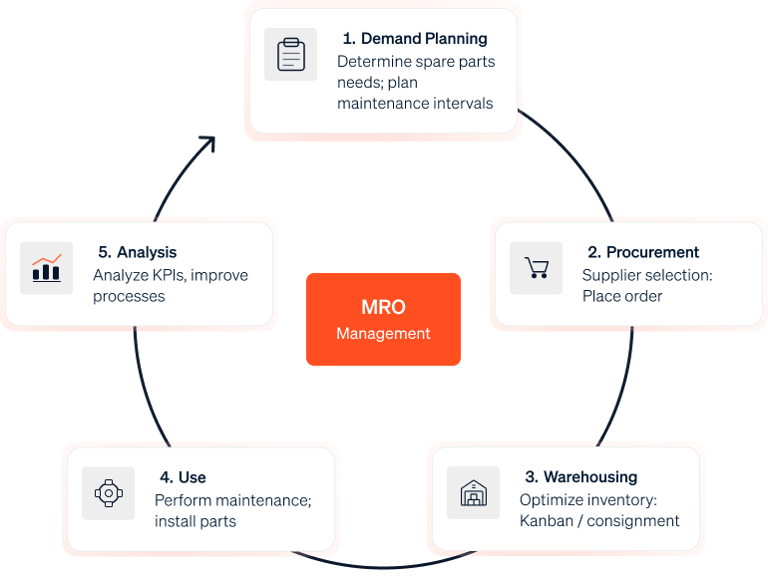
The key lies in a closed-loop process that spans from demand planning through procurement, warehousing, and deployment all the way to process analysis. Only through centralized control and the use of data can companies ensure that their MRO activities not only maintain operations but also actively contribute to value creation and increase efficiency along the entire value chain.
To transform MRO from a reactive necessity into a strategic advantage, a foundation consisting of four key pillars is required. These pillars are interlinked and create a closed-loop system designed for continuous improvement and increased efficiency.
The procurement of MRO materials is often fragmented and uncontrolled. Employees place orders with various suppliers as needed, leading to high process costs and a lack of transparency. Optimized procurement consolidates these needs. It analyzes which materials—often C-parts such as screws or protective equipment—are needed and consolidates suppliers.
The goal is to transition from reactive individual orders to strategic framework agreements and a centralized purchasing platform. This not only reduces the workload on your procurement teams but also secures better terms, ensures high-quality supplier data, and delivers significant cost savings. A digitized procurement process is the foundation for lean MRO management.
A warehouse full of spare parts offers a false sense of security. Excessive inventory ties up valuable capital, incurs high storage costs, and carries the risk of obsolescence. On the other hand, shortages of critical parts inevitably lead to costly production downtime. Intelligent inventory management strikes the right balance.
The key is to forecast exact demand and define safety stock only for the truly critical components (A-parts). Modern MRO systems help track material consumption precisely, automatically set reorder points ,and thus ensure availability without overfilling the warehouse. This allows you to minimize both tied-up capital and the risk of stockouts.
The traditional approach—a machine breaks down, a technician repairs it—is the most expensive way to conduct maintenance. Strategic MRO management shifts the focus from reactive repair to proactive maintenance. There are various levels of maturity:
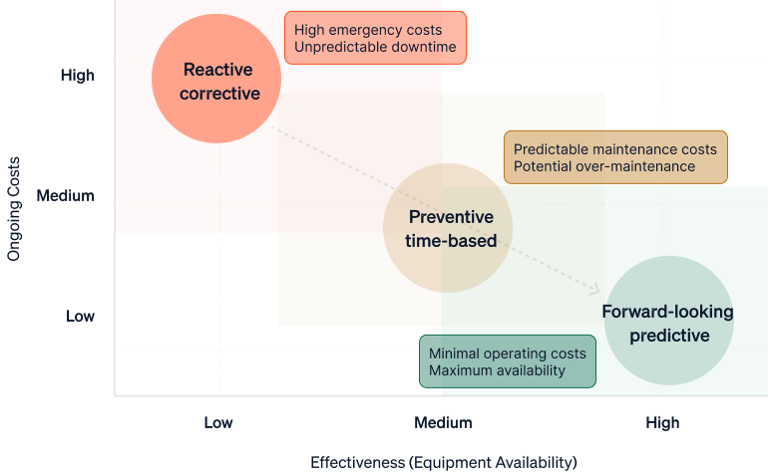
Predictive maintenance, in particular—made possible by the use of AI and machine data—is considered the key to increasing efficiency, as research by the Fraunhofer Institute confirms. The goal is to perform maintenance tasks only when they are truly necessary and to drastically reduce unplanned downtime.
You can’t improve what you don’t measure. This principle is at the heart of modern MRO management. Without a solid data foundation, attempts at optimization are like flying blind. Many companies struggle with data silos—information is trapped in isolated Excel spreadsheets or various departmental systems.
Effective MRO management breaks down these silos. It establishes clear key performance indicators (KPIs) such as Mean Time Between Failures (MTBF) or Overall Equipment Effectiveness (OEE). Through continuous performance management and the analysis of this data, you can recognize patterns, identify weak points, and optimize your MRO processes in a targeted and data-driven manner.
The systematic optimization of your MRO processes based on the four pillars is not an end in itself. It leads to measurable improvements that directly impact your operating results. Strategically structured MRO management transforms what is often perceived as a cost burden into a genuine competitive advantage and strengthens your company’s resilience.
Implementation pays off in several areas:
The path to efficient MRO management is often fraught with obstacles. While many companies recognize the potential, they fail to implement it because established structures and processes are deeply entrenched. Identifying these stumbling blocks is the first step toward overcoming them in a targeted manner.
One of the biggest challenges is the accumulation of data silos and a lack of transparency. Critical information regarding spare parts, maintenance intervals, or suppliers is often stored in isolated Excel spreadsheets, local databases, or even just in the minds of individual employees. This makes strategic management impossible.
Closely related to this is fragmented procurement. When every employee places orders independently as needed, process costs skyrocket. There is no bargaining power with suppliers, no overview of expenditures, and a high risk of errors in data maintenance.
Finally, the prevailing reactive culture poses a mental barrier. Many maintenance teams are conditioned to act as “firefighters” and put out fires. The shift toward a planned, forward-looking mindset requires a change in thinking across the entire company, which must be actively encouraged.