09.09.2026


Outsourcing indirect procurement helps companies reduce costs, optimize processes and focus on core competencies by having external partners take on procurement tasks. Despite challenges such as data security and dependency, the benefits outweigh the risks when implementation is clear and structured.
In an increasingly globalized and digital economy, outsourcing procurement processes is becoming more and more important. Companies are under pressure to optimize their processes, reduce costs and stay competitive at the same time. Indirect procurement in particular, which is often considered time-consuming and resource-intensive, has great potential for outsourcing.
This article looks at the benefits, challenges and strategic approaches to procurement outsourcing and shows when it makes sense to outsource procurement.
Procurement outsourcing means handing over specific procurement processes or areas to external service providers. Many companies know the term, but the exact benefits and process are often unclear. Procurement outsourcing is becoming increasingly important, especially for indirect procurement, which is not directly related to the core business.
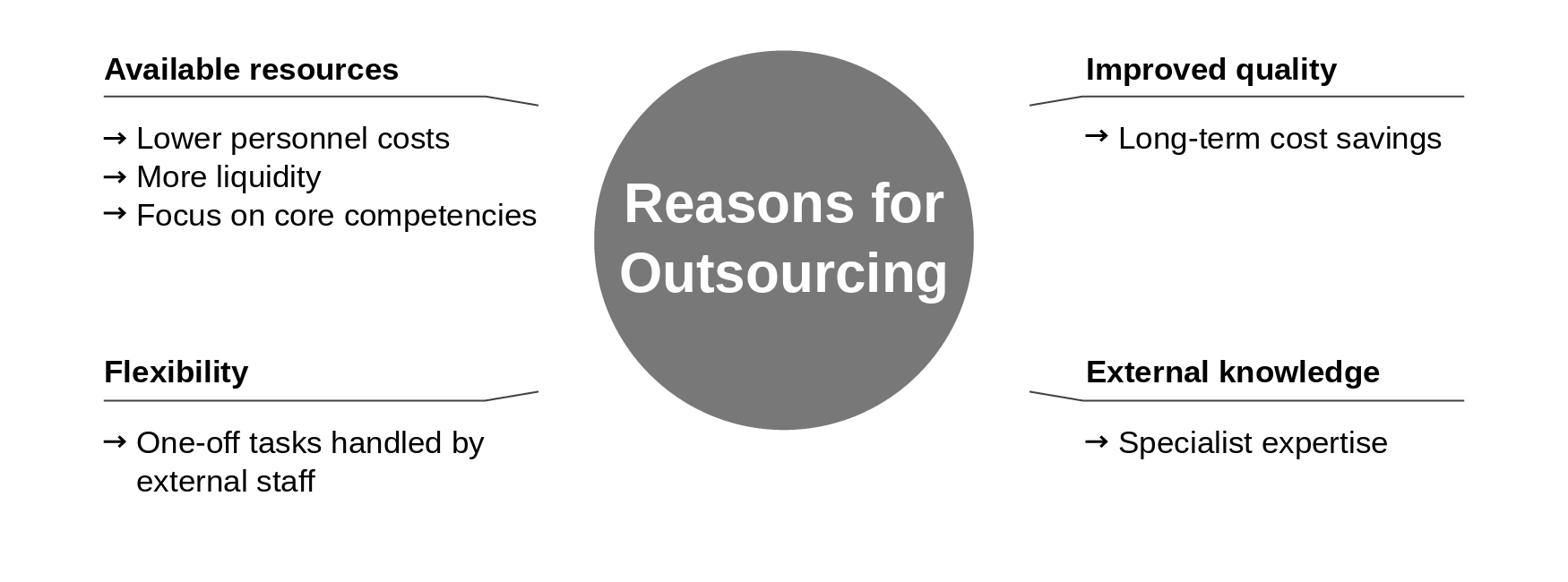
Procurement outsourcing means that external partners take over parts of procurement management, from sourcing to invoice verification. This reduces administrative effort and allows companies to focus on strategic tasks. With growing complexity and requirements, this model is becoming more important, especially in industries under high cost pressure that want to save money and improve their supply chain.
The key difference between direct and indirect procurement lies in the type of goods procured and their importance for the company's value creation.
Direct procurement covers materials and components that go directly into production. Examples are raw materials, parts, semi-finished goods and other product-related items a company needs to manufacture products. These purchases directly affect product quality and business success, which is why they must be planned especially carefully.
Indirect procurement, on the other hand, covers all goods and services that do not go directly into production but are necessary for smooth operations (indirect materials). These include office supplies, IT services, cleaning services or advertising campaigns. While direct procurement focuses more on cost and quality, indirect procurement is often about efficient purchasing and administration. Both areas require specialized approaches to achieve their goals (cost reduction, quality assurance and efficiency).
In outsourcing, certain tasks such as vendor selection, negotiating terms or order processing are delegated to external partners. The process starts with an analysis of internal procurement activities, followed by selecting a suitable service provider and implementing clear processes and KPIs (key performance indicators) to measure success.
Outsourcing procurement work offers companies several attractive benefits:
Outsourcing brings some challenges that companies need to weigh carefully. A central challenge is dependence on the chosen procurement service provider. A wrong decision can lead to significant risks such as quality problems or supply bottlenecks that affect business operations. Working with an external partner also requires smooth communication and transparency. Without clear coordination processes, misunderstandings can easily arise and reduce procurement efficiency.
Another critical point is data security. Because outsourcing procurement processes often requires access to sensitive company data, clear data protection agreements and strict controls are essential to minimize the risk of data leaks or misuse.
A successful outsourcing partner brings expert knowledge and experience. This is particularly important for handling complex procurement activities efficiently and identifying potential problems early. Without this expertise, there is a risk that savings potential will not be fully exploited. Pay close attention to the partner's outsourcing experience.

When selecting vendors, reliability, flexibility and innovation are decisive. A reliable vendor ensures punctual deliveries and consistent quality, which forms the basis of stable business relationships. Flexibility is important to react quickly to changes in demand or unexpected disruptions.
Innovation shows in the use of modern technologies and optimized processes that increase efficiency and open up new opportunities. One example of efficient vendor management is simple system, a platform that helps companies optimize indirect procurement and simplify vendor relationships.
With business process outsourcing, companies must consider various risks and legal aspects to avoid long-term problems and ensure stable cooperation with service providers.
The success of procurement outsourcing can be assessed with clear, measurable criteria. Key figures (KPIs) such as savings on procurement costs, efficiency gains from shorter procurement cycles and the quality of the goods or services delivered are decisive. Compliance with contract terms, process transparency and the satisfaction of internal departments also play an important role.
Regular, thorough evaluations and feedback loops help identify optimization potential early and continuously improve cooperation with the outsourcing partner.
Specific key figures are essential to evaluate the efficiency and success of procurement processes. They give a clear overview of performance and optimization potential in the procurement department:
Strategic optimization of procurement requires clear goals and an analysis of existing processes. Manual steps should be minimized, data made more transparent and collaboration with vendors strengthened. Often, indirect procurement does not need to be outsourced at all: digital tools like simple system reduce the effort so much that it stays manageable in-house and control remains within the company.
simple system simplifies the procure-to-pay process (P2P) by bringing more than 1,000 vendors together on one central platform. Companies can search product catalogs, place orders and monitor delivery times in real time, all clearly in one place. Analytics features help identify savings potential and evaluate vendor performance.
With a user-friendly interface, the platform brings clarity to complex processes and supports compliance requirements. It can be adapted to each company's needs and integrated into existing ERP and accounting systems. You can test it free of charge for 30 days.
Outsourcing brings small, mid-sized and large companies numerous benefits, from cost savings to greater efficiency. Despite challenges such as data security and dependence on the service provider, the benefits outweigh the risks when the process is planned systematically.