![Jörg Schmidt [Head of Vendormanagement]](https://simplesystem.com/hs-fs/hubfs/Autoren_Blog/Joerg_schmidt_autor.png?width=200&name=Joerg_schmidt_autor.png)

09.09.2026

![Jörg Schmidt [Head of Vendormanagement]](https://simplesystem.com/hs-fs/hubfs/Autoren_Blog/Joerg_schmidt_autor.png?width=100&name=Joerg_schmidt_autor.png)

Effective process optimization and well thought-out C-parts management are the key factors in actively reducing costs and increasing security of supply within the company. Particularly in the case of C-parts, whose value is low but whose process costs often account for a large proportion of total costs, digitalization, automation and targeted vendor selection can generate immense savings.
C-parts management encompasses all measures for optimizing the procurement and storage processes for C-parts, meaning small parts with a low procurement value but a high procurement quantity. C-parts include screws, nuts, seals, drawing parts, tools, connecting elements and fastening technology as well as many other operating resources for manufacturing products.
C-parts are classified according to the ABC analysis. A-parts are less common, but have a high individual value. B parts have a medium product value and medium use. The process costs are significantly lower for A and B parts, which is why they have less of an impact on overall costs despite their higher procurement costs.
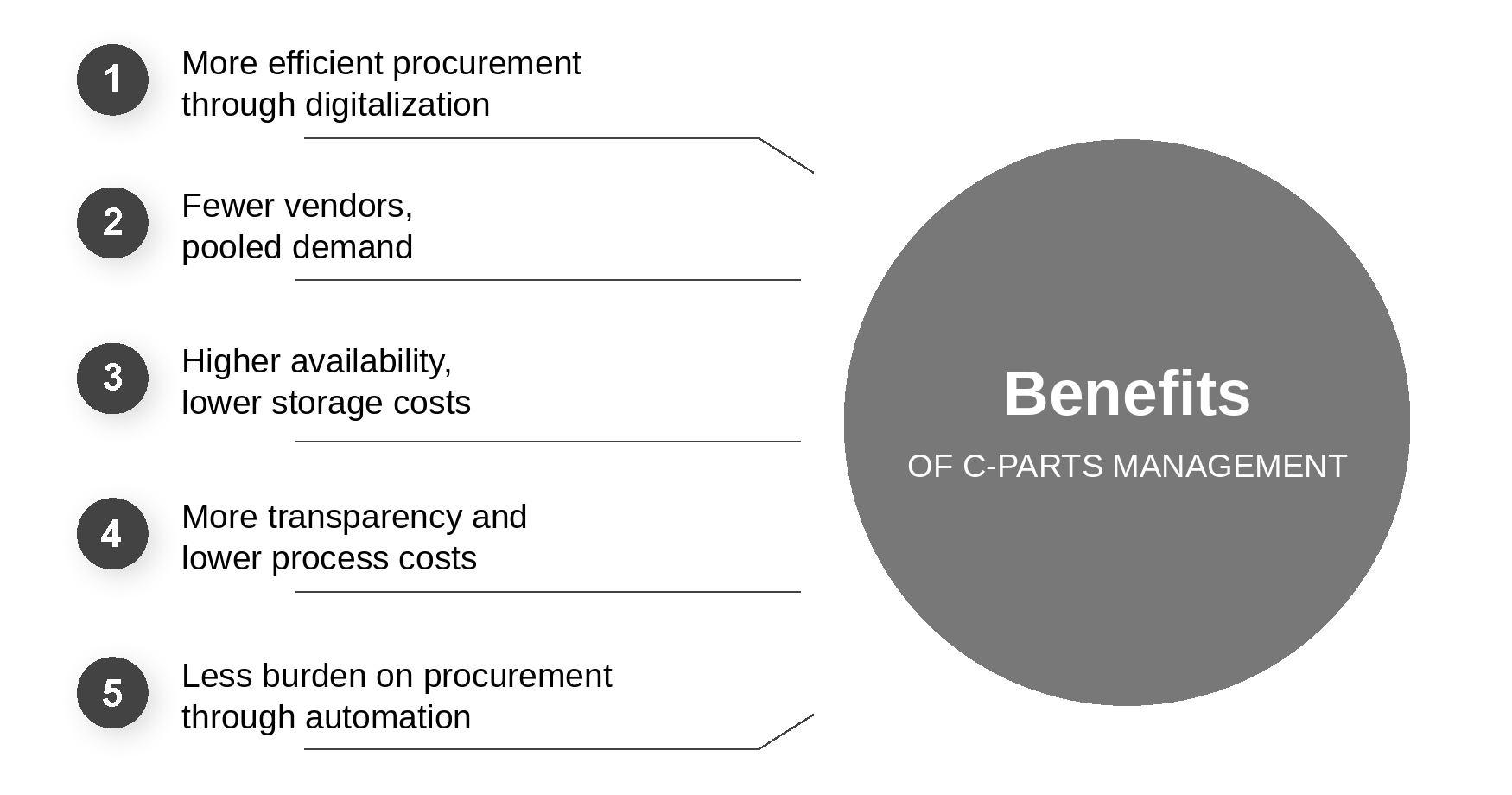
The process costs for C-parts are often many times higher than the actual value of the goods. Effective management helps companies to make targeted savings in time, costs and resources in order to ensure security of supply.
The main objectives of C-parts management include
C-parts manufacturers play a central role in the industrial supply chain, even if their products usually only account for a small proportion of total costs. They ensure a reliable supply of standardized components(standard parts) such as screws, seals and fasteners. They therefore make a significant contribution to operational safety and efficiency. Especially in Industry 4.0, a continuous and reliable supply of C-parts is crucial in order to avoid production downtimes and increase a company's overall performance.
Manufacturers of C-parts specialize in high-performance mass production and standardization of components. By producing large quantities, they promise competitive prices and ensure consistent quality. Standardization makes it possible to procure C-parts easily and cost-effectively, as they are offered by various vendors. They are also available in large quantities. Mass production and standardization not only reduce procurement costs, but also simplify warehousing within the company, as well as replacement when necessary.
Consistent quality control also speaks in favor of specialized C-parts manufacturers. They rely on certified processes such as ISO 9001 and carry out inspections at regular intervals to ensure compliance with quality standards and norms. These measures are crucial, as even minor deviations in standard parts can lead to disruptions in production.
Important: Appropriate certifications create trust and promise consistent, first-class product quality.
C-parts manufacturers often work closely with system vendors and distributors to further improve the supply chain. System vendors often take on the coordination and logistical tasks for various small parts. They create a central point of contact for customers for the procurement of their C-goods.
Through targeted cooperation, the procurement process as a whole is automated and stocks are aligned. Security of supply in the company is also increased. Especially in the context of intelligent e-procurement solutions and Kanban, companies benefit from the seamless integration of manufacturers into their efficient C-parts management.
Find out how in our free e-procurement report. Download it now, free and without obligation.
Read now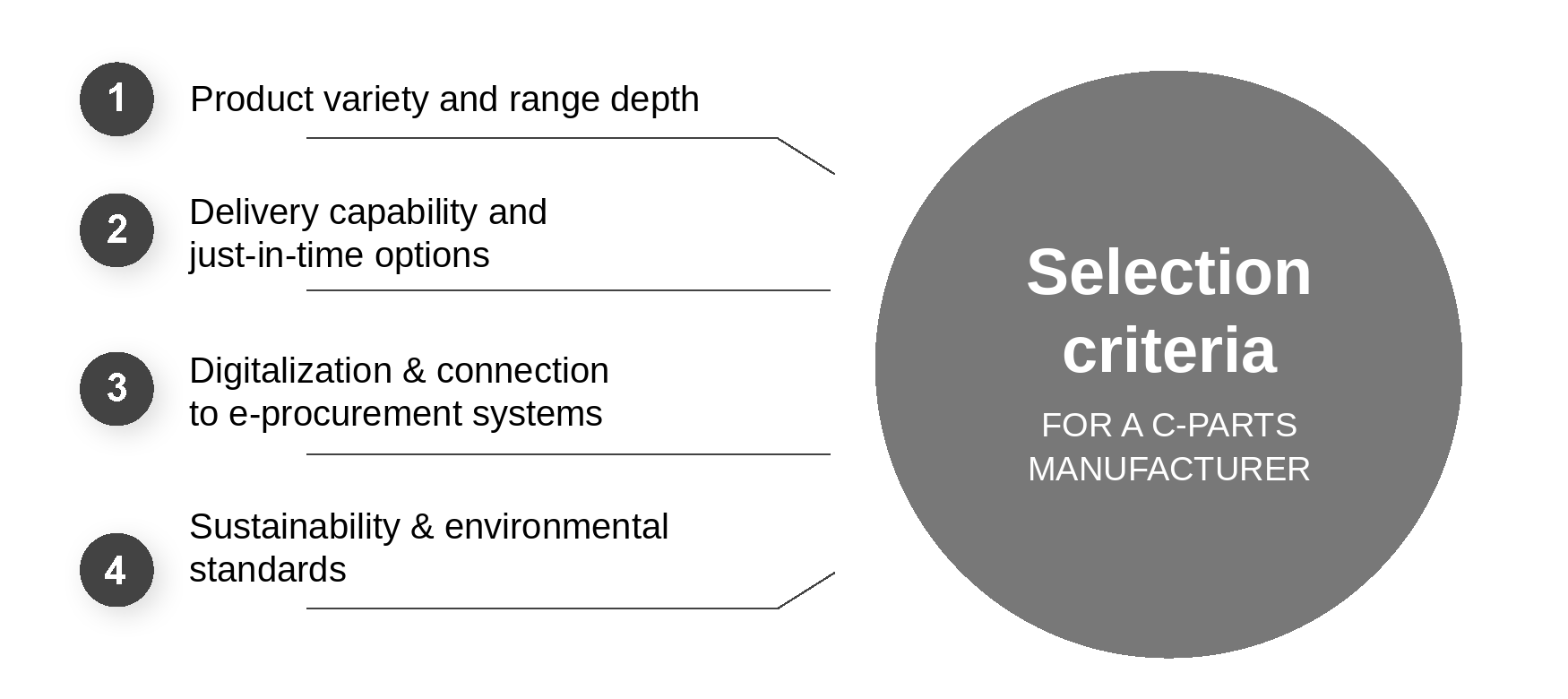
The selection of a suitable C-parts manufacturer is crucial for efficient and reliable supply in the industry. In addition to price and quality, other criteria are increasingly coming into focus these days that significantly influence the long-term success of cooperation with specialists.
With a broad and deep product range, many requirements can be covered by a single manufacturer. This simplifies procurement processes and actively reduces the variety of vendors. This noticeably relieves procurement.
High delivery reliability and the option of just-in-time deliveries are essential in order to minimize stock levels, avoid bottlenecks and keep production flexible at all times.
Modern manufacturers offer interfaces toERP and e-procurement systems, support automated ordering processes and enable seamless integration into digital procurement platforms to simplify repeat orders and optimize procurement processes.
Certifications, transparent environmental reports and compliance with social and environmental standards are becoming increasingly important and are therefore also an important prerequisite for long-term cooperation.
The procurement of C-Parts is developing rapidly, from manual individual orders to automated, digitally supported solutions. Innovative technologies such as AI, modern e-procurement platforms and a networked supply chain are revolutionizing the way companies identify, order and manage C-Parts. The focus here is on increasing efficiency, maximizing transparency and complying with sustainability standards.
Artificial intelligence and automated systems analyze consumption data, forecast requirements and trigger orders independently. This reduces sources of error, avoids bottlenecks and speeds up the procurement process by significantly reducing administrative work.
Digital logistics solutions and marketplaces such assimple system bring together a large number of vendors and products in one place. They enable a greatly simplified search, transparent price comparison and centralized order processing. In the area of C-parts management, platforms such as simple system are indispensable for standardizing processes, saving costs and increasing the flexibility of your own procurement.
More and more companies are opting to bundle their C-parts requirements with a few strategic partners. This reduces complexity, strengthens the negotiating position and simplifies storage and outsourcing. At the same time, costs can be saved through framework agreements and integrated vendor relationships thanks to improved conditions .