![Fabian von Kleinsorgen [VP Growth & Sales Operations]](https://simplesystem.com/hs-fs/hubfs/Autoren_Blog/Fabian_vin_kleinsorgen_autor.png?width=200&name=Fabian_vin_kleinsorgen_autor.png)

09.09.2026

![Fabian von Kleinsorgen [VP Growth & Sales Operations]](https://simplesystem.com/hs-fs/hubfs/Autoren_Blog/Fabian_vin_kleinsorgen_autor.png?width=100&name=Fabian_vin_kleinsorgen_autor.png)

The pressure on companies to optimize processes and reduce costs is enormous. Inventory management, in particular, ties up capital and carries risks. This is where Just-in-Time (JIT) procurement comes in — a strategy that promises to radically increase efficiency and minimize inventory costs. But what exactly does this approach entail, and is it the right choice for every company? In this comprehensive guide, you’ll learn everything about how JIT works, its key advantages and disadvantages, and the technological requirements of the JIT concept.
Just-in-Time (JIT) procurement, often referred to as demand-driven production, is a logistics and organizational concept aimed at optimizing the flow of materials throughout the entire supply chain. The core idea is that materials and components are delivered exactly when and in the quantities needed for production. This reduces inventory levels and the associated storage costs to a minimum.
The Just-in-Time concept was originally developed by the Japanese automaker Toyota as part of the Toyota Production System to eliminate all forms of waste. Instead of keeping large quantities of raw materials and components in stock, orders are placed with suppliers only when a specific need arises in the production process. This leads to lean production, shorter lead times, and significantly lower capital tied up in inventory, which in turn improves the company’s liquidity.
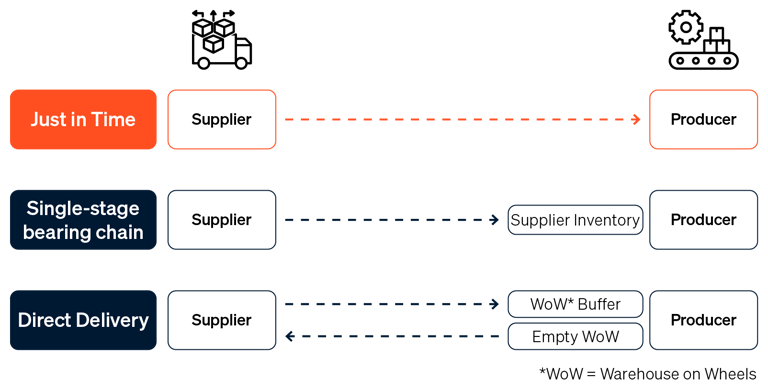
Adopting the JIT method can transform your company, but it also carries risks that must be carefully weighed. Successful implementation depends on whether the benefits outweigh the potential drawbacks for your specific situation. Below, we analyze the most important aspects so that you can makean informed decision regarding your procurement.
When companies reap the benefits, they can significantly boost their competitiveness. The shift to demand-driven procurement has a positive impact on various areas of the business, from finances to production efficiency.
As tempting as the advantages may be, the JIT method carries significant risks that require careful planning and robust processes. Without the right precautions, attempting to eliminate inventory can quickly leadto costly problems in the material flow.
The introduction of just-in-time procurement is not a project that can be implemented overnight. Rather, it is a far-reaching strategic realignment that affects the entire company. To ensure the concept does not fail due to its own risks, several fundamental prerequisites must be met. Without a stable foundation of technology, partnerships, and processes, the targeted efficiency gains cannot be realized.
A seamless flow of information in real time is the nervous system of any JIT strategy. At its core is typically a powerful ERP (Enterprise Resource Planning) system that synchronizes production planning, material requirements, and inventory levels in real time. Only when the demand signal from production is forwarded without delay to procurement and from there to the supplier can the material flow remain synchronized.
Communication with suppliers must be largely automated. Technologies such as EDI (Electronic Data Interchange) are essential for this. They enable the direct, automated exchange of purchase orders, shipping notices, and invoices. This digital networking minimizes sources of error and greatly accelerates processes. The central role of modern IT is also underscored by recent research findings from the Fraunhofer Institute for Material Flow and Logistics (IML).
In the JIT approach, your suppliers are no longer interchangeable service providers but strategic partners. This high level of interdependence requires the utmost trust, transparency, and reliability. Long-term framework agreements and open communication about production plans and potential bottlenecks form the basis for successful, close collaboration. Professional management of your suppliers is therefore a critical success factor.
Ideally, the most important suppliers are located in close geographical proximity to the production facility. Short transport routes not only reduce transportation costs and risks but also increase flexibility in the event of last-minute schedule changes. Selecting the right partners who embrace the JIT philosophy and can keep pace technologically is therefore of fundamental importance.
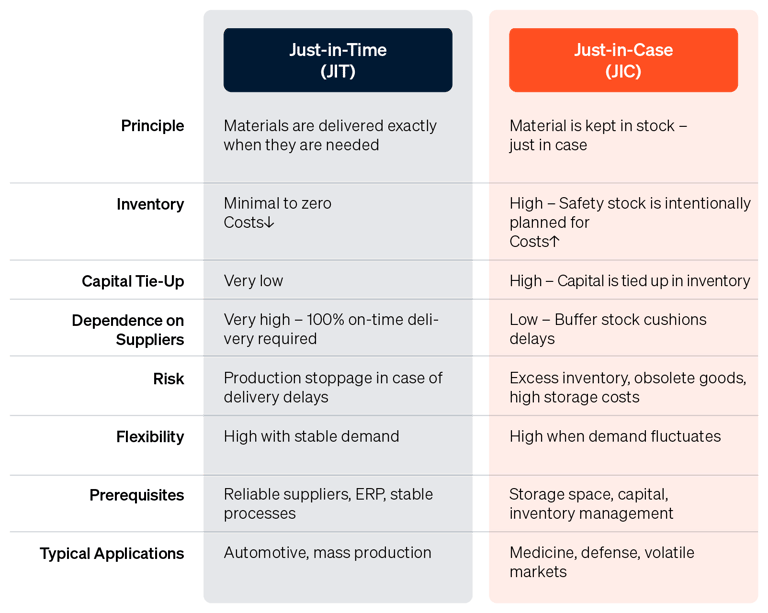
Just-in-Time only works in a stable and predictable environment. Production processes must be standardized to the extent that material requirements can be forecast with a high degree of accuracy. Significant fluctuations in demand or irregular production flows can quickly cause the system to collapse. Continuously smoothed production is therefore a fundamental prerequisite.
Since there are no buffer stocks, the quality of the delivered components must be 100% correct. A defective delivery inevitably leads to a production stoppage. Seamless quality assurance — ideally starting with the the supplier as part of a certified process — is therefore non-negotiable. Incoming goods inspection is often limited to an identity check rather than a comprehensive quality control process.
Just-in-time procurement is far more than just a logistical measure to reduce costs; it requires a profound strategic realignment of the entire company. The enormous potential for increasing efficiency and drastically reducing tied-up capital is offset by significant dependence on suppliers and increased vulnerability to external disruptions. Without a strong technological foundation, a seamless flow of information, and virtually error-free quality control, the risks can quickly outweigh the benefits.
Ultimately, JIT is not a panacea, but a powerful method for organizations with highly standardized processes and absolutely reliable partners. Those who opt for this procurement model must be prepared to investheavily in digital infrastructure and trusting supplier relationships in order to successfully navigate the fine line between uncompromisingly lean production and the necessary resilience.