Wholesale Suppliers 2025: How to Find Suppliers in the Wholesale Industry
Clever supplier sourcing in wholesale will be a key success factor for companies in 2025. It has a significant influence on the price, quality and availability of goods. With increasing digitalization, the integration of AI and the focus on sustainability (ESG), the way in which suppliers are found and evaluated is changing.
At a glance
- Efficient cost control: In 2025, companies will increasingly rely on AI and digital tools to reduce their process costs and make the search for suppliers more transparent and faster.
- Sustainability and resilience: The selection of wholesale suppliers is increasingly based on sustainability, ESG criteria and the diversification of supply chains to minimise risks.
- Strategic supplier evaluation: Clear evaluation criteria such as price, quality, delivery reliability and innovation potential help companies to find specialised and suitable partners for long-term cooperation.
How does the wholesale supplier search work?
The search for wholesale suppliers is strategic, as it is crucial for the price, quality and availability of goods. As a first step, companies develop a procurement strategy and analyse the required products or materials. Special channels - such as supplier databases, wholesale platforms and search engines - can contribute to efficient supplier selection. Classifying suppliers according to their importance for the supply chain plays an important role here. Clear selection criteria are used to determine quantitative and qualitative factors - from price and delivery punctuality to innovation and communication - in order to find the best possible suppliers for the required product range.
What are the best methods for finding suppliers?
The best method for selecting suppliers is traditional research combined with digital tools. Online procurement platforms and B2B marketplaces enable purchasing departments to make quick comparisons and make direct contact with a number of suppliers. Industry directories and supplier exchanges are also a good option. They offer structured overviews and show ratings of potential suppliers. In this way, companies can find high-quality, customised solutions from leading specialists in every sector.
Invitations to tender and targeted inquiries also help to systematically obtain and compare offers. Networks and personal recommendations can be used to assess the reliability and service of manufacturers and wholesalers. But innovative ERP systems and e-procurement solutions, such as simple system also digitalize supplier selection, bundle data, and simplify selection and administration as a whole.
What role do wholesalers and manufacturers play in the supplier search?

Wholesalers and manufacturers play a central role in supplier selection, as they fulfill different but complementary functions in the supply chain. Wholesalers act as intermediaries, bundling products from different manufacturers and offering a wide range of products in larger quantities. This is particularly attractive for companies with diverse requirements and a desire for flexible supply. Manufacturers, on the other hand, sell their goods directly and allow for individual customisation, special quality requirements or even exclusive conditions. This is an advantage for specific or technically demanding products.
The choice between wholesalers and manufacturers depends on the company's requirements. While wholesalers offer variety, fast availability and often more favourable conditions through volume bundling, manufacturers have a direct influence on product quality and innovation. In practice, many companies use both channels in parallel in order to reliably combine flexibility, security of supply and price advantages.
How does registration for the supplier search work?
Registering for the supplier search at simple system is straightforward: Customers start with a simple login to the platform and configure their user account. They then gain access to an extensive network with a large selection of over 850 verified suppliers and can either choose from existing suppliers or add their desired supplier in just a few clicks. All further processes - from supplier selection to ordering and administration - are carried out centrally and digitally via the platform. Procurement processes can be managed transparently and efficiently.

Shop & save
Find out how it works in our free e-procurement report. Download now free of charge and without obligation.
Read the report nowWhich criteria are decisive for evaluating B2B suppliers?

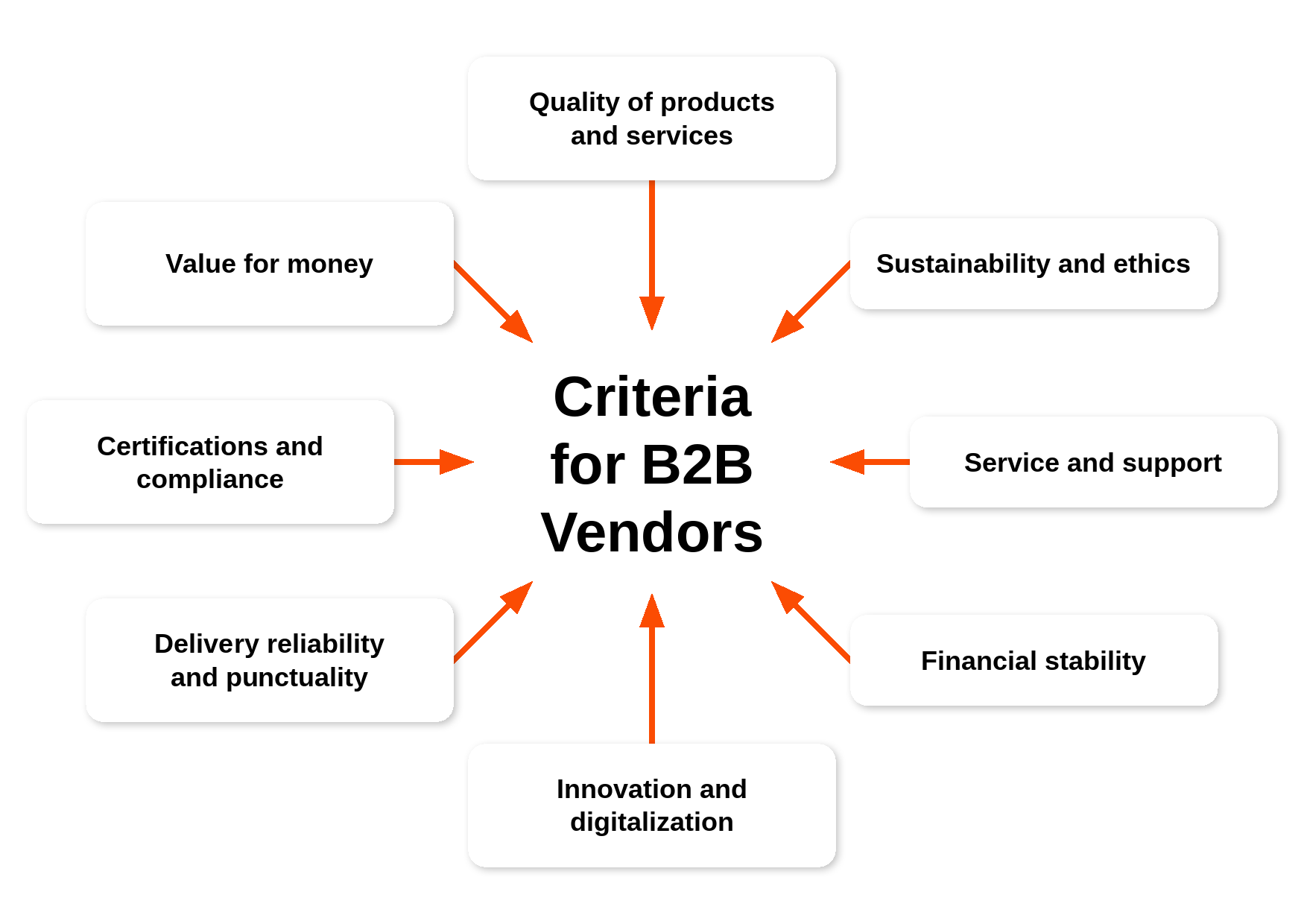
Decisive criteria for B2B suppliers to increase customer satisfaction are:
- Quality of products and services: Key factors are high product quality, a low error rate, compliance with essential standards (such as ISO 9001) and effective quality management systems.
- Value for money: Suppliers should not only impress with low prices, but also with first-class performance, satisfactory service and additional benefits.
- Delivery reliability and adherence to delivery dates: Punctual and complete deliveries are the be-all and end-all. It is also important to react quickly to changes and keep delivery promises in order to avoid production downtimes.
- Service and support: Customer support must be easily accessible and have competent contact persons. The ability to solve problems quickly and an accommodating attitude in the event of complaints also speak for a renowned B2B supplier.
- Certifications and compliance: B2B suppliers should provide evidence of quality and environmental management - such as ISO certificates. Compliance with legal requirements and sustainability standards is also playing an increasingly important role.
- Financial stability: Credit rating, solvency and long-term financial security of the supplier are important key points.
- Innovative capacity and digitalisation: Suppliers should be open to new technologies and digitally connected, for example, with an e-procurement system such as simple system.
- Sustainability and ethics: Environmentally friendly production, social responsibility and an ethical business model are becoming increasingly important.
How do I recognise high-quality products?
High-quality materials and brands can be recognized by the following characteristics:

- Material selection: The product should be made from durable, robust and high-quality raw materials.
- Quality of workmanship: Clean seams, even surfaces, stable connections and careful details are all signs of a first-class product.
- Warranty and service: Clear and fair warranty conditions and good customer service are important.
- Transparent origin: A traceable supply chain and the disclosure of the production locations of our own products are basic requirements.
- Functionality: The product should reliably fulfill its purpose and be user-friendly.
- Certifications: Evidence such as ISO standards and environmental and safety certificates are good indicator of a high-quality product.
- Durability and reliability: Under normal conditions, the product should function for a long time without faults.
- Safety standards: There must be no health risks whatsoever. In addition, all necessary safety regulations must be complied with.
Frequently asked questions
What are the advantages of wholesale for resellers?
Wholesale distribution gives resellers access to competitive prices, a wide range of products and reduced storage costs. This lowers costs and minimises risk.
How do I effectively register as a trade buyer?
With the help of a valid trade license, you can register with wholesalers or online platforms by filling in all the necessary information. Digital tools can speed up the registration process.
What role do remnants play in purchasing?
Remnants are surplus or seasonal goods that are often offered at greatly reduced prices. They enable resellers to achieve high profit margins at low risk.
How do I negotiate effectively with suppliers?
Resellers can achieve competitive prices by knowing market prices and volume discounts, using remaining stock as a bargaining chip and aiming for long-term partnerships with clear conditions.
What should I know about delivery times and logistics?
Delivery time depends on the efficiency of the supply chain; close coordination with suppliers and logistics service providers, and the use of tracking systems are crucial to ensure on-time and transparent deliveries.
Similar Posts
Procurement definition: Operational and strategic procurement explained simply