23.10.2026


The transition to electronic invoicing now affects nearly every business. If you regularly send invoices to public-sector clients, the XRechnung standard is certainly nothing new to you. But what exactly is behind this structured XML format, and how can you strategically prepare for the upcoming B2B requirements? In this article, you’ll learn everything you need to know for a legally compliant and practical implementation.
XRechnung is a standardized, purely machine-readable data format for electronic invoices in Germany. It is based on a structured electronic format (XML) that fully enables automatic and electronic processing. The standard implements the legal requirements of the European standard EN 16931 and was developed by the Coordination Office for IT Standards (KoSIT).
Unlike a simple image file, an invoice in the XRechnung format contains no visual elements visible to the human eye. It is a purely semantic data set. This specification aims to digitize the entire invoicing process—from creation to payment—without any media breaks and to eliminate manual data entry errors.
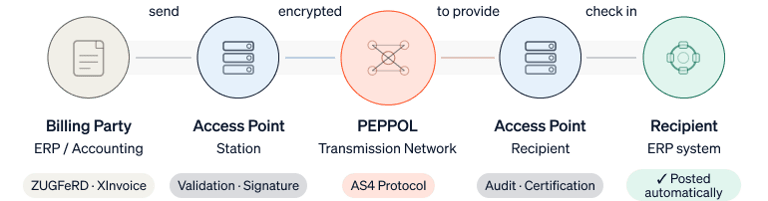
The legal basis for the standard in Germany is the EU Directive 2014/55/EU on electronic invoicing in public procurement. This directive requires public administrations—that is, the federal government, the states, and local governments—to be able to consistently receive and process electronic invoices.
Conversely, for you as a supplier, this means: If you operate within the B2G (Business-to-Government) sector, submitting invoices in the XRechnung standard to a federal agency or the federal administration is already mandatory. There is no longer any alternative to structured submission for public contracts.
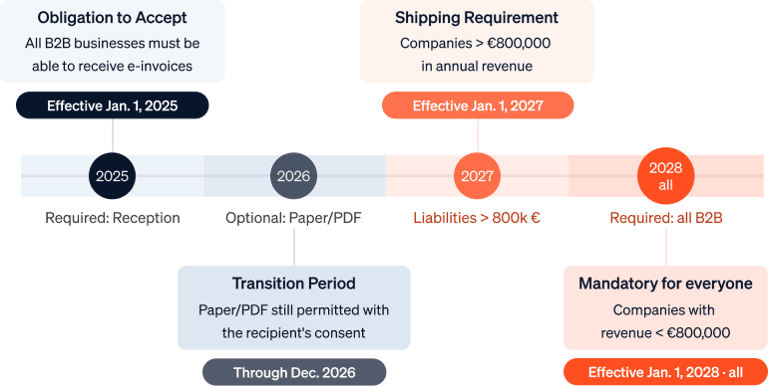
But the private sector is following suit as well. Starting in 2025, the mandatory e-invoicing in the B2B sector will be phased in. According to the relevant Chamber of Industry and Commerce (IHK), the legally mandated transition will affect thousands of companies, as paper documents will gradually lose their legal validity.
Two terms are often mentioned in the same breath when discussing e-invoicing: XRechnung and ZUGFeRD. Both formats comply with the EU standard and differ primarily in their design:
Which format you should use depends on your systems and customers. Public sector clients typically require the pure XRechnung format. For B2B exchanges among small and medium-sized businesses, however, the hybrid ZUGFeRD format offers an excellent bridge technology.
Creating XRechnungen requires suitable ERP software. These systems ensure that all information elements of the semantic data model are correctly mapped. The standard defines very clear business rules and their technical implementation in the background to prevent erroneous transmissions.
The so-called CIUS (Core Invoice Usage Specification) specifies how the European standard EN 16931 is applied in detail at the national level, for example as CIUS XRechnung. A compliant file uses all information elements in accordance with these exact specifications. If required fields—such as the routing ID—are missing, the file is rigorously rejected by the system.
For seamless accounts payable management, it is therefore essential that your system automatically verifies whether the document is compliant before it is legally validly transmitted and received.
Adhering to the standard for electronic invoices is only the very first step toward digital excellence. If you procurement and your entire e-invoicing process holistically on a single platform, you’ll immediately benefit from massive savings in process costs and time.
The digitization of invoicing is no longer just a trend—it’s a legally mandated reality. First ,the structured XRechnung formateliminates sources of error in manual data entry; second, it significantly speeds up your payment processing; and third, it fully complies with the EU’s strict requirements. Those who proactively embrace automated invoicing today will secure a tangible competitive advantage for their company in the future.