Procurement Logistics: Definition, Tasks and Examples
Author
Andy Freund Head of Growth & Customer Management
Procurement logistics makes sure that materials, spare parts and operating supplies arrive on time, complete and at reasonable cost. It covers scheduling, order processing, transport and goods receipt. How well this works is often decided not by the large production materials, but by the many small orders for indirect needs.
What Is Procurement Logistics? Definition
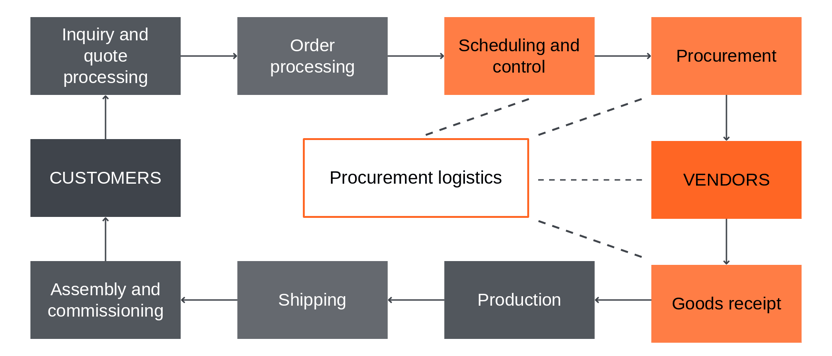
Procurement logistics covers all activities that plan, control and monitor the flow of materials and information from the vendor to your own goods receipt. It ends where the material is put into storage or handed over to the point of use.
Procurement logistics is one of three areas of business logistics:
Procurement logistics: from the vendor to goods receipt
Production logistics: from the warehouse through manufacturing
Distribution logistics: from the finished goods warehouse to the customer
Procurement in the narrow sense decides what is bought from whom and on which terms. Procurement logistics answers a different question: how the goods get into the company reliably and cost-effectively. Learn more about the term procurement in our article Procurement: Definition, Types and Goals.
Tasks of Procurement Logistics
Demand planning and scheduling: Which quantity is needed and when? Scheduling defines order dates and order quantities. For production materials this usually happens in the ERP system, for consumables often on request from individual departments.
Order processing: A need becomes an order with the right vendor. This includes approval, account assignment to Accounting and G/L account, and transmission to the vendor.
Transport and delivery: Procurement logistics plans how the goods reach the company. Every additional single delivery adds shipping costs, small order surcharges and work in goods receipt.
Goods receipt and inspection: The delivery is accepted, checked against the order and delivery note, and inspected for quantity and quality. Mistakes at this point turn into clarification cases in invoice verification later on.
Storage and provision: The goods are put into storage or taken directly to the point of use. Read how to manage stock levels sensibly in our article Procurement and Warehousing.
Goals of Procurement Logistics
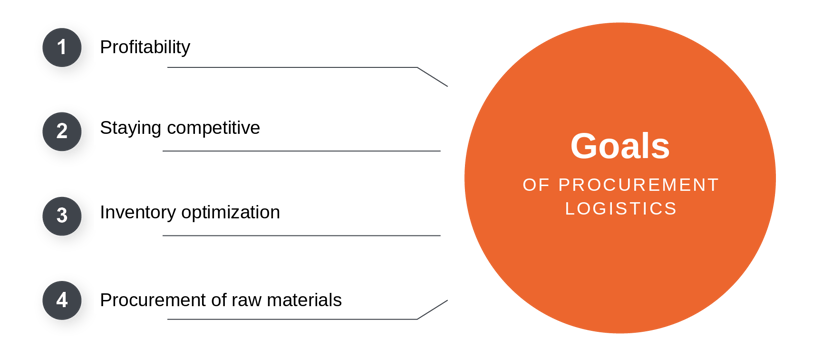
Profitability: Procurement logistics lowers the costs that come on top of the purchase price: process costs per order, freight costs and capital tied up in stock. For small orders, these costs quickly exceed the value of the goods.
Staying competitive: If your materials are reliably available, you can deliver reliably yourself. Short delivery times and stable supply chains are a competitive advantage your customers notice directly.
Inventory optimization: Too much stock ties up capital and storage space, too little stock leads to downtime. The goal is a stock level that prevents shortages without building up excess inventory.
Procurement of raw materials, auxiliary materials and operating supplies: Raw materials are not the only thing that has to be available on time. If safety gloves, lubricants or a spare part for maintenance are missing, the line stops just the same. These goods belong to indirect needs and are procured far less systematically in many companies.
Key Figures of Procurement Logistics
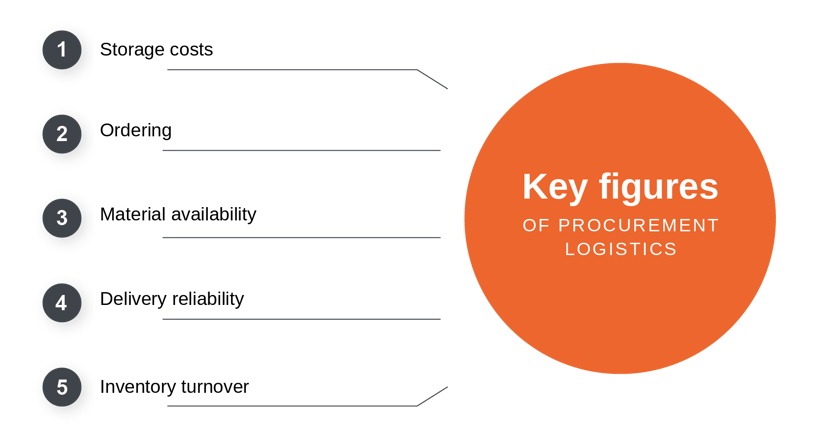
Storage costs: Rent, staff, insurance and tied-up capital. This figure shows what it costs to keep material in stock.
Order costs and order frequency: How often do you order and what does a single order cost? According to a study by HTWK Leipzig, a manual ordering process costs 146 EUR on average, a fully digitalized one 86 EUR.
Material availability: The share of needs that can be covered from stock or delivery without delay. Low availability means waiting times in production and maintenance.
Delivery reliability: The share of deliveries that arrive on time and complete. This figure shows which vendors you can rely on.
Inventory turnover: How often your stock turns over per year. A high value means little tied-up capital and up-to-date stock.
Examples from Practice
Example 1, direct materials: A machine builder sources steel sheets from two regular vendors. Orders are created automatically in the ERP system, delivery dates are fixed by contract, and goods receipt is set up for these deliveries. Here, procurement logistics is usually well organized.
Example 2, indirect needs: In the same company, maintenance, warehouse and administration order gloves, drill bits, cable ties and printer paper. Each department orders on its own, often from different vendors, sometimes bypassing the system. The result is lots of small parcels, small order surcharges and a goods receipt team that cannot match deliveries to any order. This is where most companies have the biggest potential. Read how to reduce orders outside the system in our article Maverick Buying.
Improving Procurement Logistics for Indirect Needs with E-Procurement
An e-procurement platform like simple system targets the points where procurement logistics for indirect needs loses the most time and money.
Fewer single deliveries: In the shared cart of the Marketplace module, several contributors add their items to one common cart. A buyer reviews it and places one bundled order. Ten parcels become one delivery.
No small order surcharges: You can set a minimum order value for each vendor. This helps you avoid small order surcharges and excessive shipping costs.
Clean goods receipt: Order confirmations, delivery notes and invoice copies are attached to the order as follow-up documents. Goods receipt can see what should have been delivered and mark items as received in the platform.
Reordering without detours: With simpleScan, small parts are reordered by barcode directly from the warehouse, cabinet or bin. Dispensing machines can be connected as an external ordering system and order automatically, using your Accounting and approval workflows.
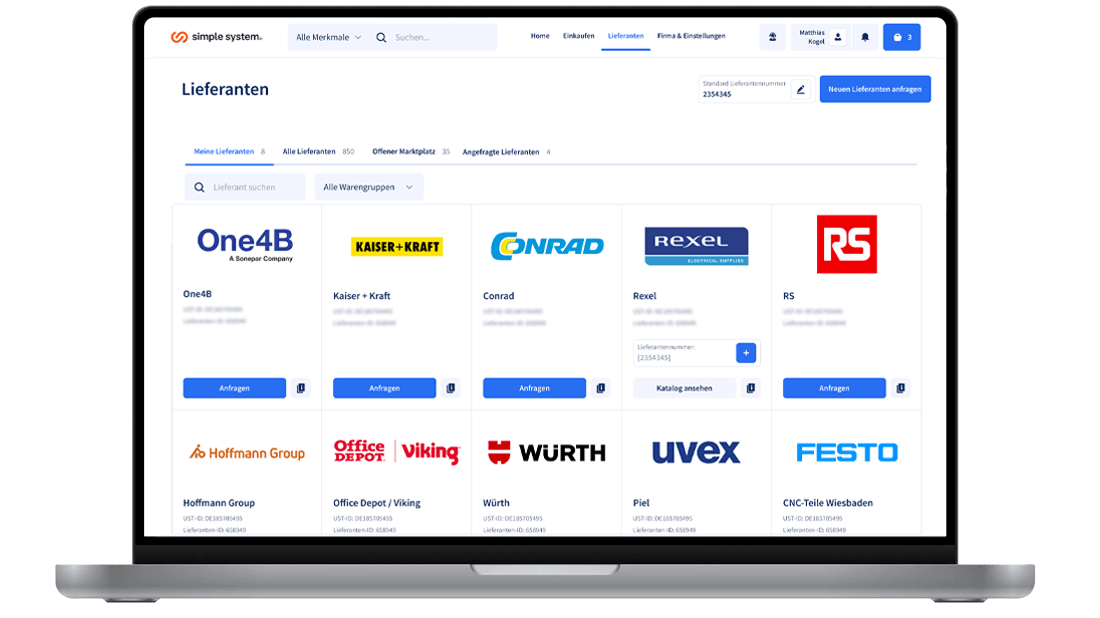
One ordering process for all vendors: More than 1,000 vendors are connected to the platform. Instead of dozens of web shops and email orders, you have one process, one order history and one interface to your ERP system.
Christian Baderschneider, Procurement & Processes at Hartmann Valves GmbH, puts it this way: “Thanks to connecting our proven GARANT Tool24 dispensing machine to simple system, requisitions now run fully automatically all the way to goods receipt.”
Frequently Asked Questions about Procurement Logistics
Procurement decides what is bought from which vendor and on which terms. Procurement logistics makes sure the ordered goods arrive at the company on time, complete and cost-effectively.
With goods receipt, inspection and storage or handover to the point of use. After that, production logistics takes over.
Because this is where most orders with the lowest value are placed. Process and freight costs per order are high in relation, and missing operating supplies or spare parts can stop production just like missing raw materials. Want to see how you can bundle orders for indirect needs and take pressure off goods receipt? Book a demo now
![Andy Freund [Head of Growth & Customer Management]](https://simplesystem.com/hs-fs/hubfs/Autoren_Blog/Andy_Freund_autor.png?width=200&name=Andy_Freund_autor.png)


![Andy Freund [Head of Growth & Customer Management]](https://simplesystem.com/hs-fs/hubfs/Autoren_Blog/Andy_Freund_autor.png?width=100&name=Andy_Freund_autor.png)