![Fabian von Kleinsorgen [VP Growth & Sales Operations]](https://simplesystem.com/hs-fs/hubfs/Autoren_Blog/Fabian_vin_kleinsorgen_autor.png?width=200&name=Fabian_vin_kleinsorgen_autor.png)

14.10.2026

![Fabian von Kleinsorgen [VP Growth & Sales Operations]](https://simplesystem.com/hs-fs/hubfs/Autoren_Blog/Fabian_vin_kleinsorgen_autor.png?width=100&name=Fabian_vin_kleinsorgen_autor.png)

The news usually hits you unexpectedly and with full force: A key supplier has filed for bankruptcy. At that moment, alarm bells go off for every buyer and CEO. Is production now at risk of coming to a standstill? Are payments already made lost? This sudden uncertainty can paralyze the entire business and raises a series of urgent questions that require a swift and strategic response.
You are not alone in facing this challenge. The current economic situation is leading to a rising number of corporate bankruptcies in Germany, thereby increasing the risk of supplier insolvency for every company. This guide offers clear direction and concrete steps you can take to limit the impact on your own company, secure your supply chain, and ensure you’re on solid legal ground. We’ll show you how to manage the situation professionally.
A supplier’s insolvency occurs when a supplier can no longer meet its payment obligations and files for insolvency proceedings. For you as a customer, this means that the fulfillment of existing contracts and the future delivery of goods or services are at acute risk. Management of the insolvent company is typically taken over by an insolvency administrator, who decides whether to continue the business relationship.
The best strategy for dealing with a supplier’s insolvency is to ensure you are not caught off guard by it in the first place. Often, financial difficulties at a business partner become apparent long before the official filing for insolvency. Proactive management of supplier risk is therefore not a luxury, but an essential component of modern procurement. Look for a combination of the following signs, which may indicate that your supplier is at risk of insolvency. Good communication at every stage is crucial here.
These signs may seem harmless on their own, but taken together, they often paint a clear picture of a partner’s financial stability. Take such signals seriously and proactively seek dialogue to ensurethe security of your supply chain and prepare for potential scenarios early on.
As soon as you receive official notification that your supplier has filed for insolvency, swift and structured action is required. Panic is a poor guide. Instead, keep a cool head and systematically work through the following steps to limit the damage to your own business and maintain control of the situation.
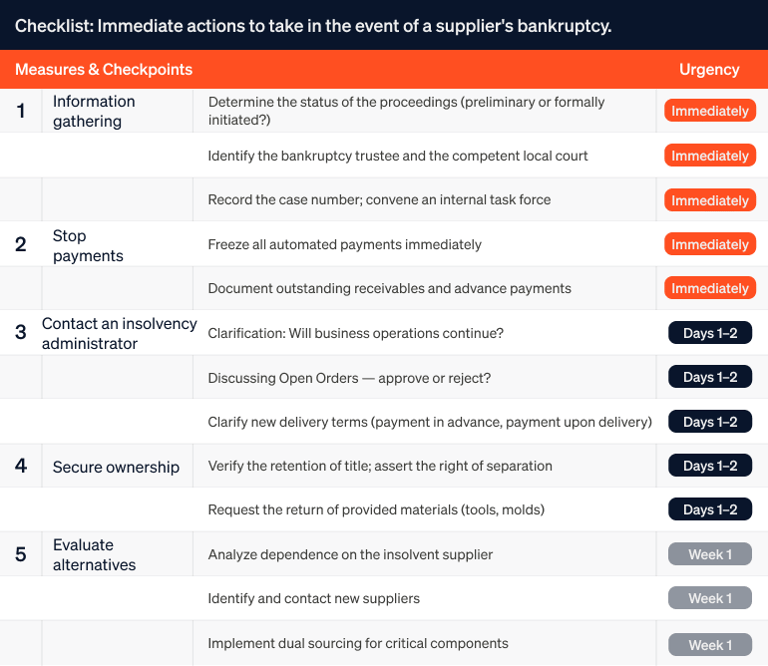
The following measures provide you with a clear roadmap for the first few hours and days after learning of your supplier’s insolvency.
The first step is to gather all the facts. Immediately clarify the key points regarding the insolvency proceedings:
At the same time, you must mobilize your internal team. Form a task force consisting of members from purchasing, the legal department, accounting, and production .This group must immediately analyzeall current contracts, open orders, advance payments made, and outstanding receivables from the insolvent supplier. It is absolutely essential to immediately halt all automated payments to the supplier in order to avoid financial losses.
The insolvency administrator is now your primary point of contact. Do not hesitate to reach out immediately. The administrator’s goal is to securethe insolvency estate and achieve the most equitable distribution of payments to all creditors. A cooperative and professional approach on your part can be decisive in determining whether continued deliveries are possible.
In consultation with the trustee, clarify whether business operations will continue and whether there is a chance for the company’s restructuring. Ask specifically whether your existing orders will still be fulfilled and under what conditions new deliveries are possible. The trustee will often insist on payment in advance or delivery against payment to avoid depleting the insolvency estate.
One of the most critical aspects of insolvency law is the insolvency administrator’s discretion. An important provision is the insolvency administrator’s discretion under Section 103 of the Insolvency Code (InsO). This grants the trustee the authority to decide whether to perform an existing contract or to refuse performance.
If the trustee decides to honor the contract, both parties must continue to fulfill their contractual obligations: The supplier must deliver, and you must pay. However,if the trustee refuses to honor the contract, your claim for delivery is converted into a purely monetary claim. You must file this claim with the insolvency table, but you will generally only recover a small portion of your original claim. This uncertainty is why prompt clarification with the administrator is so important.
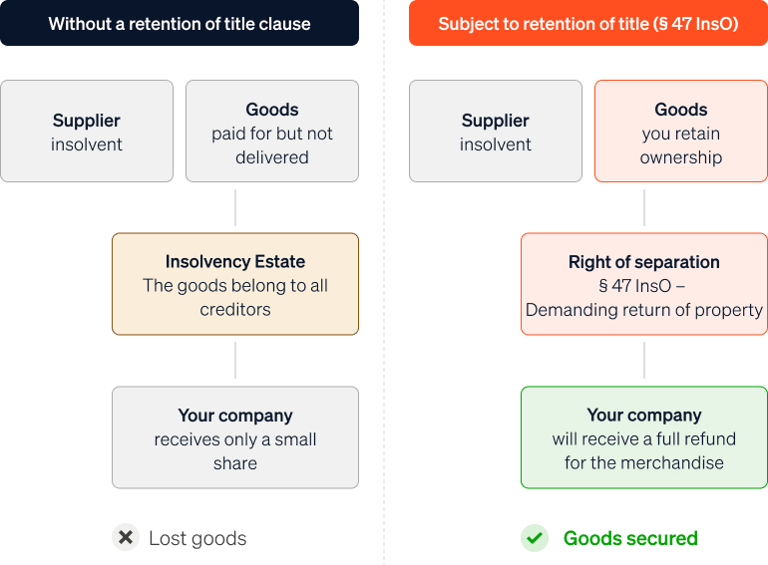
The situation becomes particularly critical if you have already paid for goods that are still in the supplier’s possession, or if you have provided the supplier with tools and materials. This is where the so-called retention of titlecomes into play. If you have agreed to such a retention of title in your contracts, ownership of the delivered goods is not transferred to you until full payment has been made. Until then, you remain the owner.
This right is worth its weight in gold in the event of insolvency. You can asserta so-called right of separation under § 47 InsOagainst the insolvency administrator and demand the return of your property. It is crucial that you can prove ownership beyond a doubt. Therefore, keep all contracts, delivery notes, and invoices on hand that substantiate the retention of title and clearly identify the goods in question.
The same applies to materials provided by you—such as tools, molds, or raw materials—that you have entrusted to the supplier for production. These materials are your property and do not form part of the insolvency estate. Coordinatethe pickup with the trustee to restore your production capacity with a new supplier as quickly as possible.
In parallel with the legal and financial clarification, you must immediately assess the operational impact of the supplier’s insolvency on your own company. How dependent are you on this supplier? Is it a single-source supplier for a critical component? A swift and honest analysis is the foundation for all further strategic decisions.
Begin immediately to identify and evaluate alternative suppliers. Use your network, industry directories, and platforms to find potential partners. The goal is to ensurethe continuity of your supply chain and avoid a production shutdown. Don’t wait for the insolvency administrator to make a final decision—take proactive action.
This incident should also serve as an impetus to thoroughly review your entire supplier portfolio. Strategic diversification and establishing a second-source supplier for critical components are essential measures for minimizing risk. View the current crisis as an opportunity to makeyour procurement more resilient and future-proof.