26.10.2026


Requesting quotes via email and comparing them in Excel costs buyers hours every day—and still doesn’t provide a reliable basis for decision-making in the end. AI can streamline this process in clearly defined areas, but there are others where it has no place. This article explains which steps can be automated today, what limitations exist, and how to make the transition without changing systems.
Yes, AI helps with quote requests—especially in two areas: creating a well-structured RFQ from unstructured requirements and parsing incoming quotes in various formats. Your purchasing rules and approval processes remain unchanged. In customer projects, the time required to process a request for quotation drops from about two hours to roughly fifteen minutes. Your procurement rules and approval processes remain unchanged. You decide for yourself how much automation to allow.
The most important points at a glance:
Anyone who still sends RFQs via email isn’t doing it wrong—just expensively. The process works, but it doesn’t scale: the more requests, the more Excel spreadsheets, the less clarity. We’ve been building procurement processes for medium-sized industrial companies for 26 years and see this bottleneck in almost every project. Below, we outline where AI has a measurable impact in procurement today, where the limits lie, and what a realistic transition looks like.
Sending a request takes minutes. Making the responses analyzable takes hours. This is exactly where the procurement team loses the time it needs for negotiations and supplier development.
The reason is the format. One supplier responds with a PDF, the next with an Excel file, and the third writes the prices directly in the email body. Item names vary, units of measure differ, and tiered pricing is listed in footnotes. Before anything can be compared, someone has to retype everything—and that’s where the errors creep in that become apparent later in the award process.
Definition: An RFQ (Request for Quotation) is a request for specific prices and terms for a predefined service—as opposed to an RFI, which gathers information, and an RFP, which solicits proposed solutions.
We explain in detail which type of request is appropriate in which situation in our article on the differences between RFQ, RFP, and RFI. For the purposes of this article, we’re focusing on the RFQ—that is, the scenario involving a clear need and multiple bids on the table.
AI does not play a role throughout the entire process, but rather in five clearly defined steps. It is crucial that a human continues to provide final approval at each of these steps.
|
Process Step |
Today with Email and Excel |
With AI Support |
Who Decides |
|---|---|---|---|
|
Assess needs |
A shout, email, or note, followed by follow-up questions |
Free-form text and attachments are turned into a request ready for ordering |
Requester confirms |
|
Select suppliers |
Expertise of individual buyers |
Recommendations for suitable suppliers from our own network |
Purchasing makes the selection |
|
Send a request |
Individual emails with inconsistent information |
Structured RFQ with standardized line items |
Purchasing approves |
|
Compare quotes |
Manually entering data into an Excel matrix |
Automatic extraction of all formats into a comparison view |
Purchasing evaluates and awards the contract |
|
Assign to product group |
Done retrospectively, often with errors |
Automatic assignment to the correct product group |
Controlling reviews |
The biggest lever is in line four. Everything before that is preparation, everything after is rework—but comparing offers is the step that no one automates today and that everyone finds tedious.
Tip: If you want to measure the benefits of AI in procurement, measure the time from receipt of the last quote to a comparison overview ready for a decision—not the total turnaround time of the request. As a guideline: In customer projects, this figure is about fifteen minutes after the transition, compared to around two hours before.
With the simpleAI Agent Suite, we’ve broken down the steps described above into individual agents, each of which handles exactly one task. No assistant that can do a little bit of everything—instead, clearly defined functions within the ongoing process.
|
Agent |
Task |
When it is triggered |
|---|---|---|
|
simpleAI Intake |
Converts informal requests into a ready-to-order inquiry |
As soon as a need arises |
|
simpleAI Vendor Profiling |
Suggests suitable suppliers from the network for each request |
Before sending the RFQ |
|
simpleAI RFQ |
Generates a structured request from text and attachments |
When creating the request |
|
simpleAI Quote |
Reads incoming quotes in any format and makes them comparable |
After receiving the responses |
|
simpleAI Classify |
Assigns each item to the correct product category |
After awarding the contract |
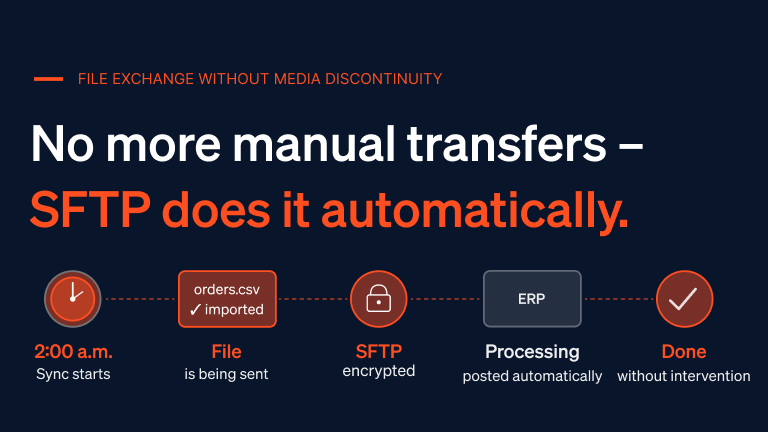
Agents work within the platform, not alongside it. An assigned quote becomes an order, and the order flows through the SAP integration via OCI Punchout into the ERP system. No additional tool is created that someone has to maintain.
No risk, no commitment, no payment details.
Experience the entire platform, from the first shopping cart to automated invoicing.
Discover at your own pace how simple digital purchasing can be.
A supplier recommendation is only as good as the data it’s based on. This is exactly where a procurement platform differs from a pure AI provider.
simpleAI draws on the order history of over 28,000 active buyers and more than 1,000 connected suppliers, accumulated over 26 years. Which suppliers reliably deliver which product categories, where delivery times are realistic, and which suppliers actually respond to which types of inquiries—this information is contained in this data, not in the training data of a general-purpose language model.
A general language model knows half the internet, but not your purchasing process. It doesn’t know what a normal delivery time is for your business or which rule should stop an order. We explain in more detail why, in purchasing, it’s not the model that decides but the data foundation in our article on the simpleAI Engine.
Tip: Ask every AI provider in procurement what data foundation their supplier recommendations are based on. A model without its own transaction data can only estimate relevance.
For the request process, this means that buyers can query recurring orders and product lines and view existing RFQs without opening the interface. Approvers are shown a list of open shopping carts and can identify where an order deviates from historical patterns. Login is handled using existing credentials; no IT project is required.
What’s crucial is what doesn’t happen: The agent doesn’t receive a master key, but rather a plant ID card. Product range restrictions, price limits, and approval processes apply just as they would if a human had clicked.
The quotation process is the most visible use case, but not the only one. In indirect procurement, the bulk of the effort is spent on tasks that occur daily and are unremarkable on their own: recording requirements, triggering reorders, posting to accounts, and verifying invoices.
Not all of these steps can be automated to the same extent. The key factor is determining where rules apply and where human judgment remains necessary.
|
Process |
What AI Takes Over |
What Remains the Responsibility of Humans |
|---|---|---|
|
Capturing needs |
Free-form text, photos, or attachments are used to generate a structured needs report with product assignments |
The requester confirms that the suggested item is the correct one |
|
Recurring orders |
Identification of ordering cycles, suggestion at the appropriate time |
Approval of the suggestion, adjustment of the quantity |
|
Reorder when stock falls below the threshold |
Triggering the order proposal when the reorder point is reached |
Defining reorder points |
|
Account assignment |
Assignment of cost center, G/L account, and product group based on item, role, and history |
Controlling reviews variances, not every transaction |
|
Invoice verification |
Reconciliation of purchase orders, goods receipts, and invoices; identification of variances |
Clarification of reported discrepancies |
|
Supplier selection |
Recommendation of suitable suppliers from our own network |
Selection and negotiation |
|
Approval |
None |
Approval. At every level of autonomy, this remains the responsibility of a human. |
Automation in indirect procurement rarely fails due to technical issues; rather, it often fails because no one can trace who approved what. That is why approval remains a system rule and not a model decision.
Definition: In procurement, the degree of autonomy refers to the extent to which a system is permitted to complete transactions without human confirmation. It is defined for each process step and product group and is independent of how powerful the model used is. We discuss which approval levels can be implemented without slowing down the process in our article on approval workflows in procurement.
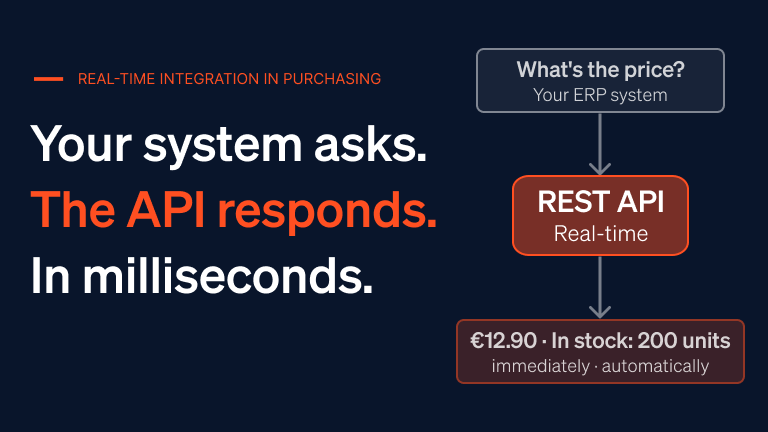
The existing text explains how a purchase order moves from the quotation process into the ERP system. For automation, however, the reverse direction is more important: what AI retrieves from the ERP system.
An account assignment can only be suggested if cost centers, general ledger accounts, and PSP elements are known from the ERP system. A purchasing cycle can only be identified if the complete purchase order history is available. A variance can only be reported if the purchase order, goods receipt, and invoice are based on the same data. Without an integration, AI lacks the foundation in all three cases and can only make estimates.
|
What AI Can Do |
What ERP data it needs for this |
|---|---|
|
Suggest account assignment |
Cost centers, general ledger accounts, PSP elements, role assignments |
|
Identify ordering patterns |
Complete order history spanning several years |
|
Report discrepancies |
Purchase order, goods receipt, and invoice as linked documents |
|
Apply budget limits |
Approval hierarchies and budget balances |
This is precisely why AI tools that aren’t integrated into the process have little impact on indirect procurement. They sit alongside the process, not within it. An assistant who drafts a purchase requisition—which someone then enters into the ERP system—has not eliminated the media discontinuity, but merely shifted it.
simple system is integrated with SAP ERP, SAP S/4HANA, and Microsoft Dynamics 365 via the OCI interface and EDI. The simpleAI agents work with the same data used to process the purchase order. The SAP Integration page explains how the integration works technically and what it entails for IT .
Tip: For any AI tool used in procurement, check whether it has read-write access to the ERP system or only read access. A tool that makes suggestions which someone then has to manually enter shifts the workload rather than reducing it.
AI in the engine room, not in the showcase. This principle doesn’t mean that AI in procurement is never allowed to make decisions. It means that you determine where the line is drawn.
The degree of autonomy ranges from the approval of each individual transaction to agents that you connect via MCP. What remains the same at every level are your rules: budget limits, approval hierarchies, and product-group-specific ordering rights are defined as system rules—not as the judgment of a language model. An order that violates the purchasing policy is blocked—regardless of whether it was initiated by a human or an agent.
Definition: In procurement, “Human in the Loop” refers to an automation principle in which AI handles routine steps, while rules and approval levels are defined by the company and remain unchanged at every level of autonomy.
This is the difference between automation and loss of control. We’ll address separately how approval workflows in procurement can be designed so that they don’t slow down the process.
The transition doesn’t have to be a year-long project. It requires an honest assessment of the current situation and a clear plan of action.
AI in procurement is useful when it transforms quote comparison from a data-entry task into an evaluation task. It replaces neither the negotiation nor the award—it frees up time for them. Anyone still comparing quotes in Excel today is wasting time on a step that has been automatable for two years.
→ Book an AI Check: 15 minutes, honest assessment
Using your actual requests, we’ll show you which simpleAI agents have a measurable impact for you—and which ones you can do without.
Yes. AI reads quotes in PDF, Excel and email text, identifies line items, quantities and prices and converts them into a uniform comparison view. Evaluation and the award decision remain with purchasing. simpleAI Quote handles this step within the simple system platform.
An RFQ requests specific prices for a defined service, an RFP gathers proposed solutions for a problem that is still open, and an RFI collects market information before the actual request. The distinction determines the effort involved and how comparable the responses are.
That is up to the company, not the AI. In simple system, the adjustable level of autonomy ranges from approving each individual transaction to connected agents. Budget limits, approval hierarchies and ordering rights remain fixed system rules at every level.
Not necessarily. A separate RFQ tool means another system, another interface and another data store. If the procurement platform includes this function, request, award and order run in the same process and the same ERP data flow.
Yes. Via the simple system MCP, your AI assistant can search the approved product range, put together shopping carts and retrieve existing RFQs. Product range restrictions, price limits and approval processes remain unchanged. Login uses your existing credentials.
Platform access starts at €99 per month for the Basic package, which forms the basis for use. The simpleAI agents can be tested free of charge for 30 days. You can find an overview of the packages on our pricing and packages page.
In customer projects, the effort for a request for quotation drops from around two hours to about fifteen minutes. The difference is not in sending the request but in processing the responses: quotes in PDF, Excel and email text are automatically converted into a uniform comparison view instead of being typed up by hand. Evaluation and the award decision remain with purchasing.
AI in purchasing needs ERP data because otherwise it can only guess. To suggest an account assignment, it needs to know cost centers, G/L accounts and WBS elements. To recognize ordering patterns, it needs the complete order history. To flag discrepancies, order, goods receipt and invoice must be available as linked documents. A tool without a connection sits next to the process instead of within it: it drafts a purchase requisition that someone then has to transfer to the ERP by hand. The break between systems is not eliminated, just moved.