![Jörg Schmidt [Head of Vendormanagement]](https://simplesystem.com/hs-fs/hubfs/Autoren_Blog/Joerg_schmidt_autor.png?width=200&name=Joerg_schmidt_autor.png)
14.10.2026

![Jörg Schmidt [Head of Vendormanagement]](https://simplesystem.com/hs-fs/hubfs/Autoren_Blog/Joerg_schmidt_autor.png?width=100&name=Joerg_schmidt_autor.png)

Global uncertainties—ranging from geopolitical conflicts to the aftermath of the COVID-19 pandemic and extreme weather events—have exposed the fragility of global supply chains. Companies are facing unexpected disruptions that can range from delivery delays to complete production shutdowns. In this volatile environment, the ability to respond quickly and effectively to disruptions is no longer a luxury but a critical competitive advantage. This is where supply chain resilience comes into play.
In this comprehensive guide, you’ll learn exactly what supply chain resilience means, why it’s essential for your business, and what strategic levers you can use to build a truly resilient and future-proof supply chain.
Supply chain resilience describes a supply chain’s ability to anticipate, withstand, recover from, and adapt to disruptions. A resilient supply chain is designed not only to achieve maximum efficiency during normal operations but also to quickly regain operational capability in the event of a crisis. It’s about strategically combining robustness and agility to maintain the flow of materials and value creation even under pressure and to minimize the vulnerability of the entire system.
Investing in a resilient supply chain pays off far beyond mere crisis management. Companies that strategically strengthen their supply chains benefit from a wide range of advantages that sustainably solidify their market position.
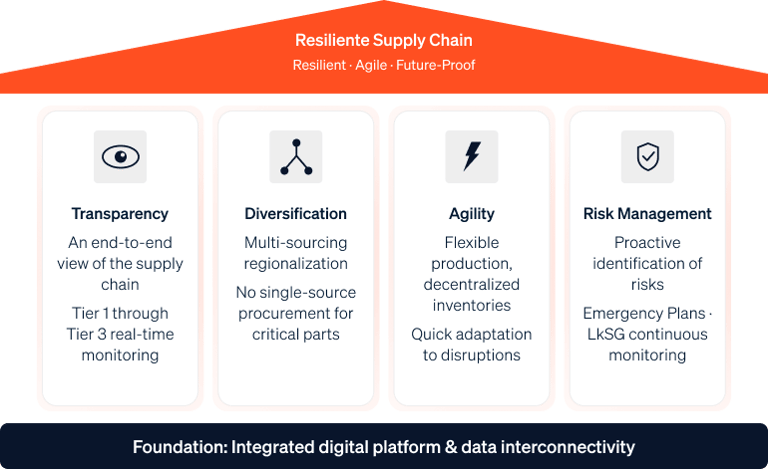
Building a resilient supply chain is an ongoing process that rests on several strategic pillars. Implementing the following action areas is crucial to significantly increasing the resilience of your network.
You can only manage what you see. End-to-end transparency across your entire supply chain is the fundamental prerequisite for resilience. This means that you must not only monitor your direct suppliers but also their upstream suppliers (Tier 2, Tier 3). Technologies such as the Internet of Things (IoT) and connected platforms help track the flow of materials in real time and identify potential bottlenecks early on.
Reliance on a single supplier (single sourcing) for critical material groups poses an enormous risk. Strategically diversifying your supplier pool is a key lever. Consider multi-sourcing strategies in which you distribute orders among multiple partners. Regionalizing parts of the supply chain can also reduce dependence on distant, unstable markets and simplify logistics.
A resilient supply chain must be flexible and able to respond quickly to changes such as sudden fluctuations in demand. You can achieve operational agility through flexible production planning, decentralized inventory, and the ability to adjust transport routes or modes at short notice. Intelligent inventory buffers can help with this without generating unnecessary excess inventory.
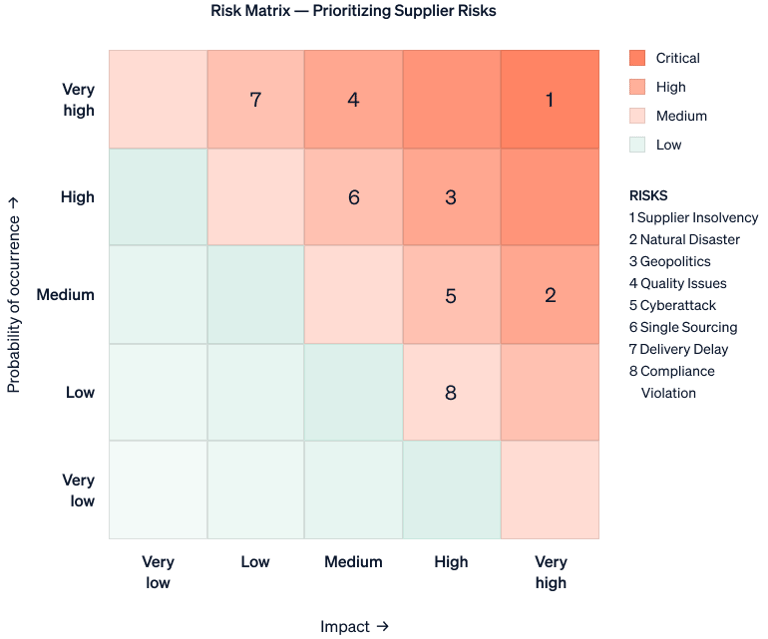
Proactive risk management aims to anticipate potential disruptions and plan countermeasures before they occur. This includes the systematic identification, assessment, and monitoring of risks. The necessity of this is also emphasized by the Federal Ministry for Economic Affairs and Energy (BMWE), which highlights the importance of resilient supply chains for the German economy. Comprehensive risk management is a core aspect of any successful procurement strategy.
Modern technologies are the key enablers of a resilient supply chain. Artificial intelligence (AI) and big data analytics enable predictive analytics to anticipate risks and optimize demand planning. Blockchain technology can ensure tamper-proof documentation and complete transparency. These technological tools are no longer a thing of the future, but essential building blocks of modern supply chain management.
Building supply chain resilience is not a one-time project but an ongoing, strategic endeavor. The three pillars— transparency, diversification, and agility —are the cornerstones upon which a resilient and sustainable supply chain rests. Companies that invest in their resilience today not only safeguard their day-to-day operations but also create a decisive and sustainable competitive advantage in an increasingly unpredictable world.