![Fabian von Kleinsorgen [VP Growth & Sales Operations]](https://simplesystem.com/hs-fs/hubfs/Autoren_Blog/Fabian_vin_kleinsorgen_autor.png?width=200&name=Fabian_vin_kleinsorgen_autor.png)

14.10.2026

![Fabian von Kleinsorgen [VP Growth & Sales Operations]](https://simplesystem.com/hs-fs/hubfs/Autoren_Blog/Fabian_vin_kleinsorgen_autor.png?width=100&name=Fabian_vin_kleinsorgen_autor.png)

A sudden halt in production, an unexpected machine breakdown— unplanned downtime is every manufacturing company’s nightmare. Not only do these incidents result in high costs due to repairs and lost production, but they also disrupt entire supply chains. The key to avoiding such scenarios lies in a well-thought-out maintenance strategy. But which strategy is right for your specific requirements and equipment?
This comprehensive guide walks you through the most important maintenance strategies, from reactive to predictive maintenance. We compare the approaches, highlight their pros and cons, and help you findthe optimal strategy for your company to maximize equipment availability and minimize costs in the long term.
A maintenance strategy is a long-term, comprehensive plan that defines how the maintenance of a company’s equipment, machinery, and technical systems is organized and carried out. It goes far beyond simply repairing defective parts and encompasses all measures aimed at maintaining or improving the functionality and value of an asset throughout its entire lifecycle.
The overarching goal is to ensure smooth operation and maximize equipment availability. The technical foundations of maintenance are defined in the DIN EN 13306 standard. A sound strategy is therefore a central element of asset management and a critical management decision that significantly influences the efficiency and cost-effectiveness of the entire operation.
Choosing the right maintenance strategy is not merely a technical decision, but a strategic business decision with direct implications for your competitiveness. A reactive “wait-and-see” approach may seem cost-effective in the short term, but in the long run it leads to uncontrollable risks and high follow-up costs. A proactive approach transforms maintenance from a cost center into a value driver.
Ultimately, the goal is to gain control over the condition of your equipment in order tominimize downtime and optimize production. Which of the various maintenance strategies is best suited for this depends on numerous factors, such as equipment type, criticality, and business objectives.
There is no one-size-fits-all solution on the path to optimal maintenance. Rather, there is a spectrum of strategies ranging from purely reactive to highly data-driven approaches. Choosing the right strategy—or often a combination of different strategies—is crucial for the efficiency of your operations. Below, we present the four basic types of maintenance, starting with the simplest model.
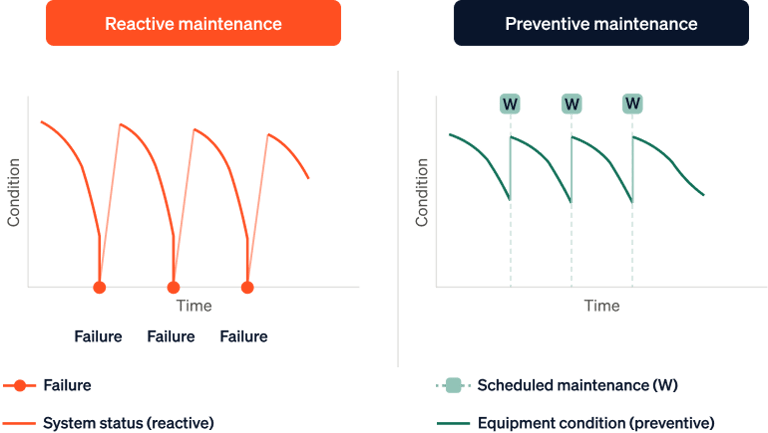
Reactive maintenance, often referred to as corrective maintenance or the “run-to-failure” strategy, is the most basic approach. In this approach, maintenance measures are taken only after a piece of equipment or machine has already failed or a defect has occurred. There is no proactive planning or preventive measures; one simply reacts to the failure.
Although this strategy requires the least planning effort in the short term, it carries the greatest risks in the long term. Unplanned outages lead to abrupt production stoppages, costly emergency repairs, and can jeopardize the entire supply chain. You leave the condition of your critical equipment to chance, resultingin incalculable costs and significant downtime.
This strategy is suitable exclusively for low-criticality systems whose failure has no significant impact on production, safety, or costs—for example, office lighting.
Preventive maintenance is a proactive approach. Instead of waiting for a failure to occur, maintenance tasks are performed at regular, predefined intervals to reduce the likelihood of a failure. The goal is to identify and resolve potential problems early on, before they lead to costly downtime.
These intervals can be time-based (e.g., an annual inspection) or usage-based (e.g., after 5,000 operating hours). They are usually based on manufacturer recommendations or empirical data. Scheduled maintenance significantly increases the reliability of the equipment and extendsits service life.
Preventive maintenance is a proven standard for many critical systems and represents a significant improvement over the reactive approach. It creates a solid foundation for stable and efficient production operations.
Condition-Based Maintenance (CBM) goes a decisive step further than the purely preventive method. Instead of relying on fixed time intervals or operating hours, maintenance measures are based on the actual condition of a piece of equipment. This is made possible by the regular or continuous monitoring of relevant parameters such as vibration, temperature, pressure, or oil quality.
As soon as a measured value exceeds a predefined threshold or shows a significant deviation from normal conditions, a maintenance action is triggered. This approach thus uses real-time data to determine the ideal time for maintenance—not too early (as can potentially happen with a preventive strategy) and not too late (as with a reactive one). The inspection is data-driven and targeted.
This maintenance strategy is particularly well-suited for highly critical and complex systems where a failure would have serious consequences and where wear does not follow a linear pattern.
Predictive maintenance, also known as PdM, is the most advanced of the strategies presented here and a central component of Industry 4.0. It builds on condition-based maintenance but goes a step further: Instead of merely reacting when a threshold value is reached, it uses historical and real-time data to predict failures before they occur.
With the help of IoT sensors, large amounts of data (big data) regarding the condition of machines and equipment are continuously collected. Intelligent software and machine learning algorithms analyze this data, identify patterns, and calculate the probability of future malfunctions. This allows maintenance measures to be planned not only as needed but also based on precise predictions. Studies, such as those conducted by renowned institutions like the Fraunhofer Institute demonstrate the enormous potential of this data-driven optimization.
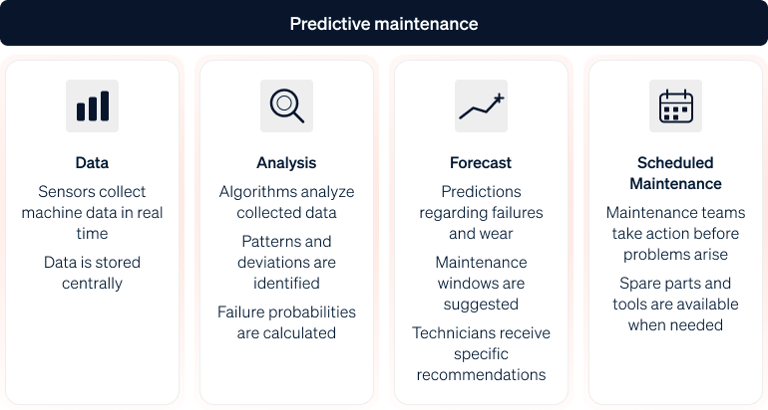
Predictive maintenance is the optimal maintenance strategy for companies that aim for maximum production efficiency and are willing to invest in forward-looking technologies to minimize downtime and gain full control over their assets.