![Fabian von Kleinsorgen [VP Growth & Sales Operations]](https://simplesystem.com/hs-fs/hubfs/Autoren_Blog/Fabian_vin_kleinsorgen_autor.png?width=200&name=Fabian_vin_kleinsorgen_autor.png)

09.09.2026

![Fabian von Kleinsorgen [VP Growth & Sales Operations]](https://simplesystem.com/hs-fs/hubfs/Autoren_Blog/Fabian_vin_kleinsorgen_autor.png?width=100&name=Fabian_vin_kleinsorgen_autor.png)

Purchasing and procurement logistics ensure that materials, goods and services are available on time, in the right quantity and quality. This article explains the definition, differentiation, tasks, goals and key figures of procurement logistics and shows how e-procurement makes it more efficient.
Purchasing and procurement logistics are two inseparable terms in business operations and the value chain. In today's competitive business environment, the effective and efficient procurement of materials, products and services is crucial for a company's success. But what exactly do these terms mean?
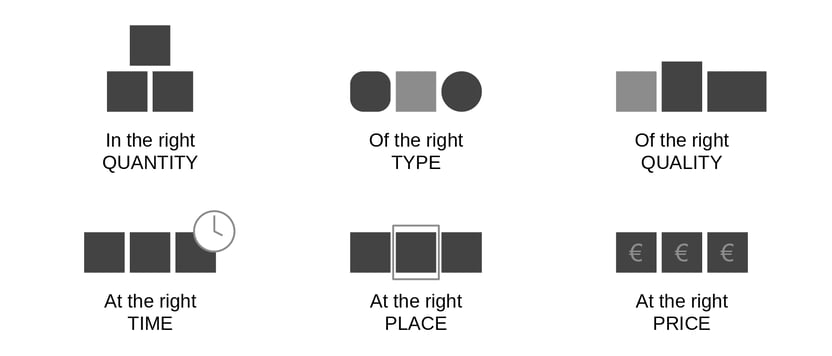
Procurement logistics covers all processes and measures needed to ensure that a company is supplied smoothly with materials, goods and services. In other words, it is about making sure that all required resources are available on time and in the right quantity.
This includes planning, managing and controlling all activities related to purchasing raw materials, semi-finished products and supplier components. Vendors are also selected and evaluated, and contracts and terms are negotiated. Procurement logistics is a central part of the entire procurement process.
The terms purchasing and procurement are often used incorrectly and are sometimes mixed up even by experts. Procurement can indeed be interpreted in different ways. In principle, however, purchasing is part of procurement. Procurement is the umbrella term for purchasing and procurement logistics.
While logistics manages the entire flow of materials and goods from receipt to delivery, procurement logistics focuses on procurement and the internal flow of materials. Logistics covers the entire organization of warehousing, transport and distribution, while procurement logistics focuses specifically on procuring materials and their internal transport and storage.
Essentially, procurement logistics is a sub-area of general logistics that concentrates on the specific tasks of procurement and the internal flow of materials.
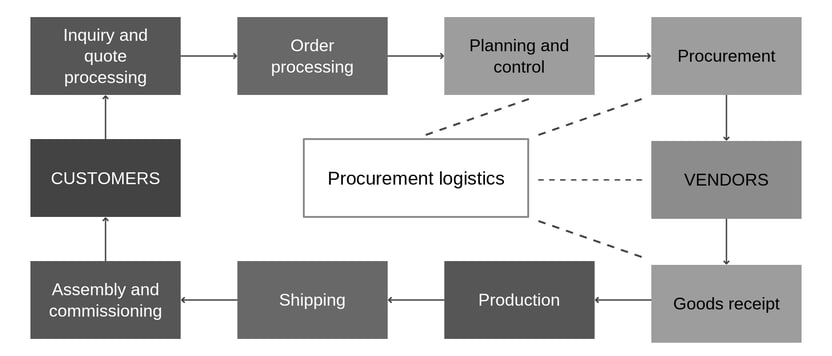
Procurement logistics covers the planning, management and control of all processes related to purchasing goods and services. This includes material procurement, vendor selection, cost and performance tracking, procurement market research and ensuring the quality and quantity of the goods delivered. This ensures that all required resources are available on time and in the right quantity.
An important task of procurement logistics is to determine the demand for materials and resources and to place orders accordingly. Efficient communication with vendors and precise demand analysis play a decisive role here. Precise planning and control of ordering processes help avoid bottlenecks and reduce costs.
Procurement logistics also takes care of selecting vendors and negotiating prices, terms and delivery times. It is important to build long-term partnerships with vendors to ensure a stable supply chain.
In addition, procurement logistics monitors supply chains to make sure that ordered goods are delivered on time and in the desired quality. Close cooperation with vendors and regular quality checks play a decisive role here.
Efficient procurement logistics therefore contributes to a company's efficiency and competitiveness.
The goals of procurement logistics are varied and serve to optimize the purchasing process and ensure a smooth flow of materials. Another goal is to guarantee high product quality by selecting suitable vendors and carrying out quality checks. Cost reduction through efficient procurement management is also a central goal: processes should be designed so that costs go down and bottlenecks are avoided.
Environmental aspects such as sustainable procurement and waste avoidance are also important goals of procurement logistics. By implementing these goals, a company can improve efficiency and competitiveness while promoting sustainable practices.
Key figures of procurement logistics are quantifiable measures used to evaluate the performance and efficiency of procurement logistics.
Find out how in our free e-procurement report. Download it now, free and without obligation.
Read nowPurchasing plays an important role in procurement logistics, because it is responsible for procuring goods and services. By carefully selecting vendors and negotiating contracts, purchasing helps optimize the procurement process. This not only reduces costs but also improves the quality of the products or services procured.
Purchasing also has a direct influence on the supply chain, because it ensures that the right quantities are delivered at the right time. Efficient, well-organized procurement logistics is therefore crucial for a smooth procurement process and contributes to a company's efficiency and competitiveness.
One way to optimize purchasing is to work closely with vendors to improve processes and reduce costs together. Sharing information helps identify and avoid bottlenecks early and create more efficient processes. Vendors can also contribute valuable insights and expertise from their production processes to ensure higher quality. Such partnerships make procurement logistics smoother and more effective.
Implementing a vendor evaluation system is another important measure. By regularly reviewing vendor performance, a company can ensure quality and reliability. Such a system makes it possible to define KPIs and other measurable factors to assess vendor performance and adjust where necessary.
Another way to optimize the procurement process is to use technologies such as e-procurement. With an electronic procurement platform, companies can automate ordering, reduce time spent and minimize errors.
E-procurement refers to the electronic purchasing of goods and services via the internet or other digital platforms. It offers benefits such as faster order processing, transparency on prices and availability and fewer errors. Automating the ordering process saves time and reduces administrative tasks. Online procurement also enables better integration between companies and vendors, which leads to an optimized supply chain.
Implementing an electronic procurement platform allows companies to simplify purchasing and save costs. Real-time information on prices, availability and product quality supports informed decisions. This automation reduces time spent while ensuring that the goods and services needed are available at the right time and in the right quantity.
E-procurement also enables closer cooperation between companies and vendors, leading to smooth information exchange and a more efficient supply chain. Overall, e-procurement is an effective way to optimize purchasing and increase a company's efficiency and competitiveness.
For indirect materials and C-parts, simple system offers such a platform: more than 28,000 buyers order from over 1,000 vendors there through a single access point, with digital approvals and connections to existing ERP systems.
In summary, optimizing procurement and supply chain processes is essential for companies to stay competitive in today's fast-moving, digitalized world. With effective strategies such as information sharing, vendor partnerships, technologies like e-procurement, vendor evaluation systems and negotiation techniques, companies can improve the efficiency of their procurement logistics. These measures streamline processes, ensure a stable supply chain, minimize costs and increase overall competitiveness.