23.10.2026


The requirement for electronic invoicing is inexorably approaching and will drastically change day-to-day business operations. Starting January 1, 2025, new, far-reaching regulations for sending and receiving invoices will take effect in Germany. If you operate in the B2B sector, you must address the issue of electronic invoicing.
Current market observations show that a significant portion of the German business community is not yet sufficiently prepared for e-invoicing. You risk serious legal consequences and frustrating delays in receiving payments if you fail to make the transition to electronic invoicing in a timely manner. Find out here in detail what specific steps are now absolutely necessary and how you can successfully navigate the technological transition for your company.
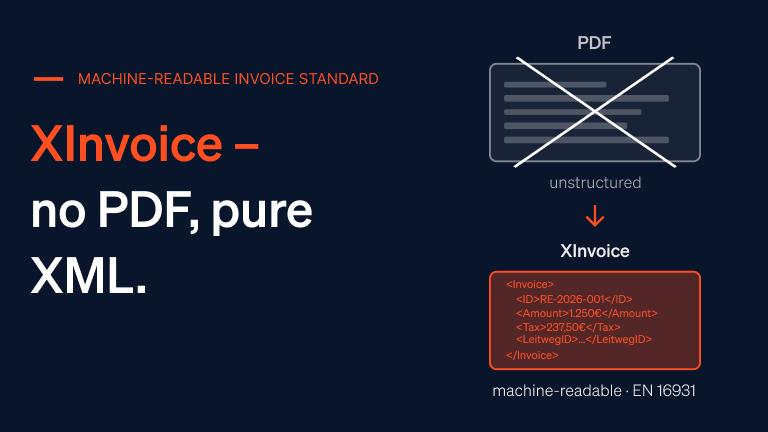
An e-invoice is an invoice document that is issued, transmitted, and received in a structured electronic format. It enables automated electronic processing without a change in media. A simple PDF or image file will no longer be considered a valid electronic invoice as of the effective date in January 2025. Instead, the invoice data must comply with the European standard EN 16931. Well-known formats in Germany for this purpose include XRechnung and the hybrid ZUGFeRD format. The introduction of mandatory e-invoicing starting in 2025 will thus gradually phase out traditional paper invoices from everyday business operations.
The new legal regulations on e-invoicing generally affect all domestic companies. According to the most recent amendments to the Value-Added Tax Act (see UStG § 14), fully electronic invoicing for business-to-business (B2B) transactions in Germany will become mandatory. If both the issuer and the recipient of the invoice are based in Germany, there is no way to avoid the new regulation.
The requirement to receive a structured electronic invoice applies to all B2B companies starting January 1, 2025. Regardless of whether you are already able to send invoices in this format, you must be technically capable of receiving, verifying, and processing them in a legally compliant manner.
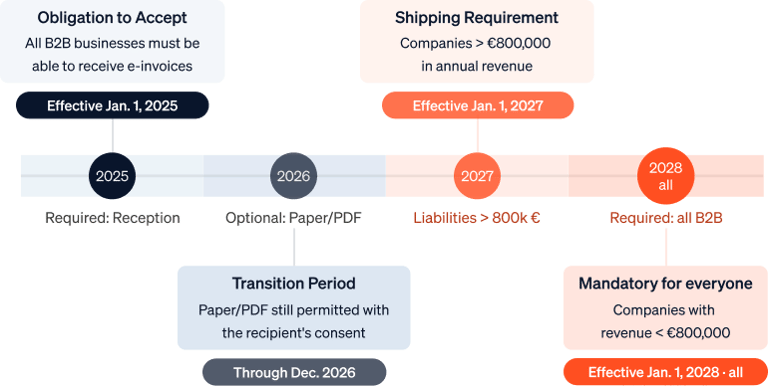
Lawmakers have recognized that an immediate and complete transition poses an enormous technical hurdle for many small and medium-sized businesses. Therefore , there is a phased transition period that gives you some breathing room for system integration. Nevertheless, you should by no means put off preparing your accounts payable management.
Before you adapt your entire IT infrastructure, it’s worth taking a detailed look at the legal exceptions. The good news: Not every invoice must be a structured electronic invoice starting in January 2025. The legislature has established pragmatic exemptions for certain commercial sectors. For example, small-amount invoices totaling up to 250 euros gross remain exempt from the e-invoicing requirement.
You may continue to send and receive these in paper form or as unstructured PDF documents. The same applies to tickets for passenger transportation. Apart from these specific exceptions, however, electronic invoicing will become the unavoidable standard for transactions between domestic businesses in the B2B sector. Therefore, ensure that your systems can process all mandatory fields of an e-invoice accurately and in compliance with the GoBD.
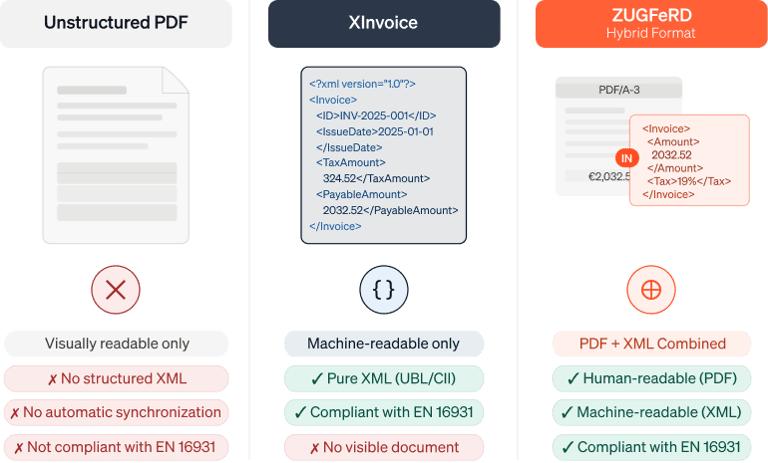
To ensure smooth electronic processing, electronic formats must comply with the European standard EN 16931. A mere image file or a simple PDF is not sufficient to meet the strict legal requirements. In Germany, two established standards have emerged as the primary options that you must keep in mind when implementing mandatory electronic invoicing.
If you need professional support with technical integration into your existing ERP system, take a look at our customized e-procurement solutions. We’ll help you make the technological transition seamlessly and in full compliance with the law.
XRechnung is a strictly structured XML format developed by the Coordination Office for IT Standards (KoSIT). It is primarily designed for fully automated, machine-based processing and is virtually unreadable to the human eye without the appropriate visualization software. This format has long been the de facto standard in Germany, particularly for invoice exchange with public sector clients (B2G). In the future, it will also gain significant importance in the B2B environment, as it enables all necessary invoice data to be transmitted and received without errors.
The ZUGFeRD format (Central User Guide of the German Electronic Invoice Forum) offers an exceptionally elegant middle ground for businesses. It is a hybrid format that combines a visual PDF document with an embedded, machine-readable XML data set.
In practical terms, this means that the structured electronic file can be automatically extracted and parsed by the system, while your accounting department can still view a familiar PDF document on screen for visual review if needed. This greatly facilitates the gradual transition to electronic invoices for many businesses.
The introduction of e-invoicing is far more than just a simple IT project; it requires a fundamental rethinking of your entire business processes. To confidently navigate the e-invoicing mandate starting in 2025, you should take a strategic and structured approach. The following roadmap shows you exactly how to procurement and accounting departments effectively prepare for the upcoming technological change.
By proactively addressing these essential steps, you’ll minimize the risk of technical failures or delays in payment receipt. This ensures that your company is legally and operationally on the safe side in time for the January 2025 deadline.
The e-invoicing mandate taking effect in 2025 requires robust technical solutions within your company. A simple email inbox where a PDF document occasionally lands will no longer meet the strict requirements starting in January 2025. Instead, your systems must be capable of automatically receiving structured invoice data, parsing it accurately, and transferring it directly to your accounting or ERP system.
Seamless electronic processing is the top priority here. If you want to remain competitive in the B2B sector and avoid payment defaults, now is the right time to replace outdated software and switch to modern solutions with the appropriate interfaces.
Seamless system integration is absolutely crucial, especially in complex IT environments. It is not enough for an electronic invoice to simply be received; it must also be directly assigned to the correct purchase orders and suppliers. Check early on whether your current ERP system natively supports new formats such as XRechnung or ZUGFeRD and can extract data from them without errors.
If you find that your systems need an upgrade, it’s worth looking into specialized extensions. For example, if you operate in a corporate environment, you can facilitate the transition through professional SAP integration and thus confidently meet your legal obligations.
In addition to receipt and processing, the law also imposes extremely strict regulations on the long-term storage of documents. The GoBD (Principles for the Proper Maintenance and Retention of Books, Records, and Documents in Electronic Form, as well as for Data Access) unequivocally stipulate that electronic documents must be archived in exactly the same format in which they were received. For you, this means: A genuine e-invoice must under no circumstances be printed out and filed as a traditional paper invoice in a physical file folder. Such a change in media format is legally prohibited and will result in severe penalties during future tax audits.
Therefore, you must ensure that your document management system (DMS) stores the structured data from incoming e-invoices in a way that is unalterable and tamper-proof. Archiving must be fully guaranteed for the statutory retention period, which is typically ten years. This is the only way to ensure that your electronic invoicing and processing can fully withstand a rigorous audit by the tax authorities at any time.
Even though the introduction of mandatory electronic invoicing may initially sound like a bureaucratic ordeal for many companies, it holds enormous potential for saving time and money. Don’t view the legal requirement merely as an obligation under Section 14 of the German Value-Added Tax Act (UStG), but rather as an effective catalyst for the consistent digitization of your internal administration. Through strategic procurement optimization and the deliberate elimination of error-prone analog processes, you can achieve sustainable competitive advantages.
The consistent transition to fully automated e-invoicing therefore not only makes your company legally compliant for 2025 but also ensures a significantly leaner, more agile, and highly efficient financial administration across the board.