26.10.2026


Special Kanban systems enhance C-parts procurement by aligning orders automatically with actual consumption and replacing manual processes. Through digitalization and automation, storage costs go down and sources of error are minimized.
C-parts are materials that usually have a low unit value. Nevertheless, they are indispensable for a company's production. Examples include screws, nuts, seals or office supplies. Despite their low unit value, C-parts account for a significant share of total procurement effort, because they are often needed in large quantities and have to be reordered regularly. Efficient C-parts management is therefore essential to control costs and minimize administrative effort.
C-parts management covers all measures for the efficient procurement and management of C-parts, which usually have a low unit value but cause high administrative effort. A central method is automated order processing: stock levels are monitored continuously and reorders are triggered as soon as a defined minimum stock is reached. In addition, companies often conclude framework agreements with vendors to secure better terms and reliable supply. Modern technologies such as e-Kanban enable seamless integration between warehouse and vendors, further optimizing ordering processes and preventing bottlenecks proactively.
Before optimizing processes, C-parts should be identified with an ABC analysis. This business method is used not only to classify goods but also to evaluate operational processes.
The principle is simple: all stock items or products are recorded and divided into three classes based on their share of procurement volume or revenue: A (very important), B (important) and C (less important). While A-parts have the largest share of value, C-parts have the lowest costs. Nevertheless, the administrative effort for C-parts is usually very high, which means they can cause high costs.
The ABC/XYZ analysis extends this by also considering consumption: X (high, constant usage), Y (fluctuating consumption) and Z (rarely needed). Especially in large production and warehouse operations, this method helps to manage resources in a targeted way and make processes more efficient:
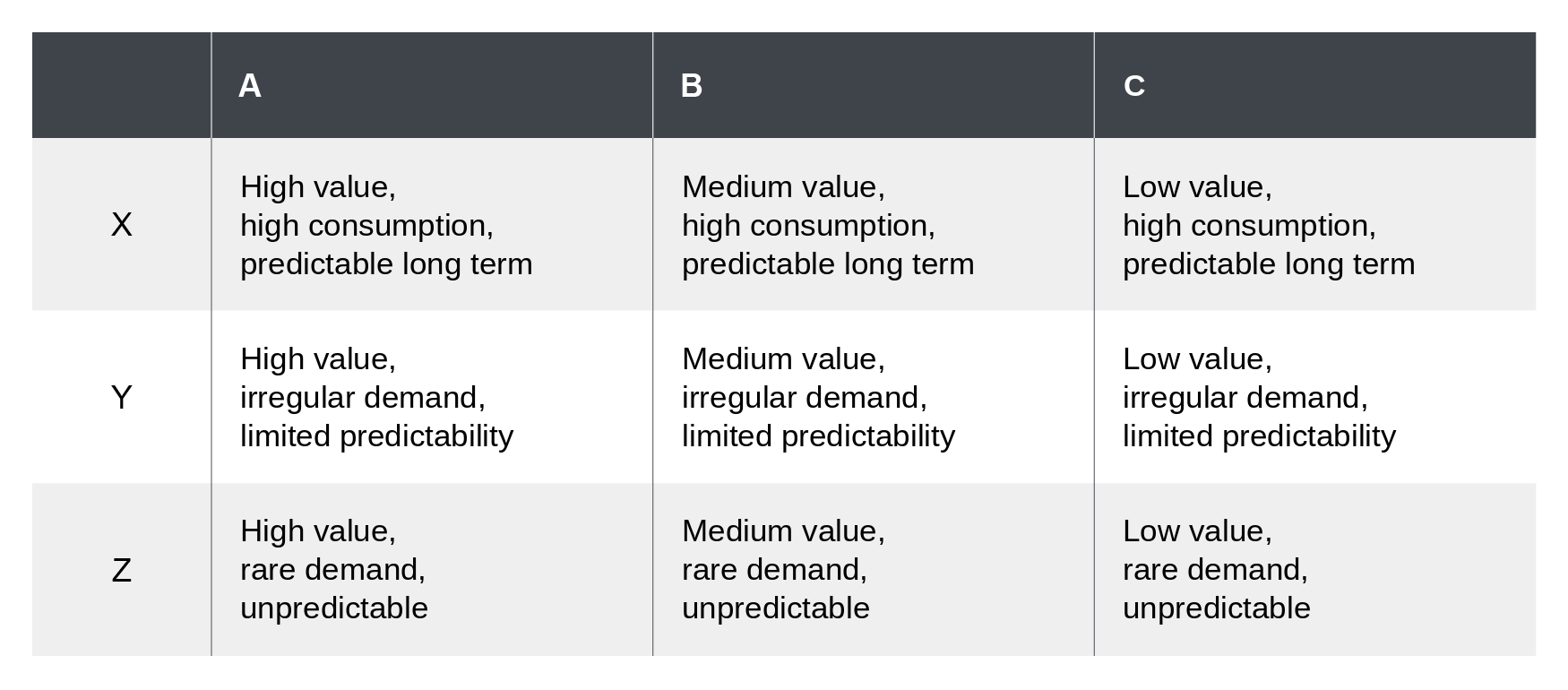

A Kanban system optimizes the procurement and management of C-parts, helps control stock according to demand and automates the entire procurement process. This reduces administrative costs and prevents bottlenecks.
Different Kanban models can be used depending on a company's requirements:
Introducing a Kanban system for C-parts gives companies many benefits for managing small parts and supplies according to demand and at low cost. The most important benefits are:

Find out how in our free e-procurement report. Download it now, free and without obligation.
Read nowKey features of e-Kanban include real-time data transfer, which enables direct communication with vendors, and seamless integration into existing ERP systems, which synchronizes all relevant order and stock data automatically. Companies benefit from much better transparency and availability of the C-items they need.
The benefits of e-Kanban are clear:
When selecting vendors for C-parts, the focus is on reliability, value for money and flexibility. Strategic partnerships with selected vendors enable longer-term framework agreements, which reduce costs and administrative effort through lower purchase prices and standardized processes. Automated ordering processes, such as e-Kanban systems, trigger the necessary reorders according to demand and reliably minimize manual errors.
Just-in-time deliveries ensure that C-parts are available exactly when they are needed. This avoids excess stock, which has a positive effect on overall value creation. Besides just-in-time, there is also just-in-sequence: parts are delivered not only on time but also in exactly the right order for production. This is particularly important in the automotive industry, where different variants are assembled efficiently directly on the line.
Integrating e-Kanban into existing ERP systems also creates transparency about usage and delivery status, so bottlenecks can be detected early. Combining digital vendor connections with clearly defined service agreements creates an efficient, uninterrupted supply chain.
For C-parts that are not replenished via Kanban, a procurement platform like simple system bundles the orders: employees order from more than 1,000 vendors through a single access point, approvals run digitally and order data goes straight to the ERP.