Initial Situation
A mid-sized company runs indirect procurement on the basis of a comprehensive 20-page procurement policy. The policy covers all the right topics: mandatory use of preferred vendors, price comparison from €500 onwards, four-eyes principle from €1,000 onwards, a strict ban on ordering personal items through company channels, and clear budget limits per cost centre.
On paper, the framework looks robust. The policy exists as a PDF, is communicated during onboarding, and is formally signed by every new employee. In daily operations, however, hardly anybody actually follows it once routine work picks up. Recent spot checks across departments revealed an uncomfortable truth: 45% of all indirect orders violate at least one policy rule. Manual controls inside the procurement and Finance teams are simply too time-consuming to scale; they happen only sporadically, and they tend to focus on the obvious individual cases rather than the systemic root causes behind the deviations.
Your Solution with simple system
simple system translates the entire procurement policy into automatic system rules through the Marketplace, Controlling, and Approval modules. Compliance is no longer a paper exercise but an inherent property of every single order flow.
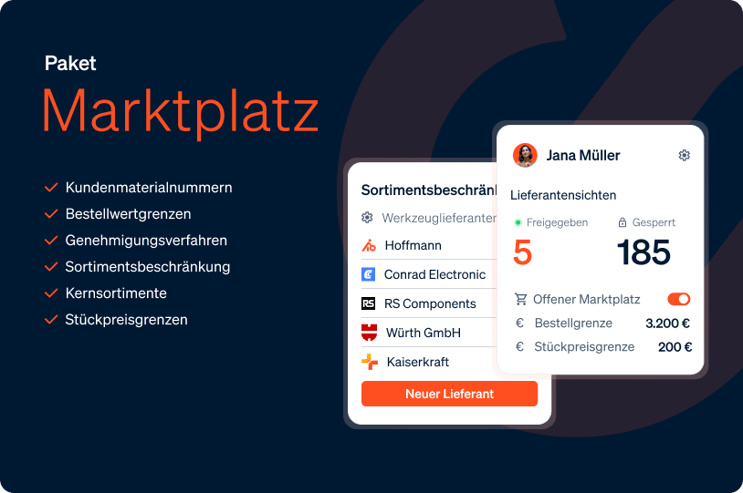
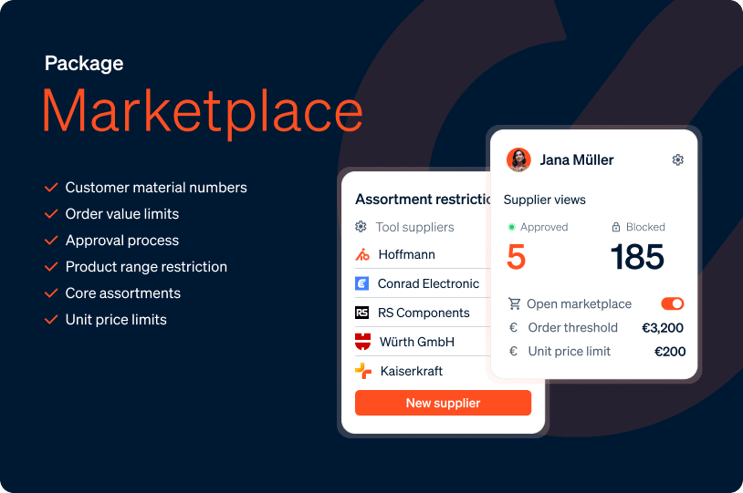
- Assortment restrictions: the rule „use preferred vendors" becomes „only preferred vendors are visible in search and selectable in the cart".
- Unit price limits: „price comparison from €500" is enforced through automatic price display and a clear threshold warning at the cart stage.
- Genehmigungsprozesse: the four-eyes principle from €1,000 onwards triggers automatic approval escalation, including delegation rules during absence.
- Assortment restrictions: „no personal items" is implemented as a category-level block, removing the temptation at the source.
- Order value limits: „Ad here to budget limits" runs as a real-time budget check directly in the cart, so overruns are prevented before they happen.
Result
The 20-page procurement policy is translated into automated, audit-ready system rules. The overall compliance rate rises from 55% to 99% within a few months of rollout. Manual checks become focused spot validation rather than the main control mechanism, and procurement leadership can finally invest its time in strategic optimisation instead of policing.
Your Benefit
- Time savings: manual control effort reduced from 15 hours per week to roughly 1 hour per week, equivalent to around 728 hours per year freed up.
- Measurable EBIT impact: +€36,400 per year in personnel cost savings, combined with a compliance rate jump from 55% to 99% across all indirect procurement transactions.