Initial Situation
A large industrial company with 5,000 SAP users already runs simple system catalogues with strong framework agreements and negotiated volume discounts. On paper, the conditions are excellent. In daily practice, however, catalogue adoption remains stuck at only 40%. A significant share of employees continues to order uncontrollably through traditional purchasing channels, e-mail requests, or unmanaged vendors, diluting the carefully negotiated discount advantage and reintroducing classic maverick buying.
The IT team is permanently caught in the middle. Orders placed outside the catalogue have to be transferred manually into SAP, or employees are forced to leave the SAP environment to access the catalogue, then re-enter the data in SAP. This double work is time-consuming, error-prone, and creates inconsistencies between the procurement system and the financial books. Cost centre assignments get lost, approval workflows are bypassed, and reporting accuracy suffers. As a result, the full pricing advantage of the framework agreements is not realised. An estimated €2 to €3 million in optimisable indirect spend is left on the table every year.
Your Solution with simple system
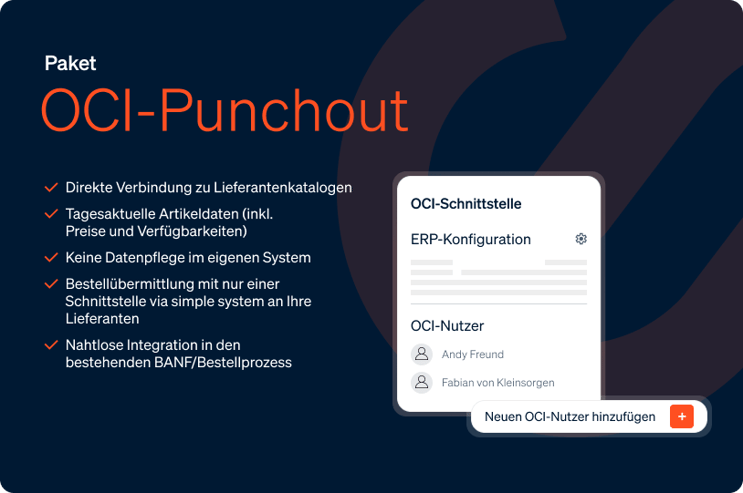
simple system connects directly to SAP via OCI Punchout, so the catalogue lives natively inside the familiar SAP environment. Users never have to leave SAP, and IT no longer has to bridge two worlds manually.
- OCI Punchout is configured and tested for SAP, typically with only around 3 hours of IT effort, including SAP ME1L or Custom Catalogue setup.
- Users see the simple system catalogue directly in SAP, integrated into their existing transaction flow without additional logins.
- Clicking the „simple system Catalogue" entry launches the punchout instantly, with no visible system switch and no media break for the end user.
- Users navigate the familiar, simple system catalogue, benefiting from intelligent search, filters, favourites, and the full 1,000+ vendor marketplace.
- The shopping cart handover transfers all order data automatically into SAP, including item descriptions, quantities, prices, and supplier information.
- Cost centre and G/L account assignment are adopted automatically from the SAP user profile, eliminating manual coding and reducing booking errors significantly.
- Approval workflows apply automatically based on existing SAP rules and simple system Genehmigungsprozesse, ensuring full compliance and audit-ready documentation.
Result
Catalogue adoption rises from 40% to 70% within just three months of go-live, while control over indirect spend reaches close to 100% and training effort stays minimal because users continue to work in their familiar SAP interface.
- Catalogue adoption increases from 40% to 70% in three months
- 100% process control through end-to-end SAP integration
- Minimal user training required because the SAP front-end stays the same
- Maverick buying has significantly reduced across all 5,000 users
- Audit-ready documentation and clean cost centre assignment by default
Your Benefit
- Time savings: catalogue adoption growing from 40% to 70% removes the need for manual SAP transfer of off-catalogue orders, saving roughly 100 hours per month in the IT and procurement teams.
- Measurable EBIT impact of more than €387,600 per year: +€345,600 (12% discount realised on €2.88 million of newly optimised spend) plus +€42,000 (reduction in process costs through automation) = +€387,600 per year.