![Jörg Schmidt [Head of Vendormanagement]](https://simplesystem.com/hs-fs/hubfs/Autoren_Blog/Joerg_schmidt_autor.png?width=200&name=Joerg_schmidt_autor.png)

09.09.2026

![Jörg Schmidt [Head of Vendormanagement]](https://simplesystem.com/hs-fs/hubfs/Autoren_Blog/Joerg_schmidt_autor.png?width=100&name=Joerg_schmidt_autor.png)

Vendor management is extremely important for entrepreneurs and industrial companies, as it has a direct influence on the costs, quality and reliability of their own products and services. Careful vendor evaluation helps to minimize risks and build long-term, stable business relationships.
A vendor is a company or person that provides goods or services and sells or delivers them to customers, mostly other companies or businesses. Vendors play a central role in the value chain by providing the required materials, products or services on time and in the desired quality.
Vendors are at the center of every supply chain: they provide the required goods or services and sell them to companies that need them for their own products and production processes. In doing so, they have a significant influence on quality, availability and costs along the entire value chain. A reliable vendor base contributes to improved planning security for your own business processes and enables on-time production. In addition, reliable service providers minimize delivery failures and provide business partners with a consistent quality of their goods and services, an essential prerequisite for the competitiveness and innovative strength of companies in global markets.
There are differences betweenvendors and manufacturers. Vendors can also be intermediaries, wholesalers or resellers, while manufacturers produce the goods themselves. Here are the most important differences between manufacturers and vendors:
Manufacturer:
Vendor:

Find out how in our free e-procurement report. Download it now, free and without obligation.
Read now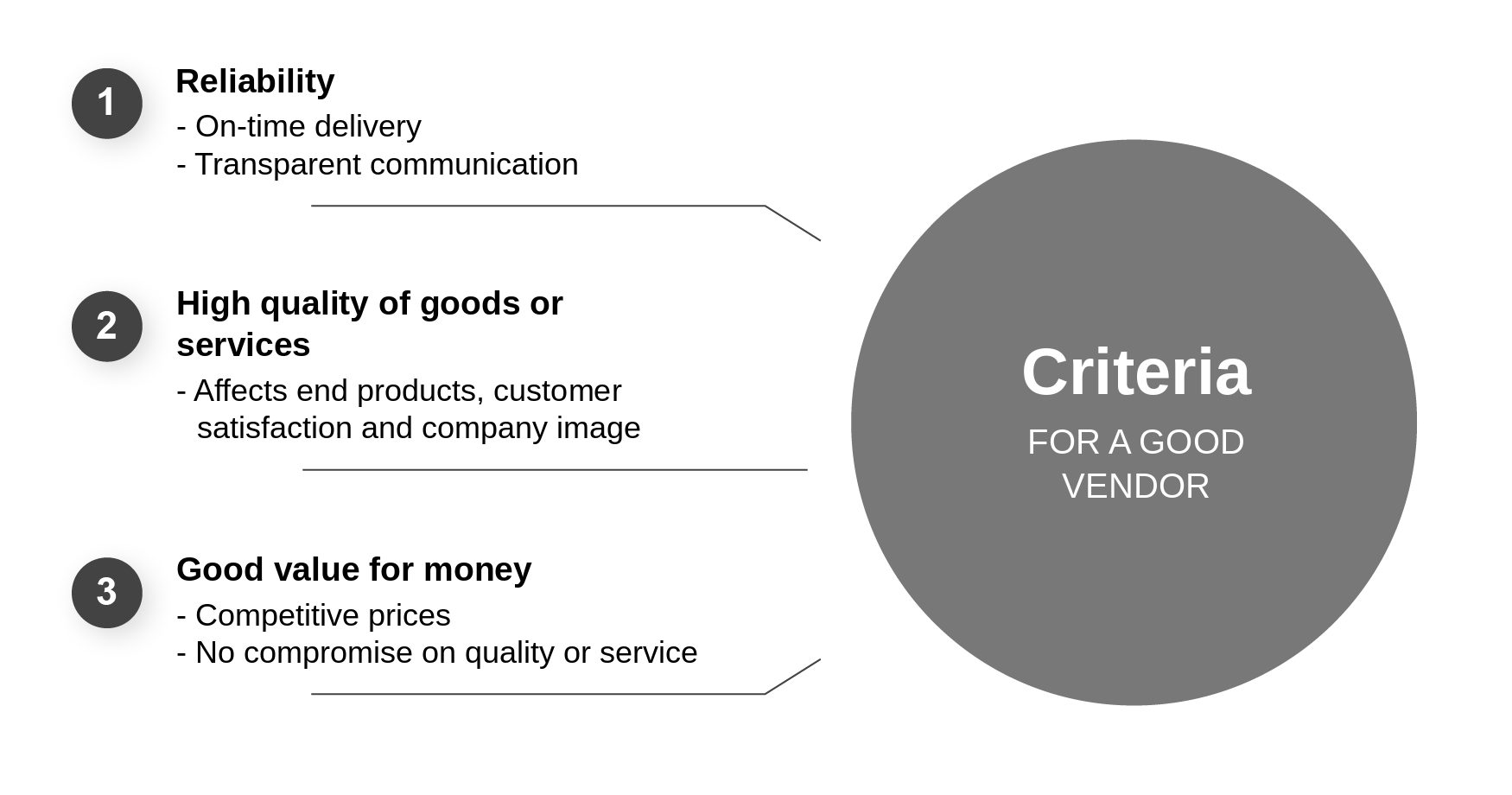
A good vendor makes a significant contribution to the smooth running of business operations. Reliability is one of the most important criteria. On-time delivery and transparent communication are crucial in order to avoid production downtimes or bottlenecks. The quality of the goods or services supplied is just as important. It not only influences the end products of the customers, but also customer satisfaction and the image of the company.
The price-performance ratio of vendors is of great importance. A suitable vendor sells goods and services at competitive prices, without compromising on quality or service.
The search for vendors is extremely important for successful cooperation. The following methods will help you to make a reliable vendor selection.
As a buyer, a checklist is helpful, which contributes to the detailed determination of requirements. What are the exact requirements in terms of products, quantities, quality and delivery times? As soon as the requirements have been determined, the performance, cost-effectiveness and reliability of vendors can be objectively included in the evaluation using ABC analysis, utility value analysis or scoring models .
Digital marketplaces, B2B platforms, industry directories, trade fairs, evaluation portals as well as internal company tools and ERP systems support the comparison of vendors and replacement vendors. E-procurement platforms such as simple system bundle more than 1,000 vendors in one place.
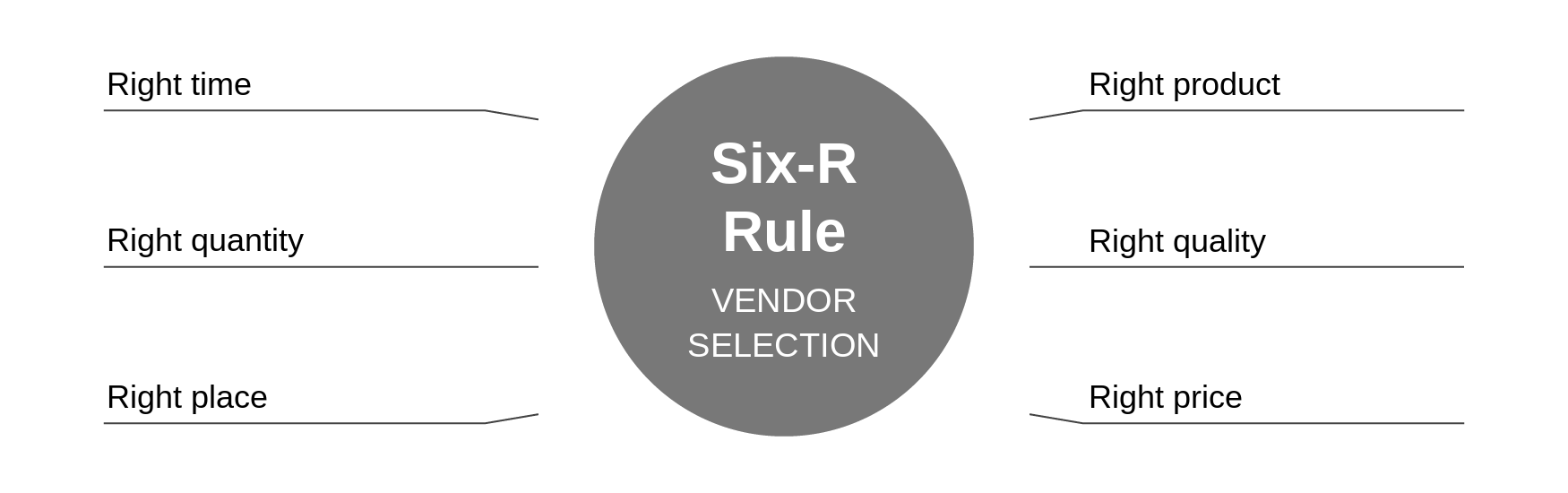
The six-R rule helps companies to identify the right source of supply: A first-class vendor ensures that the right goods are delivered at the right time, in the right quantity, to the right place, in the right quality at the right price. These characteristics are the foundation for reliable, efficient delivery and prevent delivery failures.