![Andy Freund [Head of Growth & Customer Management]](https://simplesystem.com/hs-fs/hubfs/Autoren_Blog/Andy_Freund_autor.png?width=200&name=Andy_Freund_autor.png)
09.09.2026

![Andy Freund [Head of Growth & Customer Management]](https://simplesystem.com/hs-fs/hubfs/Autoren_Blog/Andy_Freund_autor.png?width=100&name=Andy_Freund_autor.png)

Rising costs, volatile markets and fragile supply chains pose major challenges for procurement. Decisions based on outdated data are risky, and valuable potential remains untapped. Procurement analytics means analyzing your procurement data systematically to get a 360° view of processes, vendors and costs. This guide shows how you can use data-based decisions to achieve savings, minimize risks and turn procurement into a strategic partner for the company.
Procurement analytics is the key to moving from reactive management to proactive design. We take you from the basics to specific use cases and the selection of the right analytics tools.
Procurement analytics is the systematic process of collecting, cleansing, analyzing and interpreting procurement data. The aim is to identify hidden patterns, evaluate the efficiency of processes and make well-founded, strategic decisions for the entire supply chain management. It is about turning raw data (such as order volumes, vendor prices or contract conditions) into actionable knowledge. This allows you to take your procurement to a new, data-supported level.
The role of procurement professionals has changed. Previously primarily responsible for operational processing, you are now in demand as a strategic value driver. This new responsibility requires better tools. Pure cost reduction remains a core task, but the ability to manage risks, promote innovation and improve vendor performance is coming into focus. Data analysis provides the necessary basis for this.
Several factors are driving this development and make the use of procurement analytics indispensable for your company:
Without a solid analytical basis, companies in procurement are increasingly operating in uncertainty. The use of procurement data is therefore no longer an option, but a necessity in order to remain competitive and future-proof procurement.
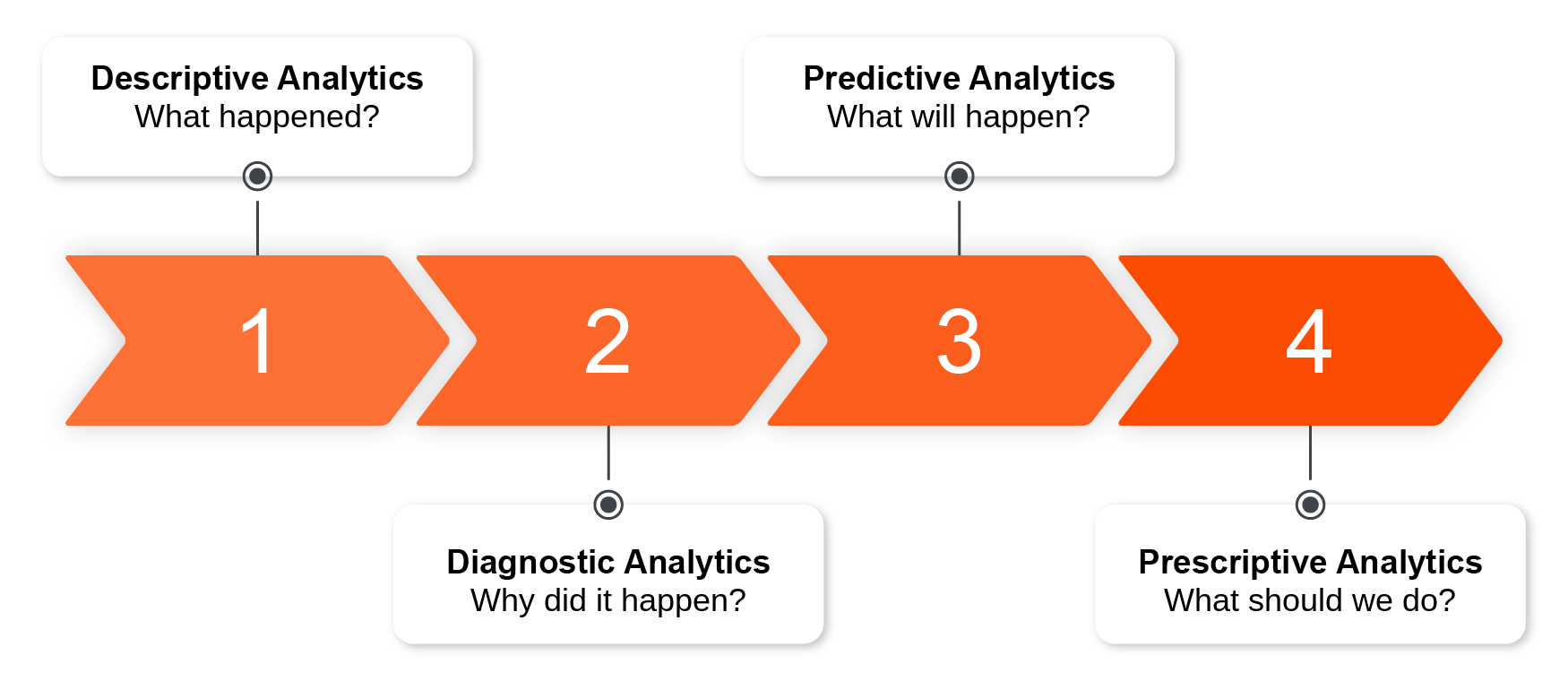
Procurement analytics is not a single tool, but an evolutionary process. It is often referred to as a maturity model that companies go through step by step. Each stage builds on the previous one and gives you new, deeper insights: from purely analyzing the past to actively shaping the future. Understanding these four stages will help you to assess the current state of your organization and define a clear roadmap for the further development of your procurement strategy.
This is the most basic form of analysis and the starting point for any data-driven procurement. Here you summarize historical data to get a clear overview of the past. Standard reports, dashboards and KPIs fall into this category. They answer questions such as: "What was our spend in category X last quarter?" or "Which vendors had the longest delivery times?". Spend analytics, i.e. the analysis of your spend data, is a classic example. Without this basic transparency, all further analyses are impossible.
Once you know what happened, you want to understand why it happened. Diagnostic analytics goes deeper and looks for cause-and-effect relationships. So if descriptive analytics shows that the cost of a particular component has gone up, diagnostic analytics will help you uncover the reasons. Is it due to an increase in the price of raw materials, currency fluctuations or changes in a vendor's contractual terms? You use techniques such as drill-downs in your data or correlation analyses to identify the real drivers behind the key figures.
This is where the look into the future begins. Predictive analytics uses historical data, statistical algorithms and machine learning to predict future events. This form of advanced analytics enables your procurement team to be proactive rather than reactive. Use cases include predicting price trends, forecasting fluctuations in demand or identifying vendors with an increased risk of default. This allows you to initiate countermeasures at an early stage and avert potential supply chain disruptions.
This is the highest level of data analysis in procurement. Prescriptive analytics goes beyond mere prediction and provides concrete recommendations for action to achieve a specific goal. The system analyzes various scenarios and suggests the optimal course of action. It answers the question: "What is the best next step?". Examples of this are the automatic recommendation of the best vendor, taking into account costs, risk and performance, or the optimization of order quantities in order to minimize storage costs. These analyses transform your procurement processes from the ground up and create a measurable competitive advantage.
The four maturity levels show the way, but the true value of procurement analytics is revealed in day-to-day use. Analyzing procurement data is not an end in itself, but a powerful tool for mastering specific challenges throughout the procurement process. In the following, we present the most important areas of application in which your procurement team will achieve immediate and measurable success through data-supported decisions.
Spend analysis is often the first and most important step. Without a clear understanding of what your company spends money on, with whom and on what terms, strategic decisions are impossible. Spend analytics consolidates data from various sources (e.g. ERP systems, invoices, orders) and answers key questions:
The result is a direct reduction in direct and indirect costs and a massive increase in efficiency in your procurement processes.
Choosing the cheapest vendor is rarely the best decision. Real partnerships are based on more than just price. Procurement analytics enables you to set up an objective and data-supported system for evaluating vendor performance. Using key figures such as delivery reliability, quality rates, complaint rates and contract compliance, you can create meaningful vendor scorecards. This not only allows you to compare performance fairly, but also to identify risks at an early stage and strategically develop your vendor base. The Deloitte Global Chief Procurement Officer Survey also addresses this data-based shift towards greater resilience and partnership.
Recent years have shown how fragile global supply chains are. With predictive analytics, you can anticipate potential supply chain disruptions before they happen. By analyzing internal performance data and external information (e.g. vendor financial data, geopolitical indicators), you can identify partners at risk. Instead of simply reacting to failures, data analysis enables you to proactively qualify alternative sources of supply, adjust safety stocks or renegotiate contracts. You turn uncertainty into a calculable strategic advantage.
Contracts are the foundation of your vendor relationships. However, monitoring them manually is error-prone and resource-intensive. You can automate this process with the help of analytics. The system automatically monitors contract terms, notice periods and compliance with negotiated conditions. You can identify immediately if orders are outside the agreed prices or quantities and thus ensure compliance. This data-based control protects your company from financial losses and legal risks and ensures that you actually realize the full value of your negotiation successes.
Find out how in our free e-procurement report. Download it now, free and without obligation.
Read nowThe benefits are convincing, but how do you get started in the world of data analysis in procurement? The introduction of procurement analytics is less of a pure IT project and more of a strategic initiative that requires a clear vision, the right technologies and the acceptance of your employees. With a structured approach, you can ensure that your investment brings the desired success and is firmly anchored in your procurement processes. The following steps serve as a proven roadmap.
Data quality is the foundation of every analysis. Your findings are only as good as the underlying information. The biggest hurdle for companies is often the fragmentation of the data landscape: order information is stored in the ERP system, invoices in the accounting software and vendor data in separate Excel lists. The first step must therefore always be to consolidate these data silos. This is followed by data cleansing, in which vendor names are standardized (duplicate cleansing), material groups are harmonized and incorrect entries are corrected. Without this groundwork, analyses lead to incorrect conclusions and destroy confidence in the new method. The Industrie 4.0 Maturity Index by acatech also names a lack of data availability as a key hurdle of digitalization. Take the time to establish a reliable "single source of truth" as the basis for all future procurement decisions.
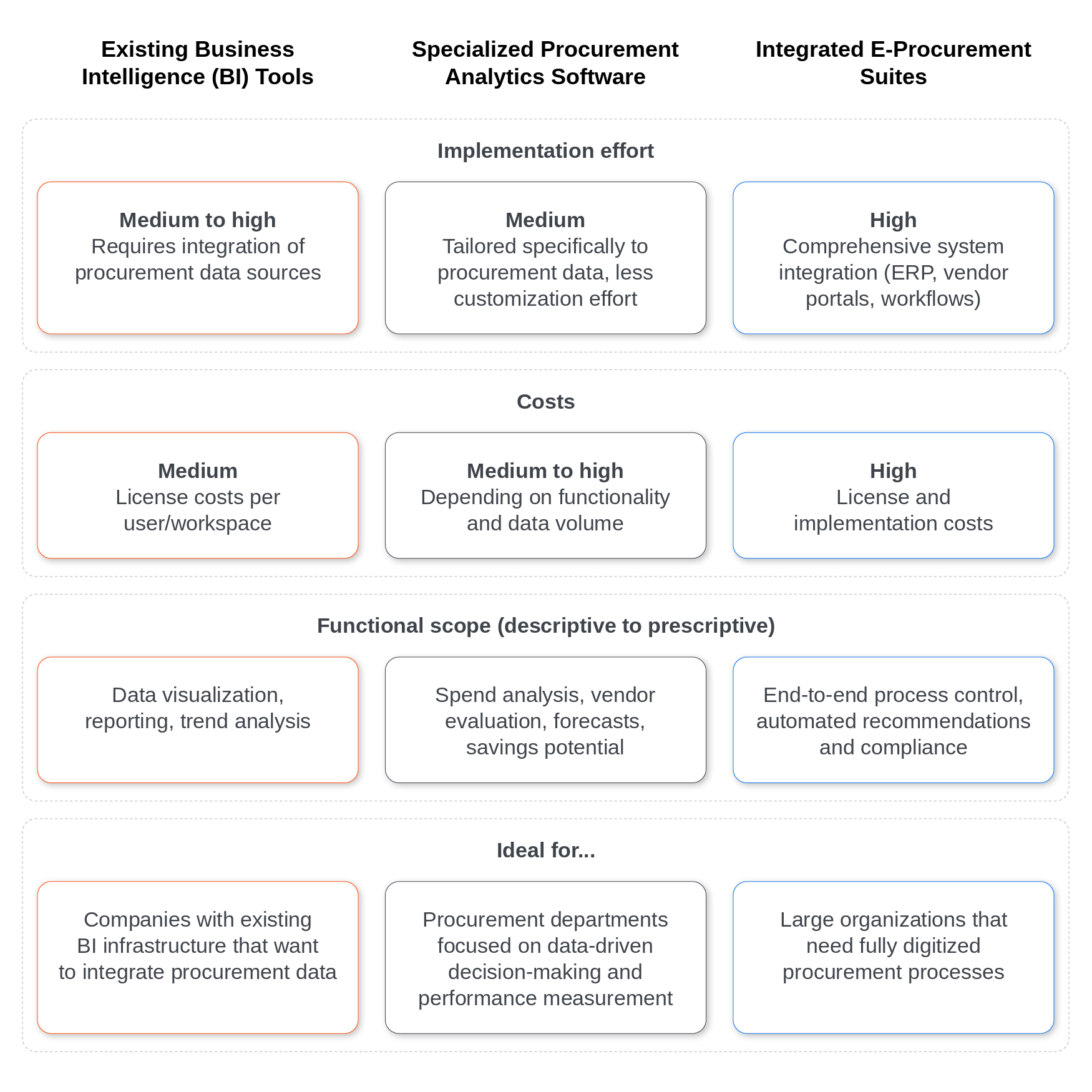
Once your database is in place, the question of the right technology arises. The market for procurement analytics tools is diverse, and the best choice depends on your maturity level, budget and existing IT infrastructure. There is no "one-size-fits-all" solution. Instead, you should evaluate the options that best suit your specific situation.
Even the best software is useless if your team does not know how to translate the insights generated into concrete measures. The introduction of procurement analytics is therefore also a change management process. It is about establishing a data-driven culture in procurement. Encourage your employees' curiosity and train them to ask the right questions of the data. The role of the procurement analyst, who acts as an interface between data and strategic procurement, is becoming increasingly important. Make sure that your team not only learns how to use dashboards, but also how to understand the stories behind the figures and communicate them convincingly.
Avoid the mistake of trying to implement everything at once. A "big bang" approach is risky and often leads to frustration. Instead, start with a clearly defined pilot project to quickly achieve initial success ("quick wins") and gain valuable experience. Such an approach creates acceptance within the company and provides you with the business case for a company-wide expansion.
The success of such a pilot project impressively demonstrates the value of procurement analytics and builds the necessary internal support to anchor data analysis as an integral part of your procurement.
The best analytics software and the cleanest database are of little use if you don't measure the right key performance indicators (KPIs). KPIs translate your strategic goals into measurable variables and make the success of your analytics initiatives visible to the entire company. They are the navigation system that shows you whether your measures are working and where you need to make adjustments. Instead of getting lost in a flood of data, you should focus on a selection of KPIs that have the greatest impact on your business goals.
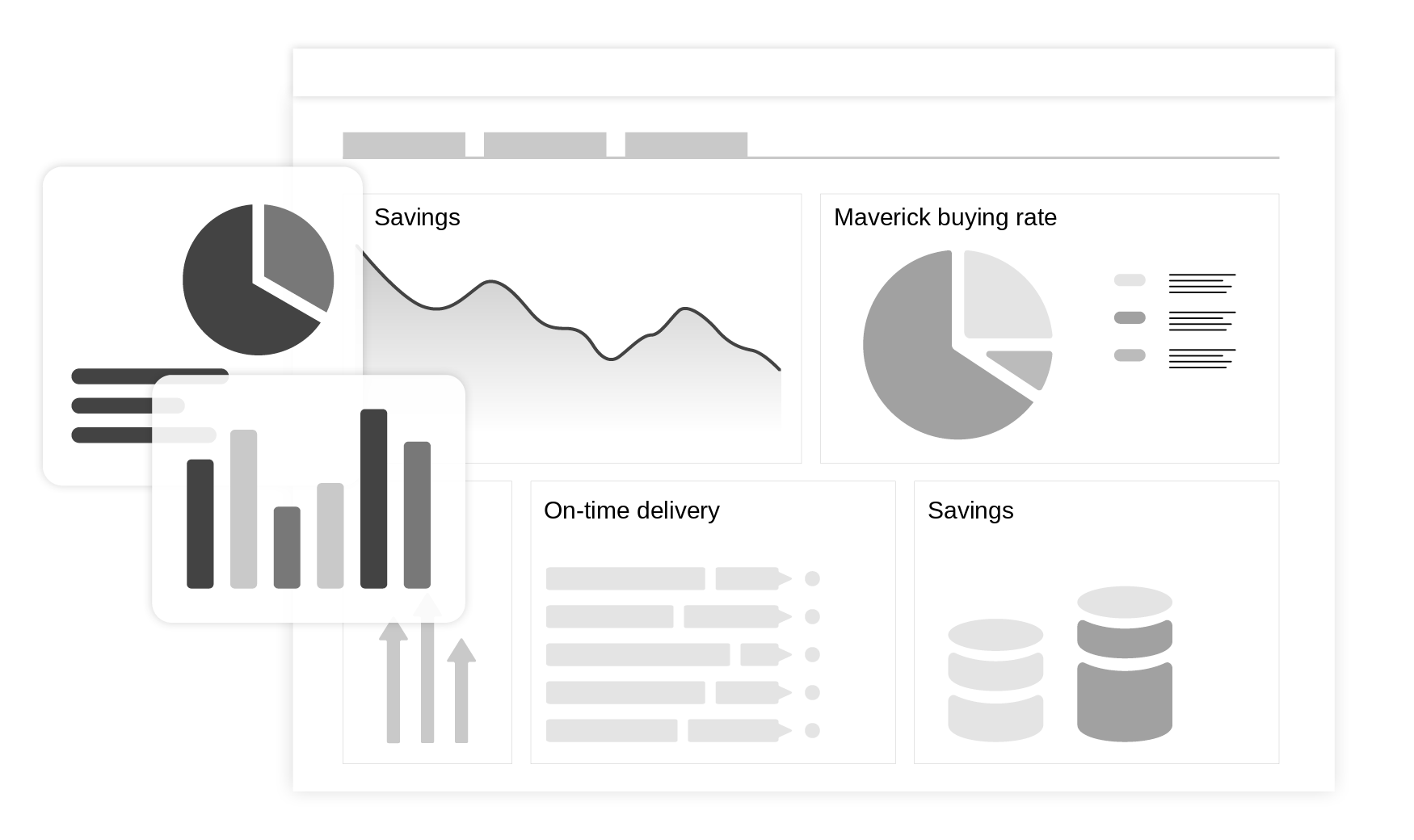
This selection is just the beginning. The right KPIs always depend on your company's objectives. The key advantage of procurement analytics is that you no longer have to laboriously compile these KPIs manually from Excel lists. A good analytics tool provides you with these insights at the touch of a button and allows your team to focus on interpreting the data and deriving strategic measures. This is a core element in strategic procurement.