![Magdalena Pentek [Senior Brand Strategy Manager]](https://simplesystem.com/hs-fs/hubfs/Autoren_Blog/Magdalena_pentek_autor.png?width=200&name=Magdalena_pentek_autor.png)
09.09.2026

![Magdalena Pentek [Senior Brand Strategy Manager]](https://simplesystem.com/hs-fs/hubfs/Autoren_Blog/Magdalena_pentek_autor.png?width=100&name=Magdalena_pentek_autor.png)

Rising material costs, uncertain supply chains and the growing pressure to operate more sustainably, procurement is facing enormous challenges today. Making decisions based on gut instinct is no longer an option. Those who lose sight of the big picture not only risk higher costs but also jeopardise the competitiveness of the entire company. Many companies are therefore asking themselves: How can we make our procurement measurable, identify risks at an early stage and develop procurement from a pure cost center to a strategic partner for the company's success?
The answer lies in procurement controlling. It is the navigation system for your procurement department. It provides the necessary data and analyses to control processes, increase effectiveness and efficiency and make well-founded decisions. This guide will show you in a practical way what is behind the term, what goals and tasks are associated with it and how you can systematically increase the value contribution of your procurement with the right tools and key figures.
Procurement controlling is a sub-area of company-wide controlling and business administration that focuses on the planning, management, measurement and control of all processes within procurement. Its primary task is to provide company management and procurement management with relevant information to ensure the economic efficiency and performance of procurement. It goes far beyond mere cost control and includes strategic aspects such as vendor management, risk assessment and the optimization of the entire supply chain in order to make a measurable contribution to the company's success.
Modern procurement has long since ceased to be a mere ordering department. It acts as a strategic partner that makes a significant contribution to value creation. In order to fulfill this role effectively, it needs a data-based foundation. Procurement controlling provides precisely this and pursues several core objectives that directly contribute to the success of the company. It ensures that overarching procurement not only works but is continuously optimized.
Find out how in our free e-procurement report. Download it now, free and without obligation.
Read nowIn order to achieve the various objectives, the work in procurement controlling is divided into two levels: operational and strategic. While the operational level secures day-to-day business, the strategic level sets the course for long-term success. A well-functioning system links both areas seamlessly.
The operational level is concerned with the short to medium-term planning, management and control of daily procurement processes. The work here is very data-intensive and reactive. The aim is to ensure efficiency and take immediate countermeasures in the event of deviations. The core tasks include:
Strategic procurement controlling takes a long-term view of the future and makes a direct contribution to achieving the company's overarching goals. The aim is to align procurement in such a way that it creates sustainable competitive advantages. The tasks are analytical, proactive and closely linked to management:
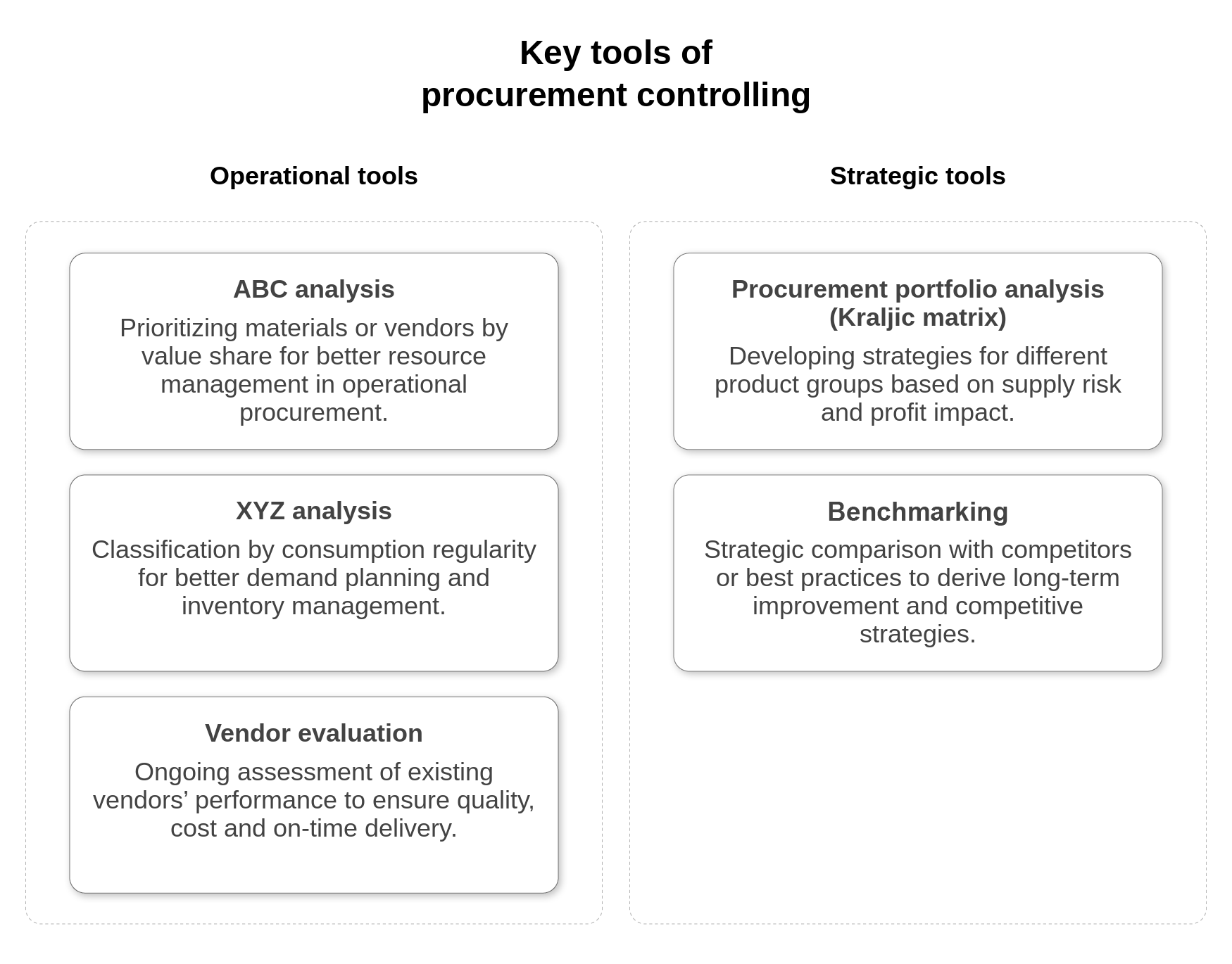
Procurement controlling uses a set of tried-and-tested tools to fulfil operational and strategic tasks. The art lies in selecting the right tool for the respective issue and interpreting the results correctly.
You can't manage what you can't measure. Key performance indicators (KPIs) are at the heart of procurement control. They translate objectives into measurable variables and make the success or failure of measures visible. A good selection of procurement KPIs is the basis for any data-supported optimization. Data-based management is also becoming increasingly important for the resilience of supply chains.
If you order indirect materials and C-parts through simple system, the data for controlling is already in one place. The controlling module provides procurement analyses of orders, prices and vendors as well as Power BI based group reports. Cost centers, general ledgers and budgets are maintained directly in the platform, so budget monitoring and the maverick buying rate become visible without manual analysis.
Procurement controlling is much more than just counting savings. It is an indispensable management tool that creates transparency, minimizes risks and develops procurement from a reactive ordering department to a proactive strategic partner in the company. Through the targeted use of the right instruments and key figures, it provides the decisive data to ensure profitability and strengthen competitiveness in the long term. In a global economy characterised by volatility, strong procurement controlling is no longer a "nice-to-have", but a business necessity for every forward-looking company.